The 'Tombouctou 52 days' sign
The well-known sign at Zagora's edge does more than simply point toward Timbuktu; it signifies a journey that once defined this entire region.
Full story unlocks in the tour
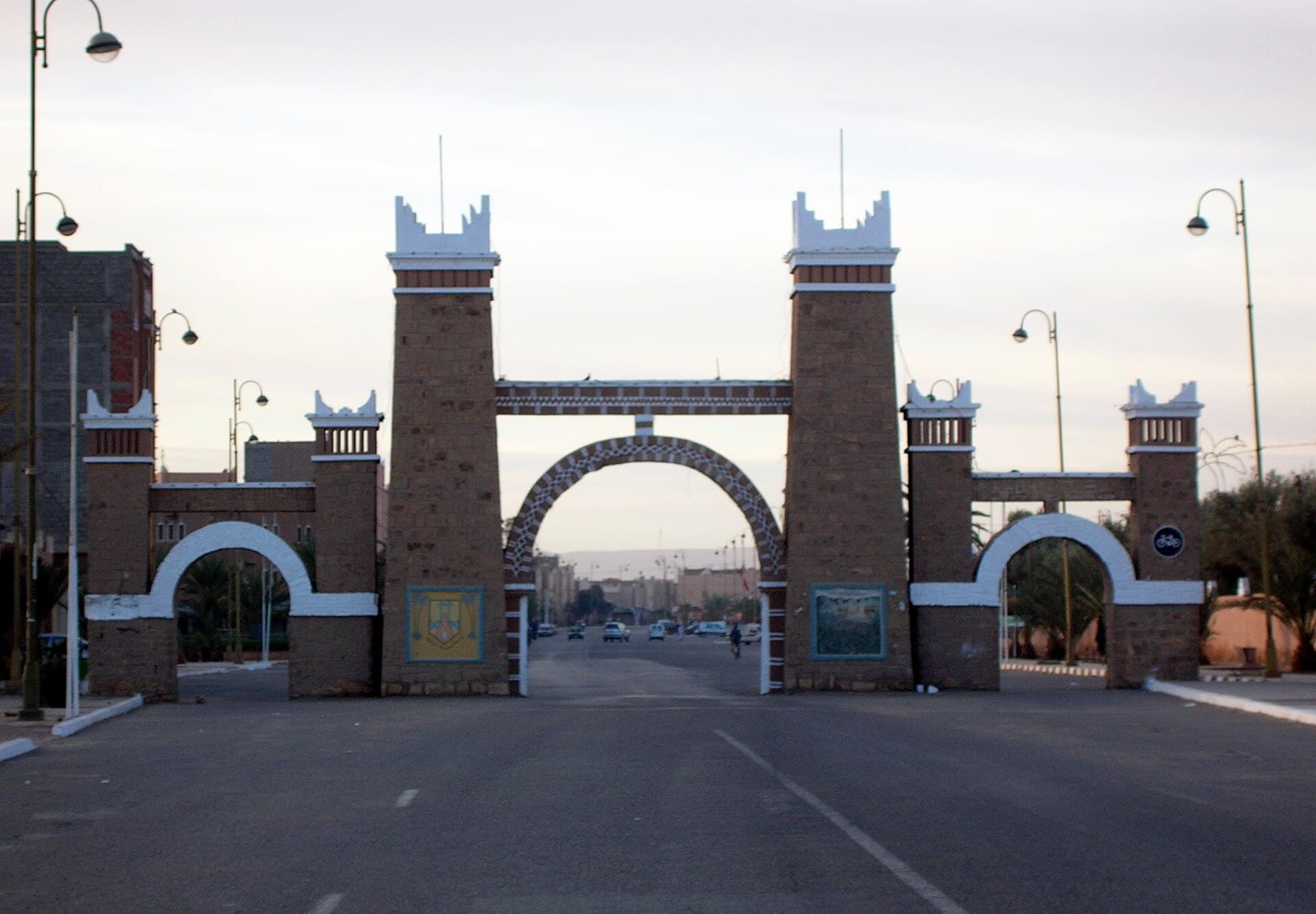 Bernard Gagnon / CC BY-SA 3.0, via Wikimedia Commons
“Where the Draa Valley echoes with the journeys of ancient caravans and the brilliance of desert constellations.”
Not the postcards. The stories even locals don't know — whispered in your ear, right where they happened.
The well-known sign at Zagora's edge does more than simply point toward Timbuktu; it signifies a journey that once defined this entire region.
Just a short drive from Zagora, a village safeguards a library holding manuscripts that predate the printing press.
Within Zagora's palm groves, a village contains a historic fortress that narrates a story of diverse communities.
Discover every secret of Zagora
Every address, every reveal in full — in your ear, right where it happened.
You pick your stops. You walk. The voice reveals what the others miss.
No tours available yet. Check back soon — we're preparing them.
Zagora, a town cradled in the Draa River valley, serves as a significant portal to the Sahara Desert in southeastern Morocco. Situated in the Drâa-Tafilalet region, it rests at an altitude exceeding 700 meters, overseen by the Jbel Zagora mountain. The town's name is thought to derive from the Berber word "Tazagourt," possibly referencing a type of palm tree or a basket woven from palm leaves, reflecting the area's agricultural heritage. While Zagora itself presents a contemporary face as a regional administrative center, it is the surrounding landscapes—expansive palm groves, parched plains, and the dramatic Draa Valley—that truly capture the imagination of visitors.
This desert outpost acts as a launching point for expeditions into the Sahara, offering camel treks, 4x4 excursions, and nights spent beneath star-strewn skies. Beyond desert explorations, Zagora provides a window into traditional Moroccan life, with its lively souks and the tranquil beauty of the Draa Valley's date palm oases. The town's strategic position on ancient trans-Saharan trade routes has forged its distinctive multicultural identity, blending Arab, Berber, and African traditions.
The history of Zagora is deeply interwoven with the Draa River valley, a region inhabited by Berber tribes for millennia. The town draws its name from the Jbel Zagora mountain, which has long served as a beacon for desert travelers. Evidence of early settlement extends to the 11th century, when the Almoravid dynasty constructed a fortress on Mount Zagora to command strategic caravan routes. The precise location of the former Almoravid mosque on the mountain continues to be a topic of discussion.
During the medieval period, Zagora ascended to prominence as a crucial stop on the trans-Saharan trade routes. Caravans laden with gold, salt, ivory, and other goods traversed this path, connecting Morocco with markets in West Africa, particularly Timbuktu. This era fostered a rich cultural exchange, with Berber, Arab, and African traders converging in the town. The renowned sign, "Tombouctou 52 days," still stands as a testament to this storied past.
In the 16th century, Zagora and the surrounding Draa Valley became the birthplace of the Saadian dynasty, who unified Moroccan lands from this region. Sultan Ahmed El Mansour, a Saadian ruler, recognized Zagora's importance, establishing it as a customs point for caravans moving to and from Timbuktu. The Saadians fortified the town, utilizing it as a military outpost for their desert expeditions. However, with the decline of the Saadian Dynasty and shifts in global trade routes, Zagora's significance as a major trading center lessened, and the trans-Saharan routes gradually fell into disuse. The town then reverted to a quieter, more traditional way of life. The creation of extensive irrigation systems in the Draa River valley also transformed the oasis into a significant center for date palm cultivation, a legacy that endures today.
Zagora offers a fusion of natural grandeur and cultural encounters. A primary attraction is the Draa Valley, Morocco's longest river, which carves a verdant ribbon through the arid expanse. Explore the expansive Zagora Palmeraie, a cultivated oasis stretching for kilometers along the Draa River, where you can wander shaded paths among date palms, fruit trees, and vegetable plots. This area is perfect for walking or cycling, providing a glimpse into traditional farming life and ancient irrigation systems known as seguias.
For a sense of desert tranquility, visit the Tinfou Dunes, a smaller erg accessible for bivouacs and observing radiant sunrises and sunsets. Many visitors undertake camel treks into the Sahara, with options ranging from brief sunset rides to multi-day expeditions, often including overnight stays in traditional Berber camps. Another essential experience is a visit to the Tamegroute village, home to a celebrated Quranic library with ancient manuscripts and skilled artisan potters renowned for their distinctive green pottery.
In Zagora town itself, do not miss the weekly souk (market), held on Wednesdays and Sundays, where vendors offer everything from local dates and olives to traditional clothing and handicrafts. You can also discover lively street art in residential areas near the city center, frequently depicting local scenes and kasbahs. For sweeping views of the city and surrounding desert, consider a hike up Jbel Zagora.
The optimal time to visit Zagora is during the cooler months, from October to April. Temperatures during this period are more moderate and comfortable for desert exploration and outdoor activities. Spring (March to May) is particularly scenic, with wildflowers occasionally blooming in the desert. Winter months (December to February) offer pleasant, sunny days, though nights can be surprisingly cold, sometimes approaching freezing. Summers, especially July and August, bring intense daytime heat, often surpassing 40°C (104°F), making extended desert excursions challenging and potentially uncomfortable.
Zagora possesses a small airport (OZG) with domestic flights, primarily connecting to Casablanca. However, many travelers arrive by road from major Moroccan cities. Direct buses from Marrakech typically take about 7 hours, while buses or collective taxis from Ouarzazate require 2-3 hours. Within Zagora, petit taxis are readily available for navigating the town.
The local currency is the Moroccan Dirham (MAD). While Moroccan Arabic (Darija) and various Berber languages (Tachelhit and Tamazight) are primarily spoken, French is also widely understood, and English-speaking guides are available for tours. It is advisable to pack light clothing for warm desert days and warmer layers for cooler nights, particularly during winter. Sunscreen, sunglasses, and a hat are indispensable throughout the year.