Assiniboine Park Zoo
Winnipeg showcases a celebrated polar bear exhibit, yet the city's bond with these Arctic creatures extends beyond what's immediately visible.
Full story unlocks in the tour
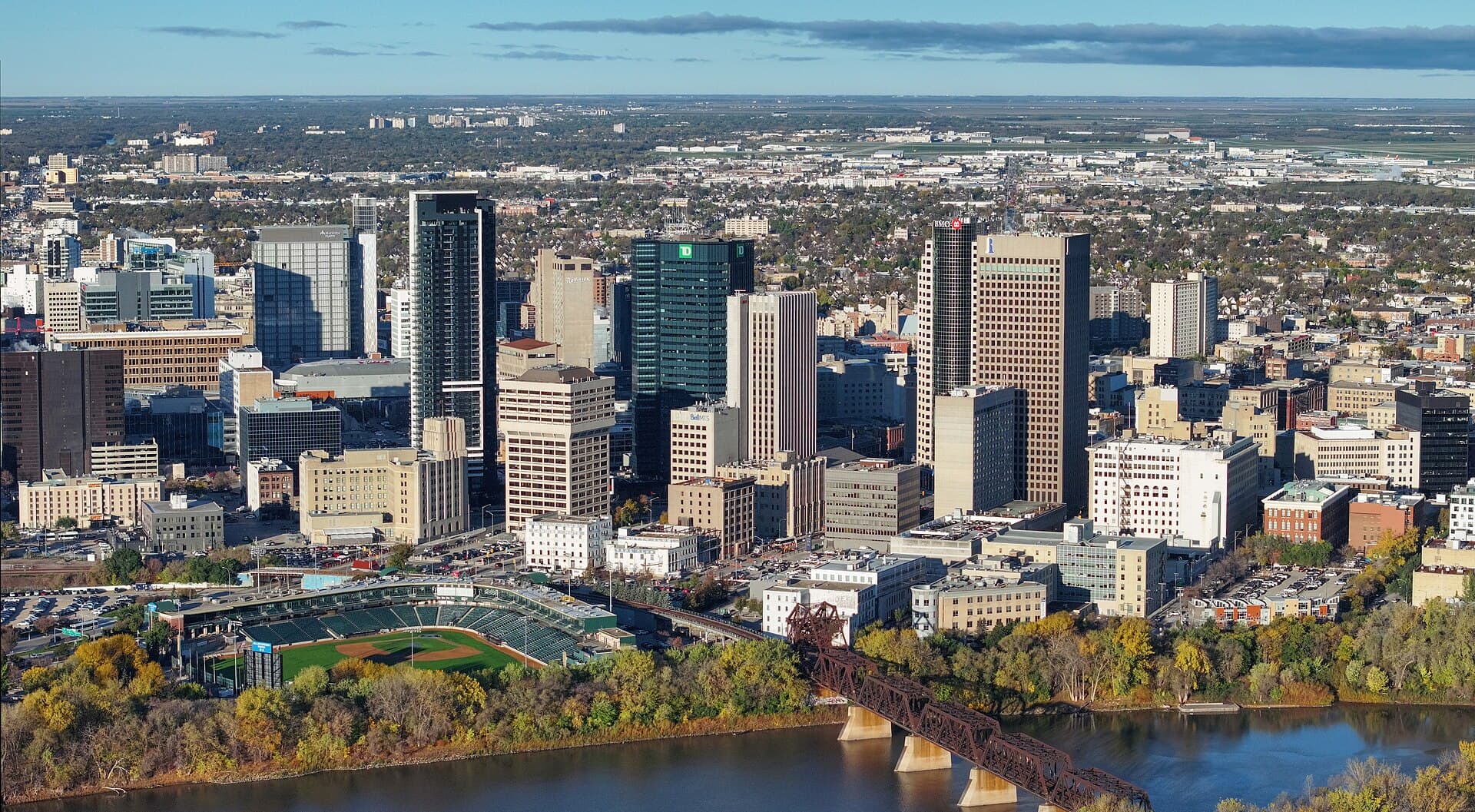 Quintin Soloviev / CC BY 4.0, via Wikimedia Commons
“Where the vast prairie meets flowing rivers, and history writes itself anew.”
Not the postcards. The stories even locals don't know — whispered in your ear, right where they happened.
Winnipeg showcases a celebrated polar bear exhibit, yet the city's bond with these Arctic creatures extends beyond what's immediately visible.
Strolling through Winnipeg's historic Exchange District transports you to a bustling turn-of-the-20th-century metropolis. This area once held a surprising moniker.
Winnipeg faces extreme temperatures, from sweltering summers to biting winters. Yet, even on the coldest days, a significant portion of downtown can be traversed without stepping outside.
Discover every secret of Winnipeg
Every address, every reveal in full — in your ear, right where it happened.
You pick your stops. You walk. The voice reveals what the others miss.
No tours available yet. Check back soon — we're preparing them.
Winnipeg, Manitoba’s capital, lies at the confluence of the Red and Assiniboine rivers, a venerable meeting point known as The Forks. The city’s name, 'Winnipeg,' derives from Cree words meaning 'muddy water,' referencing the nearby Lake Winnipeg. Often called the 'Gateway to the West,' Winnipeg has long been a vital railway and transportation nexus, nurturing a diverse economy and a lively cultural landscape.
Winnipeg offers a distinct blend of history, arts, and natural beauty. From its world-class museums to its expansive parks and a lively festival calendar, there is always something new to encounter. The city’s continental climate brings clear seasons, with warm summers and cold, snowy winters, which residents embrace with a variety of outdoor pursuits. Whether exploring its historic districts, observing Arctic wildlife, or savoring its culinary offerings, Winnipeg provides an authentic Canadian prairie experience.
For at least 6,000 years, the area now known as The Forks, where the Red and Assiniboine rivers converge, has served as a crucial gathering and trading place for Indigenous peoples, including the Anishinaabe (Ojibway), Ininew (Cree), Oji-Cree, Dene, and Dakota. Archaeological findings, oral traditions, and rock art all attest to its enduring significance for camping, hunting, fishing, and commerce.
The first European presence in the area dates back to 1738, when French traders established Fort Rouge. This was followed by other trading posts, including Fort Gibraltar and later Fort Garry, which became central to the fur trade. In 1812, the Selkirk settlers of the Red River Colony arrived, marking the beginning of European settlement. The interaction of Indigenous communities, the Métis Nation, and European settlers led to a rich and occasionally turbulent history, including the Red River Resistance in 1869, during which Louis Riel led a provisional government.
Winnipeg was officially incorporated as a city in 1873. The arrival of the Canadian Pacific Railway in 1885 transformed Winnipeg into a major grain market and a key distribution point for the Prairie Provinces. This railway boom spurred dramatic population growth, with the city’s population climbing from 25,000 in 1891 to over 179,000 by 1921, making it Canada’s third-largest city in 1911. However, the opening of the Panama Canal in 1914 altered trade routes, affecting Winnipeg’s anticipated expansion.
In more recent history, the current City of Winnipeg was formed in 1972 through the amalgamation of Winnipeg and its suburbs, a process known as 'Unicity.' Today, Winnipeg continues to evolve as a cultural and economic center, embracing its diverse heritage and its role as a prairie city.
Begin your exploration at The Forks National Historic Site, a historic meeting place for Indigenous peoples and a lively contemporary hub, offering markets, restaurants, and cultural activities. Nearby, the Canadian Museum for Human Rights stands as a striking architectural marvel and Canada’s sole national museum dedicated exclusively to human rights.
Immerse yourself in the past by walking through the Exchange District National Historic Site, a 30-block area displaying turn-of-the-20th-century architecture, now home to shops, restaurants, and galleries. For art enthusiasts, the Winnipeg Art Gallery (WAG)-Qaumajuq houses the world’s largest public collection of contemporary Inuit art.
Those who appreciate nature will find Assiniboine Park a welcome expanse of green space. It includes the Assiniboine Park Zoo with its acclaimed Journey to Churchill exhibit, providing close-up views of polar bears and other northern species. Within Assiniboine Park, The Leaf offers an immersive botanical experience with diverse ecosystems and a focus on Indigenous teachings. For a deeper understanding of Manitoba’s natural and human history, visit the Manitoba Museum. And for a distinct relaxation experience, consider Thermëa by Nordik Spa-Nature, an outdoor Nordic spa open year-round.
The most pleasant time to visit Winnipeg for warm-weather activities and festivals is from early July to late August. During these months, average daily high temperatures exceed 67°F (19°C), with July being the warmest month, averaging 79°F (26°C). Summer also sees the most rainfall due to thunderstorms. For milder weather, May and September are also good choices. For those who enjoy winter, December through March provides opportunities for ice skating on the frozen rivers and enjoying winter festivals, though temperatures can be severely cold, often falling below 26°F (-3°C).
Winnipeg James Armstrong Richardson International Airport (YWG) serves as the city’s main airport, offering domestic and international flights. It ranks as the seventh busiest airport in Canada by passenger traffic. Public transportation within Winnipeg is provided by Winnipeg Transit, operating a network of bus routes. Fares can be paid with cash, paper tickets, or a reloadable peggo card; children 11 and under ride free with a fare-paying customer. While English is the predominant language, French is also an official language in Manitoba, and you will encounter a diverse array of other languages spoken due to the city’s multicultural heritage. The Canadian dollar (CAD) is the local currency. Renting a car offers an easy way to explore the city and surrounding province, though downtown traffic can be heavy during rush hour, and many downtown streets are one-way.
Winnipeg experiences significant temperature variations, so pack layers, especially if visiting outside of peak summer. Summers are warm and can be humid, while winters are frigid, snowy, and windy, with temperatures occasionally dropping below -40°C (-40°F).