The Beehive
New Zealand's Parliament building has a distinctive shape, but the story behind its design is less about grand architectural vision and more about a casual sketch.
Full story unlocks in the tour
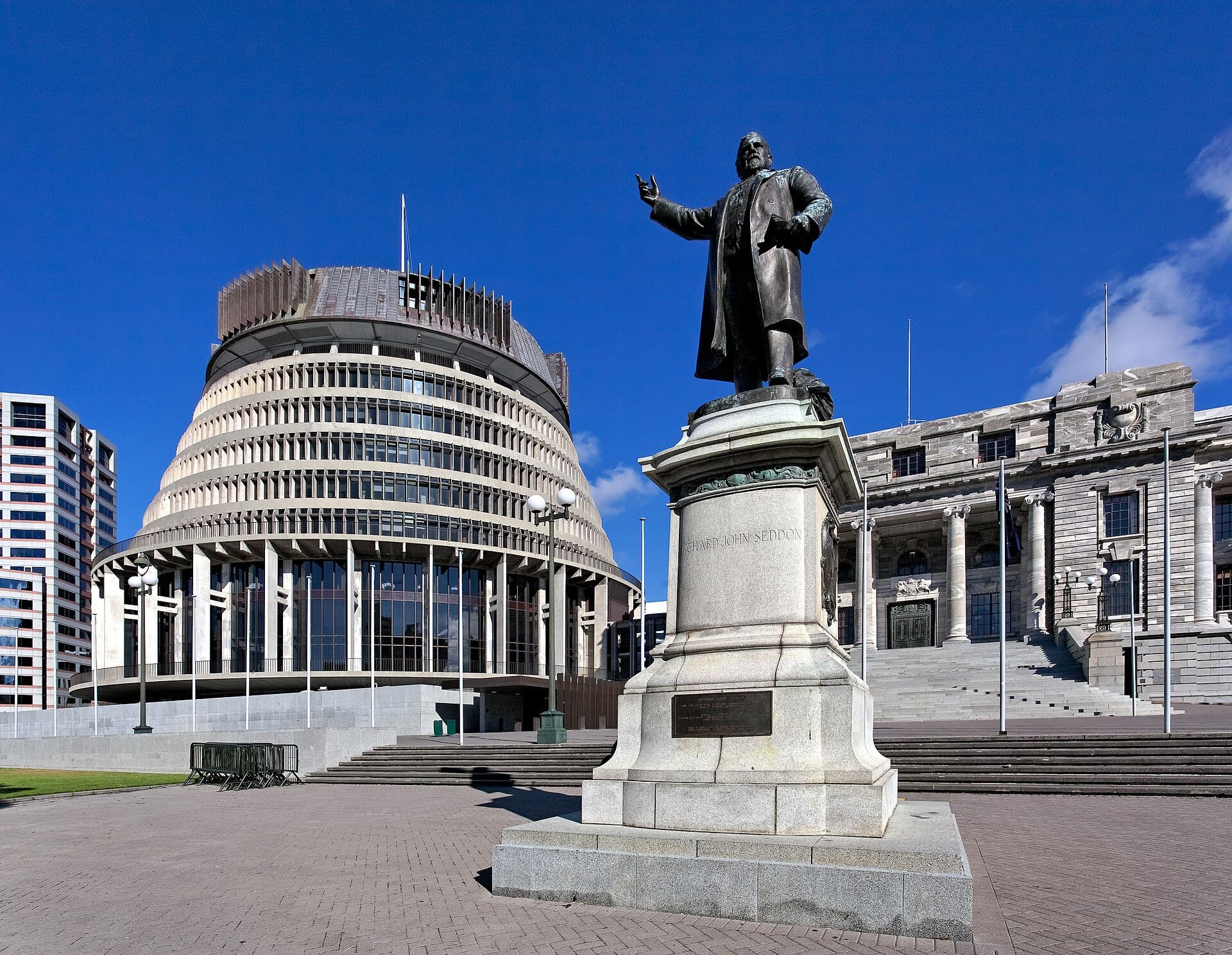 russellstreet / CC BY-SA 2.0, via Wikimedia Commons
“Wellington: Where the wind carries whispers of film magic and political intrigue.”
Not the postcards. The stories even locals don't know — whispered in your ear, right where they happened.
New Zealand's Parliament building has a distinctive shape, but the story behind its design is less about grand architectural vision and more about a casual sketch.
The iconic red cable cars that ascend to the Botanic Garden weren't always a smooth ride, and their origins are tied to an unexpected academic incentive.
This playful kinetic sculpture is famous for splashing passersby, a feature that was not an accidental oversight but a deliberate design choice.
Discover every secret of Wellington
Every address, every reveal in full — in your ear, right where it happened.
You pick your stops. You walk. The voice reveals what the others miss.
No tours available yet. Check back soon — we're preparing them.
Wellington, the southernmost capital city in the world, is a compact urban center at the southwestern tip of New Zealand's North Island. It is known for its dramatic harbor, framed by steep, green hills, offering a unique blend of culture, cuisine, and the raw beauty of the natural world. Often referred to as the 'Coolest Capital In the World' or 'Wellywood' due to its flourishing film industry, Wellington is a hub of creativity and a significant financial center in the Asia-Pacific region. Its dense population, a result of limited land between the harbor and hills, has fostered a lively, walkable city center with a high concentration of cafes and restaurants.
The city's distinctive character is shaped by its geography and climate. Situated in the 'Roaring Forties' and exposed to winds funneled through the Cook Strait, Wellington holds the title of the world's windiest city. This constant breeze, while sometimes challenging, contributes to excellent air quality and has inspired innovative solutions, such as harnessing wind energy. Despite its reputation for wind, Wellington experiences a temperate maritime climate with mild summers and cool winters, rarely seeing extreme temperatures. It's a city where you might experience various weather phenomena in a single day, making layers a practical choice for visitors.
Wellington's history stretches back to the 10th century, with Māori oral tradition attributing its discovery and exploration to the Polynesian navigator Kupe. According to legend, Kupe pursued an octopus from Hawaiki, eventually landing in what is now Wellington Harbour. The area was initially settled by Māori iwi (tribes) such as Rangitāne and Muaūpoko. The Māori name for Wellington Harbour, Te Whanganui-a-Tara, meaning 'the great harbour of Tara,' is linked to Tara, son of Chief Whatonga, who was sent to find fertile lands for settlement.
European settlement began in 1839 with the arrival of an advance party from the New Zealand Company. The initial settlement site at Petone, named Britannia, proved swampy and flood-prone, leading settlers to relocate across Wellington Harbour to Thorndon. The city was formally named Wellington in 1840, honoring Arthur Wellesley, the first Duke of Wellington, who achieved military fame at the Battle of Waterloo. This naming reflected the early settlers' hopes for stability and progress.
Wellington's status as the capital of New Zealand is a result of constitutional convention rather than statute. The New Zealand Parliament first temporarily met in Wellington in 1862, and in 1863, a resolution was passed to transfer the seat of government from Auckland to Wellington. Parliament officially convened in Wellington for the first time on July 26, 1865, when the city's population was just 4,900. The Old Government Building, one of the world's largest wooden structures, was constructed in 1876 and housed original government departments.
The city continued to grow, becoming a borough in 1842 and a city in 1886. Its strategic geography, with a natural harbor surrounded by hills, made it a vital hub for trade and exploration. Wellington's location on a major fault line has also made it a global center for earthquake research and the development of seismic strengthening techniques in buildings. From the 1990s onward, Wellington has rebranded itself as New Zealand's creative capital, fostering a thriving arts and film industry.
Begin your exploration with a ride on the Wellington Cable Car, a funicular railway that has been transporting locals and visitors since 1902. The journey from Lambton Quay to the Kelburn lookout offers expansive views of the city and harbor, leading directly to the Wellington Botanic Garden. The garden spans 25 hectares, featuring diverse plant collections, unique landscapes, and the Space Place at Carter Observatory, which delves into New Zealand's celestial stories.
Explore the Museum of New Zealand Te Papa Tongarewa, the national museum that showcases the country's identity, history, and culture through interactive exhibits. For film enthusiasts, a trip to the Wētā Workshop in Miramar offers a glimpse into the creative magic behind blockbuster movies like The Lord of the Rings and Avatar. Wander through Cuba Street, a cultural precinct known for its independent boutiques, cafes, and historic character, and don't miss the playful Bucket Fountain. For outdoor adventures, hike up Mount Victoria for arguably the best views of the city, harbor, and South Coast, or visit Zealandia Te Māra a Tāne, the world's first fully-fenced urban eco-sanctuary, to see native New Zealand wildlife.
Wellington generally experiences a mild climate year-round, with temperatures rarely exceeding 25°C or dropping below 5°C. The summer months, from December to February, are the warmest, with average temperatures between 19°C and 24°C, and are ideal for outdoor activities and enjoying the city's beaches. However, Wellington is known for its wind, so even in summer, a wind jacket is advisable. Autumn (March-May) is often considered a prime time to visit, with warm temperatures, fewer crowds, and less wind. Spring (September-November) brings blooming flowers and opportunities to see native wildlife.
Wellington International Airport serves both domestic and international flights, with many travelers arriving by road from Auckland or via inter-island ferries from Picton on the South Island. The city center is notably compact and walkable, making it easy to explore on foot. Wellington also has an extensive public transport network of buses and trains covering the city and its suburbs, so a car isn't strictly necessary for getting around. Taxis and shared shuttle services are available from the airport to the city center.
The currency used is the New Zealand Dollar (NZD). Wellington is 12 hours ahead of Greenwich Mean Time (GMT), with daylight saving observed from October to March. Due to the city's changeable weather, packing layered clothing and an umbrella is recommended, especially during winter. In case of emergencies, dial 111 for Police, Fire, or Ambulance services.