Vukovar Water Tower
The city's most prominent landmark bears hundreds of scars, yet it never fell.
Full story unlocks in the tour
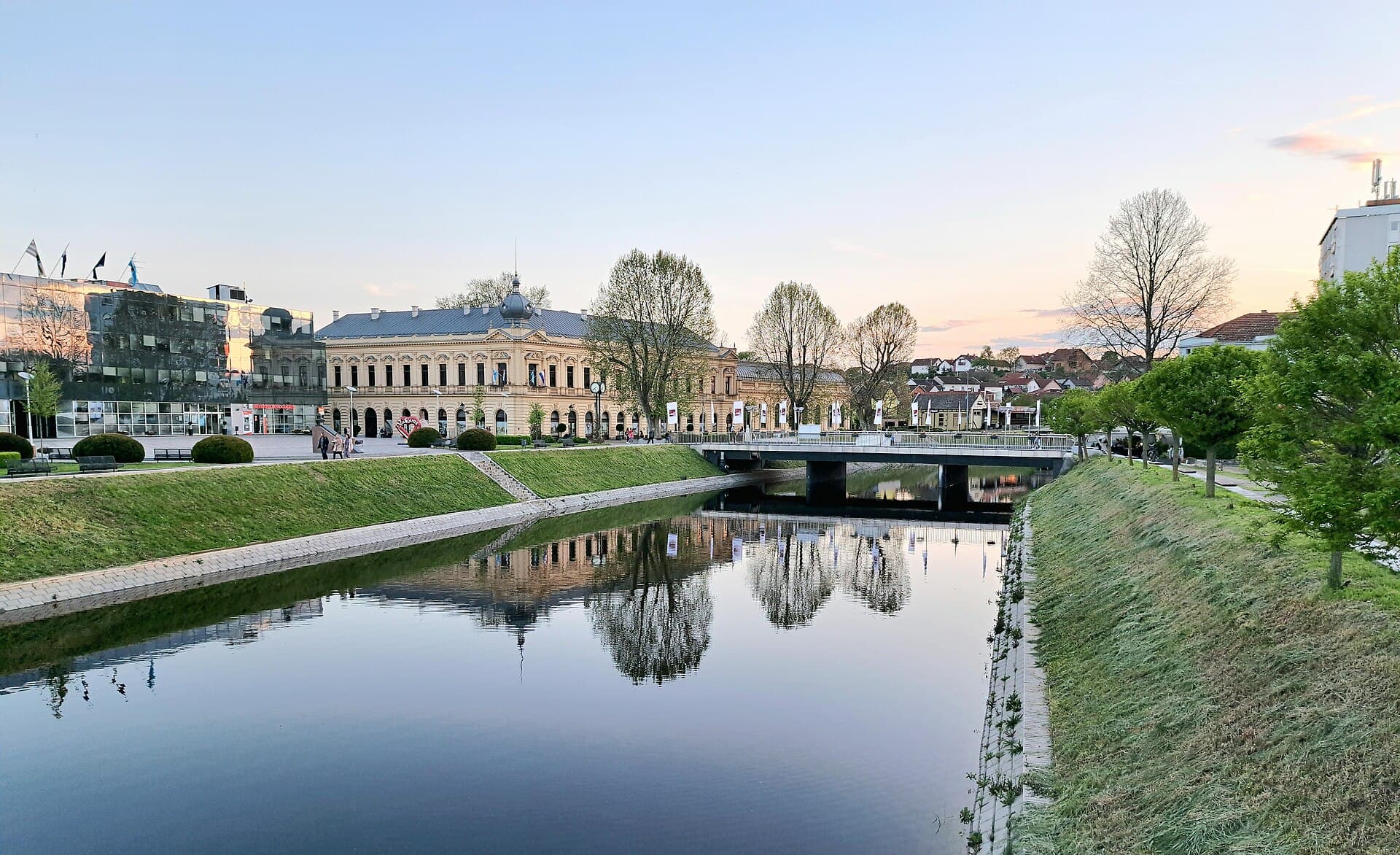 Bybbisch94, Christian Gebhardt / CC BY-SA 4.0, via Wikimedia Commons
“Vukovar: Where the Danube carries echoes of resilience and rebirth.”
Not the postcards. The stories even locals don't know — whispered in your ear, right where they happened.
The city's most prominent landmark bears hundreds of scars, yet it never fell.
This elegant Baroque palace once graced a Croatian banknote, even after suffering immense damage.
Beneath a modern hospital, a preserved basement tells a haunting story of survival and sacrifice.
Discover every secret of Vukovar
Every address, every reveal in full — in your ear, right where it happened.
You pick your stops. You walk. The voice reveals what the others miss.
No tours available yet. Check back soon — we're preparing them.
Vukovar, a city in eastern Croatia, is situated at the confluence of the Vuka and Danube rivers, near the border with Serbia. Known as "The Hero Town," Vukovar holds a significant place in Croatian history, particularly due to the devastating eighty-seven-day siege it endured during the Croatian War of Independence in 1991. Despite the extensive destruction it suffered, the city has undergone remarkable reconstruction and revitalization, emerging as a poignant destination that balances its ancient heritage with the visible and invisible scars of its recent past.
Before the 1990s conflict, Vukovar was a prosperous, multicultural community with a diverse population of Croats, Serbs, Hungarians, and other ethnic groups. Its strategic location on the Danube has made it an important river port and trade center for centuries. Today, visitors can explore its cultural heritage, from prehistoric artifacts to Baroque architecture, while also engaging with the numerous memorials that commemorate the city's resilience and the sacrifices made during the war.
The history of Vukovar stretches back five millennia, with archaeological evidence of continuous habitation. The significant Vučedol culture, which flourished around 3000–2200 BC, developed in the Vučedol locality near Vukovar. Discoveries like the Vučedol Dove, a ritual ceramic vessel, and the Vučedol Orion, considered the oldest Indo-European calendar, highlight the area's ancient heritage.
Vukovar was first mentioned in the early thirteenth century under various names like Volko, Walk, and Vukovo, eventually adopting the Hungarian-influenced 'Vukovar'. In 1231, it was granted the status of a royal free city, making it one of the most important settlements in the Kingdom of Hungary. Over the centuries, its strategic position on the Danube led to it being part of various empires and states, including the Ottoman Empire and the Habsburg Monarchy.
After the Ottoman rule, a significant portion of the Vukovar area was acquired by the German counts of Eltz in 1736. The Eltz family played a crucial role in the economic and cultural development of Vukovar for two centuries, contributing to its Baroque architectural style, evident in structures like the Eltz Manor. The nineteenth century saw Vukovar prosper as a center for trade, craft, and agriculture, utilizing the Danube for exporting goods.
In the twentieth century, as part of the Kingdom of Serbs, Croats, and Slovenes (later Yugoslavia), Vukovar experienced further industrial growth, particularly with the establishment of the Borovo shoe company in 1931. By the late 1980s, Borovo employed over 22,000 people, and Vukovar had become a thriving, multicultural industrial hub with a high standard of living.
The prosperity and multicultural harmony of Vukovar were shattered in 1991 with the outbreak of the Croatian War of Independence. The city endured an eighty-seven-day siege by the Yugoslav People's Army and Serbian paramilitary forces, becoming the first major European city to be extensively destroyed since World War II. The Battle of Vukovar resulted in thousands of deaths, mass expulsions, and the near-total destruction of the city's infrastructure. The Ovčara massacre, where hundreds of patients and civilians were taken from the hospital and executed, stands as a particularly horrific event of this period.
Following the war, Vukovar remained under Serb control before being peacefully reintegrated into Croatia in 1998. The city has since undertaken a significant rebuilding process, with many of its historic buildings restored. Today, Vukovar stands as a symbol of resilience, remembrance, and the ongoing efforts towards reconciliation.
Begin your exploration at the Vukovar Water Tower, an iconic symbol of the city's endurance during the 1991 siege. Its shell-pocked facade is deliberately preserved, and you can ascend to an observation deck for sweeping views. The Eltz Manor, a beautifully restored eighteenth-century Baroque palace, houses the Vukovar City Museum, offering comprehensive exhibits on the city's history, from prehistoric times to the present. Do not miss the Vučedol Culture Museum, located on the Danube bank, which vividly presents the story of this ancient civilization through artifacts like the Vučedol Dove and the Vučedol Orion.
For a deeper understanding of the recent past, visit the Vukovar Hospital Memorial, where the preserved basement reveals the harrowing conditions during the siege. The Ovčara Memorial Center, a short drive outside the city, commemorates the victims of the massacre that occurred there. The Memorial Cemetery for the Victims of the Homeland War is another significant site, with 938 white marble crosses marking the largest mass grave discovered in Croatia after World War II. Stroll through the city center to admire the charming Baroque arcades and buildings like the Workers' Hall and the Church of Saint Nicholas.
The best time to visit Vukovar for pleasant weather and outdoor activities is from late May to late September. During these months, average daytime temperatures range from a comfortable 19°C to a warm 30°C. July is the sunniest month, offering ample opportunity for exploring. While summers can be warm, the spring and early autumn provide ideal conditions for sightseeing and enjoying the riverside. Winters are milder, offering a quieter atmosphere for historical exploration.
Croatia's official currency is the Euro (EUR). While credit cards are widely accepted, it is advisable to carry some cash for smaller purchases. Vukovar is generally considered a safe city. However, it is important to be aware that there are active mines in the woods around the Vukovar cemetery, so stick to paved and grassy areas.
Vukovar is well-connected by bus, with direct routes to cities like Osijek and Zagreb, and daily services to Serbian cities like Sombor and Novi Sad. Train services are less frequent but connect to Osijek and Vinkovci, with a daily direct train to Zagreb. The city is also part of the EuroVelo VI cycling route. Within Vukovar, the city center is best explored on foot. Taxis are available.