The House of Orpheus
This grand residence holds a secret beneath its famed mosaic.
Full story unlocks in the tour
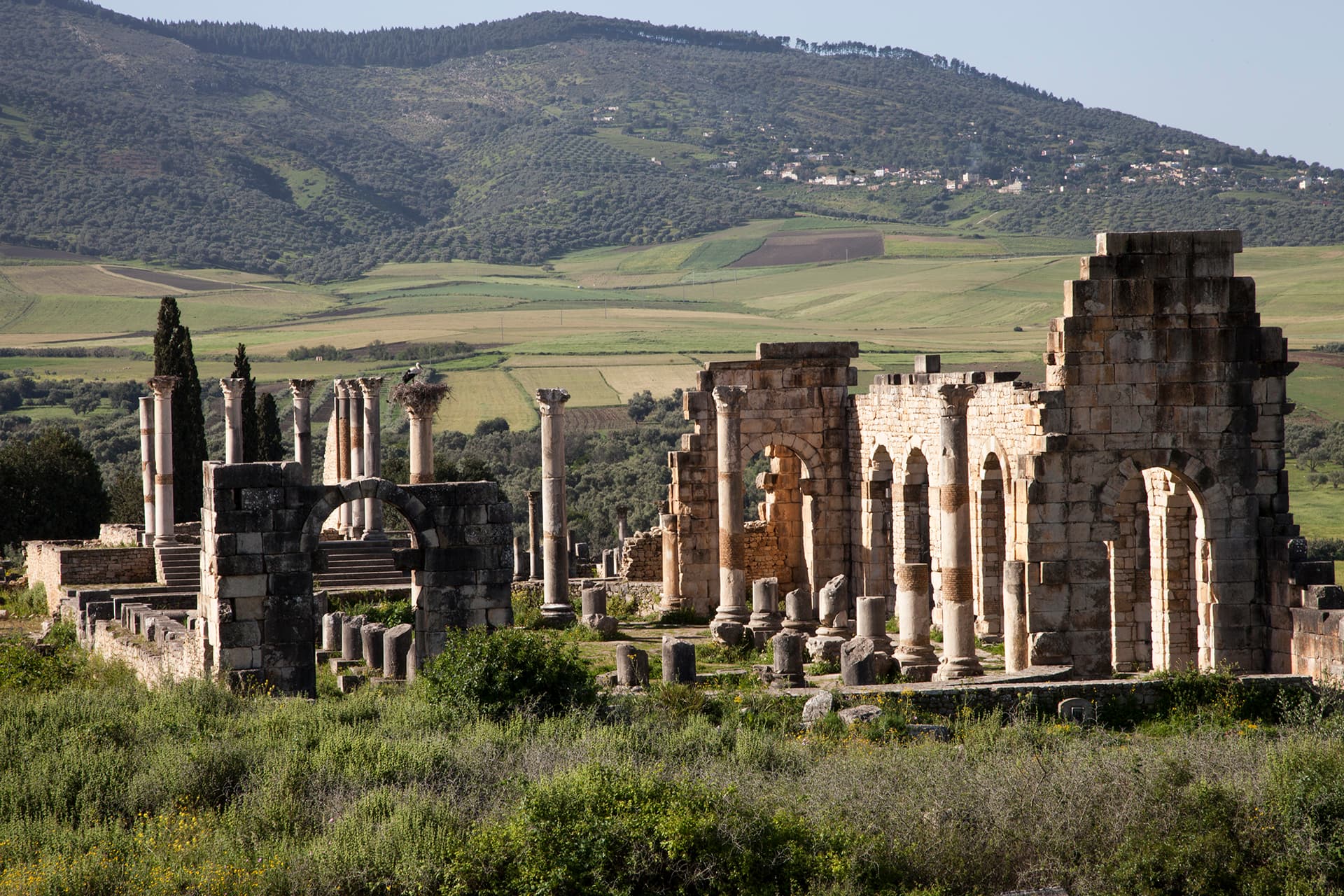 Subhros / CC BY-SA 3.0, via Wikimedia Commons
“Where Roman grandeur meets Moroccan earth, stories etched in stone and mosaic await your discovery.”
Not the postcards. The stories even locals don't know — whispered in your ear, right where they happened.
This grand residence holds a secret beneath its famed mosaic.
This impressive arch once had a dramatic flourish at its summit that's no longer there.
Look closely at the columns of the Basilica, and you might spot some unexpected residents.
Discover every secret of Volubilis
Every address, every reveal in full — in your ear, right where it happened.
You pick your stops. You walk. The voice reveals what the others miss.
No tours available yet. Check back soon — we're preparing them.
Volubilis, a UNESCO World Heritage site, presents an unexpected encounter with Roman history amidst the rolling hills and fertile plains of Morocco. Far from being a desolate outpost, this ancient city was once a flourishing hub, strategically located between the modern-day cities of Meknes and Fez. Its well-preserved ruins, including intricate mosaics and monumental public buildings, offer a tangible link to a past where Roman ambition met indigenous Berber culture.
More than just a collection of stones, Volubilis invites you to wander through its ancient streets and imagine a bustling Roman provincial town. The site, covering approximately 40 hectares, reveals only about half of its full extent, leaving much still to be unearthed. It stands as a testament to centuries of occupation, from its early Berber and Carthaginian roots to its flourishing Roman period and subsequent Islamic settlement, offering a unique perspective on North Africa's multifaceted heritage.
Volubilis carries a history stretching back millennia, with Neolithic pottery discovered in the area dating back 5,000 years, indicating early human settlement. By the 3rd century BCE, Phoenician traders established a permanent presence, which later evolved under Carthaginian influence, transforming it into an important agricultural and trade center. Evidence of a temple to the Punic god Baal has been found outside the Roman area of occupation.
The city became part of the Mauretanian Kingdom, a Roman client state, after the Third Punic War ended in 146 BCE. Roman control solidified around 40 CE, and Volubilis prospered, becoming the capital of the Roman province of Mauretania Tingitana. At its zenith in the late 2nd century, the city was home to an estimated 20,000 inhabitants, a diverse population including Africans, Syrians, Spaniards, and Jews. Its prosperity was largely due to the fertile lands, which produced valuable exports like grain and olive oil, with olive presses being a common industrial artifact found at the site.
Major public buildings, including a basilica, a temple, and a triumphal arch, were constructed in the 2nd century. The Romans, however, abandoned Volubilis around 280 CE due to attacks from Berber tribes, though the city continued to be inhabited for several more centuries. In the 8th century, Idris I, the founder of Morocco's first royal dynasty, resided here before establishing Fez as his capital. The city gradually declined as nearby Fez and Moulay Idriss Zerhoun grew in importance, with its inhabitants eventually relocating to Moulay Idriss. The site remained largely intact until an earthquake in the 18th century caused significant damage, and its marble was later repurposed for palaces in Meknes. Excavations and restorations began in the 19th and 20th centuries, leading to its designation as a UNESCO World Heritage site in 1997.
Volubilis offers a captivating journey through its ancient urban landscape. Begin at the Triumphal Arch of Caracalla, a marble structure built in 217 CE in honor of Emperor Caracalla and his mother, Julia Domna. From here, you can appreciate sweeping views of the entire site.
Stroll along the ancient Decumanus Maximus, the main street, which was once lined with shops. The Forum, the heart of public life, features the remains of the Basilica and the Temple of Jupiter, Juno, and Minerva. Look for the columns of the Basilica, often crowned with stork nests.
The true treasures of Volubilis are its remarkably preserved mosaics. The House of Orpheus showcases a mosaic of Orpheus playing the lute to enchant animals, and also features a dolphin mosaic. The House of Venus displays intricate mosaics depicting Diana and Acteon, as well as nymphs kidnapping heroes and bathing goddesses. In the Labours of Hercules House, you'll find mosaics illustrating the mythical hero's twelve tasks. Do not miss the Thermal Baths of Gallienus, which still show evidence of sophisticated underfloor heating systems. The site also features numerous olive presses, highlighting the city's economic foundation.
The best times to visit Volubilis are during the cooler months, from October to April. The summer months (June to August) can be extremely hot, with little to no shade on the site, making exploration uncomfortable. Arriving early in the morning or late in the afternoon, especially an hour or so before sunset, is recommended. The soft light at dusk casts a magical glow over the ruins and offers a respite from the harsh sun.
Volubilis is located about 20 km from Meknes and 60 km from Fez, making it a popular day trip from both cities. You can hire a grand taxi from Meknes directly to Volubilis, or take a bus to Moulay Idriss Zerhoun, which is about 5 km away, and then a short taxi ride or a 30-minute walk to the ruins. Private tours from Fez or Meknes are also a convenient option.
The site is open daily from 8:00 AM until an hour before dusk. Admission is 70 dirhams for adults and 30 dirhams for children under 12. While there is a small on-site museum with some artifacts, many significant finds are housed in the National Archaeology Museum in Rabat. Official guides are available for hire at the entrance, and their insights can greatly enhance your visit, as there are limited information signs. Wear comfortable walking shoes, a hat, and bring plenty of water, especially during warmer months, as shade is scarce.