Millionka Quarter
Vladivostok once held a bustling, almost autonomous Chinese district, known for its spirited, untamed character.
Full story unlocks in the tour
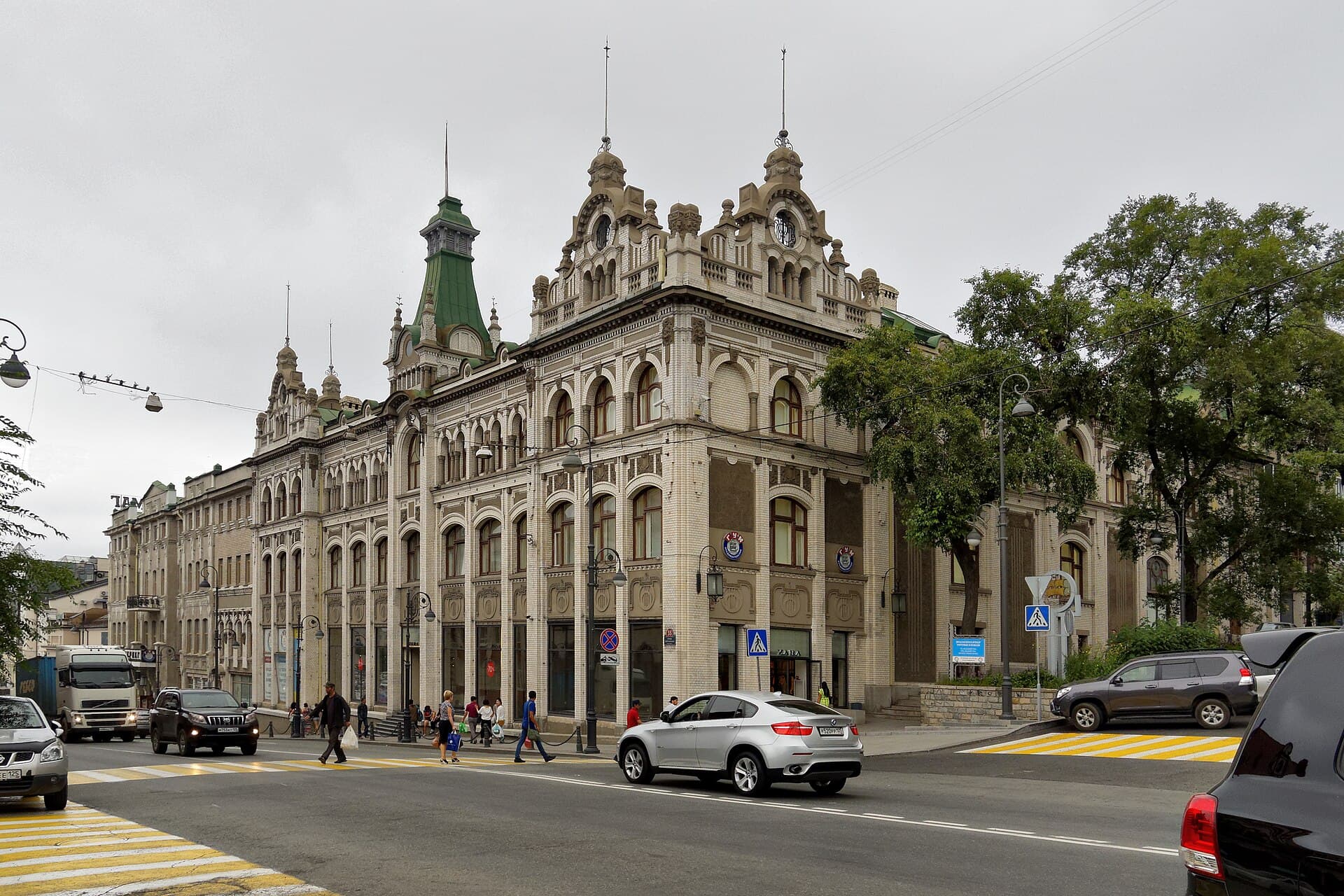 Alexxx1979 / CC BY-SA 4.0, via Wikimedia Commons
“Where the Trans-Siberian Railway meets the Pacific, a city of hills and maritime secrets.”
Not the postcards. The stories even locals don't know — whispered in your ear, right where they happened.
Vladivostok once held a bustling, almost autonomous Chinese district, known for its spirited, untamed character.
This enduring lighthouse, standing at the edge of the Eastern Bosphorus Strait, offers more than just scenic vistas.
High above the city, a peculiar geodesic dome stands like an artifact from another era.
Discover every secret of Vladivostok
Every address, every reveal in full — in your ear, right where it happened.
You pick your stops. You walk. The voice reveals what the others miss.
No tours available yet. Check back soon — we're preparing them.
Vladivostok, often termed the "Gateway to the East," serves as Russia's principal Pacific port and the largest city in the Russian Far East. It rests upon rolling hills around the Golden Horn Bay, functioning as a crucial nexus for trade and commerce, linking Russia with nations like Japan and China. The city's distinctive geographical placement in Asia, combined with its unique Russian architecture, has earned it the title "Europe in the Far East."
Beyond its role as a strategic port, Vladivostok marks the eastern conclusion of the fabled Trans-Siberian Railway, a journey stretching over 9,000 kilometers from Moscow. This expansive city, home to over 600,000 residents, presents a blend of weathered imperial facades, naval installations, and steep thoroughfares that descend towards the sea. It is a destination that rewards the curious, inviting travelers to delve into its maritime legacy, diverse cultural currents, and dramatic landscapes.
The city's boundaries extend to encompass several islands, including Russky, Popov, and Reynard, with the Eastern Bosphorus Strait connecting the Amur and Ussuri bays. Vladivostok's appeal lies in its capacity to reconcile elements of the past with contemporary life, where 19th-century architecture in the city center harmonizes with modern designs, reflecting both Western and Eastern cultural expressions.
Vladivostok's narrative began on July 2, 1860, when soldiers under Ensign Komarov established it as a Russian military outpost. The name itself, "Vladivostok," translates to "Possess the East," a clear declaration of its strategic aim to prevent China's expansion to the Sea of Japan. Its initial years saw the construction of a small seaport and a wooden fort, establishing it as a forward position in the Far East.
In 1872, the primary Russian naval base on the Pacific relocated to Vladivostok, a move that significantly spurred its expansion. By 1880, the settlement officially attained city status, further accelerating its development. The completion of the Chinese Eastern Railway in 1903, linking Vladivostok to Chita across Manchuria, provided a more direct rail connection to the rest of the Russian Empire, solidifying its importance. During the 1904-1905 Russo-Japanese War, Vladivostok became a critical Russian Pacific naval base after the fall of Port Arthur.
The early 20th century witnessed Vladivostok's flourishing, experiencing rapid economic and demographic growth, with its population surpassing 100,000 by 1914. The city's varied character was evident, with a notable Asian presence, including Chinese communities and opera houses. However, the Russian Civil War in the early 1920s inflicted considerable damage, as the Reds suppressed a White counterattack. Following the establishment of Soviet power in 1922, Vladivostok became the cultural, scientific, and industrial heart of the Far East, with thriving industries like machinery manufacturing, shipbuilding, and fishing.
From 1958 until 1992, Vladivostok was a restricted city due to its crucial role as the headquarters of the Soviet Pacific Fleet. Foreigners and even many Russian citizens required special permits to visit. The dissolution of the Soviet Union in 1991 led to the city's reopening, marking a new era of international cooperation and economic development. In 2012, Vladivostok hosted the APEC summit, which prompted substantial investment in new infrastructure, including hotels, highways, and the impressive Russky and Golden Bridges. Today, Vladivostok continues to evolve, balancing its military and maritime past with its role as a modern passage to the Asia-Pacific region.
Vladivostok offers a distinct encounter, blending its maritime identity with a hilly urban landscape. The city's Central Railway Station stands as a landmark, serving as the terminus for the Trans-Siberian Railway. Nearby, the Square for the Fighters for Soviet Power in the Far East features a monument commemorating the Russian Civil War. For sweeping city vistas, ascend to Eagle's Nest Hill, often considered the highest point in the city center. A funicular railway can carry you part of the way up.
Along the waterfront, Korabelnaya Embankment hosts a naval memorial complex, including the Memorial to the Pacific Navy and the S-56 submarine, a World War II-era vessel that was the first Soviet submarine to circumnavigate the globe. The Nikolay Triumphal Arch, rebuilt in 1998, also stands in this area. Admiral Fokin Street, sometimes called the "Vladivostok Arbat," is a pedestrian thoroughfare lined with cafes and shops. The city's bridges are engineering marvels: the Golden Bridge spans the Golden Horn Bay, and the Russky Bridge connects the mainland to Russky Island, displaying one of the world's longest cable-stayed spans.
Beyond the city center, Russky Island offers natural beauty, old fort positions, and forgotten batteries. The Primorsky Oceanarium, the fourth largest in the world, is also located on Russky Island. For a unique coastal experience, visit the Tokarevsky Lighthouse, one of the oldest operating lighthouses in the Far East.
The ideal period to visit Vladivostok for warm-weather activities extends from mid-July to mid-September. August is the warmest month, with an average temperature of approximately +20°C (68°F), and the sea temperature can reach +22°C to +24°C (72°F to 75°F), making it suitable for coastal and boating activities. While summer can bring warm, humid, and rainy conditions due to the East Asian monsoon, clear sunny days are also frequent.
September, often termed the "velvet season," is particularly agreeable, with comfortable air temperatures around +20°C (68°F), warm sea water, and less rain, making it perfect for city walks and outdoor excursions. Late spring (May) and early autumn (September) are also good for hiking, with fewer crowds and moderate temperatures.
Vladivostok is a city that rewards exploration, though some practical considerations can enrich your visit. While public transportation includes buses and taxis, the city's hilly terrain and spread-out attractions often make a car or ride-sharing service the most convenient way to travel longer distances. The airport is well-connected to the city center by train, offering a dependable and often more economical option for arrival and departure.
For lodging, Vladivostok provides a range of choices, from affordable hostels to quality hotels with contemporary amenities. The city center, particularly around Fokin Street, offers easy access to restaurants, cafes, and bars. While Vladivostok has become considerably safer than in previous decades, it is always wise to be aware of your surroundings, especially after dark. The city is a strategic base for backpackers and offers opportunities for day trips to natural landscapes.