Kruttornet (The Powder Tower)
This tower, a segment of Visby's renowned city wall, conceals a secret about its true age and initial purpose, predating the bulk of the fortifications.
Full story unlocks in the tour
 L.G.foto / CC BY-SA 4.0, via Wikimedia Commons
“Where roses climb ancient stones and Vikings left silver.”
Not the postcards. The stories even locals don't know — whispered in your ear, right where they happened.
This tower, a segment of Visby's renowned city wall, conceals a secret about its true age and initial purpose, predating the bulk of the fortifications.
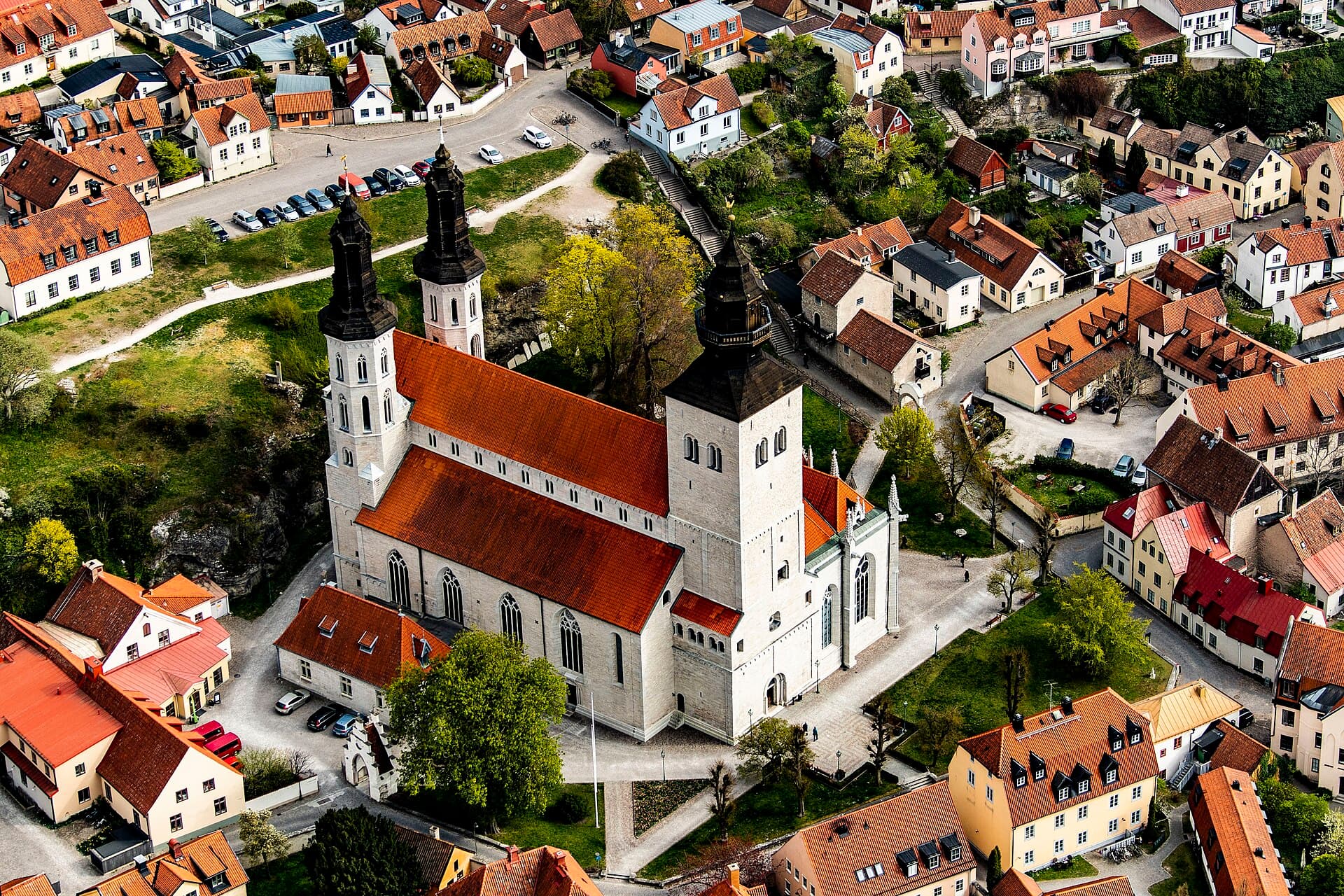
While it functions today as Visby's active cathedral, its original role was markedly different, reflecting a peculiar aspect of Visby's medieval society.
Within the medieval ramparts, this verdant garden flourishes with an unexpected array of plants, sustained by a surprising natural advantage.
Discover every secret of Visby
Every address, every reveal in full — in your ear, right where it happened.
You pick your stops. You walk. The voice reveals what the others miss.
No tours available yet. Check back soon — we're preparing them.
Visby, on the Swedish island of Gotland, is a city where history is not merely preserved; it is a living, breathing part of the landscape. Encircling it is an imposing 13th-century stone wall, inviting you to journey through time. The city's designation, 'the city of roses and ruins,' hints at the alluring blend of well-maintained medieval architecture, winding pathways, and the abundant roses that adorn ancient facades.
Once a formidable Hanseatic trading center, Visby prospered in the 12th and 13th centuries, its strategic position in the Baltic Sea drawing merchants from across Europe. Today, over 200 historical buildings remain, including numerous church ruins that stand open to the sky, merging stone with grass and light. The city's intimate scale makes it ideal for exploration on foot, where every turn seems to unveil a new narrative.
The earliest accounts of Visby are somewhat veiled, yet evidence suggests it was a center of commerce around 900 AD, inhabited since the Stone Age due to its natural harbor and access to fresh water. Early discoveries, interpreted as 'beach huts,' date back to the 7th–9th centuries AD. The name 'Visby' itself originates from Old Norse, meaning '(pagan) place of sacrifices' and 'village.'
Visby's prominence grew significantly from the 12th century onward, drawing German, Russian, and Danish traders. By 1161, it had become a leading mercantile center in northern Europe, aligning with the influential Hanseatic League. This economic prosperity enabled the construction of grand stone buildings and numerous churches; at its zenith, Visby contained more than a dozen churches.
The iconic Visby City Wall, or Ringmuren, stands as a testament to the city's medieval importance. Construction commenced in the 13th century and was largely finished by 1361. Stretching approximately 3.4 kilometers (2.1 miles), with heights exceeding 9 meters (30 feet), it remains Scandinavia's strongest, most extensive, and best-maintained medieval city wall. Of its original 29 large and 22 smaller towers, 27 large and 9 small ones endure. The wall was erected to offer protection against both foreign adversaries and even Swedish attackers from the countryside.
Visby's golden era as a trading and political hub began to fade in the 16th century. In 1525, an army from Lübeck assaulted the city, resulting in the burning of many structures and the destruction of a significant number of medieval churches. In 1572, the German traders' church, St. Mary's, was elevated to a cathedral, becoming the sole medieval church in Visby still in use. Gotland, and thus Visby, transitioned from Danish to Swedish rule in 1645 with the Treaty of Brömsebro.
The 18th century witnessed a resurgence, with many warehouses refurbished and new buildings constructed, leading to expansion beyond the medieval wall. In 1810, an official prohibition on the destruction of historical ruins was enacted, marking the inception of the preservation efforts that have shaped Visby into its present form. In recognition of its remarkably well-maintained medieval architecture and townscape, the Hanseatic town of Visby was designated a UNESCO World Heritage site in 1995.
A visit to Visby commences and concludes with its iconic City Wall (Ringmuren). Walk along its 3.4-kilometer (2.1-mile) length, exploring its 27 intact large towers and 9 smaller ones. For sweeping views of the city and the Baltic Sea, ascend the Snäckgärdstornet tower.
Within the walls, the Visby Cathedral (Sankta Maria Domkyrka) stands as the only medieval church still in active service. Consecrated in 1225, this impressive edifice, initially constructed for German traders, offers insight into centuries of religious and cultural heritage. Observe the 13th-century wooden sculpture of the resurrected Christ and the decorated wooden pulpit from 1684 inside.
Visby is also known for its many church ruins, which provide a beautifully evocative backdrop to the city. Explore the dramatic arches of St. Karin's Church on the main square or the tranquil remnants of St. Nicolai Church, frequently used for concerts.
For a peaceful interlude, wander through the Visby Botanical Garden (DBW's Botaniska Trädgård). Established in 1855, this free-entry oasis nurtures a diverse collection of flora, including exotic trees and a rose garden, flourishing in a unique microclimate. The ruins of St. Olof's church are also situated within the garden.
Delve deeper into Gotland's past at the Gotlands Museum (Fornsalen), which houses artifacts from prehistoric times, including Viking-era treasures and the Spillings Hoard, the world's largest Viking silver treasure.
Finally, simply stroll through Visby's medieval streets and alleyways. The narrow, stone-paved paths and well-maintained architecture create an immersive experience, inviting you to discover quaint shops, cafes, and restaurants.
The ideal time to visit Visby extends from late May to early September. During these months, the weather remains mild and agreeable, with average daytime temperatures in summer (June to August) ranging from 20°C to 25°C (68°F to 77°F). The extended daylight hours facilitate extensive exploration. July and August are the warmest months, with the Baltic Sea reaching temperatures suitable for swimming.
Summer also provides the most activity, with outdoor cafes, festivals, and cultural events. A particular highlight is Medieval Week (Medeltidsveckan), typically held in early August, which transforms the town with reenactments, markets, and music. For fewer crowds and flourishing gardens, late spring (May) and early autumn (September) offer a quieter, picturesque experience with comfortable temperatures.
Visby's medieval core is compact and largely pedestrian-friendly, making walking the most enjoyable and effective way to explore. Wear comfortable shoes for the stone-paved streets. Bicycles can be rented from various shops for traversing the city and surrounding countryside.
For longer distances or excursions beyond the city walls, a dependable public bus system is available, with a single ride costing approximately SEK 25-40 (€2.50 - €4). Taxis are also an option but can be more expensive. While a car is not essential for Visby itself, it is highly recommended for exploring the broader island of Gotland, including its beaches, raukar (sea stacks), and rural churches.
The official currency is the Swedish Krona (SEK), and credit and debit cards are widely accepted. English is commonly spoken in tourist areas. Visby is accessible by ferry from mainland Sweden (Nynäshamn and Oskarshamn) and by commercial flights to Visby Airport (VBY) from Stockholm.