Fort Libéria's Women's Prison
Beyond its military purpose, Fort Libéria held a secret within its stone walls, a place of confinement for a particular group of women.
Full story unlocks in the tour
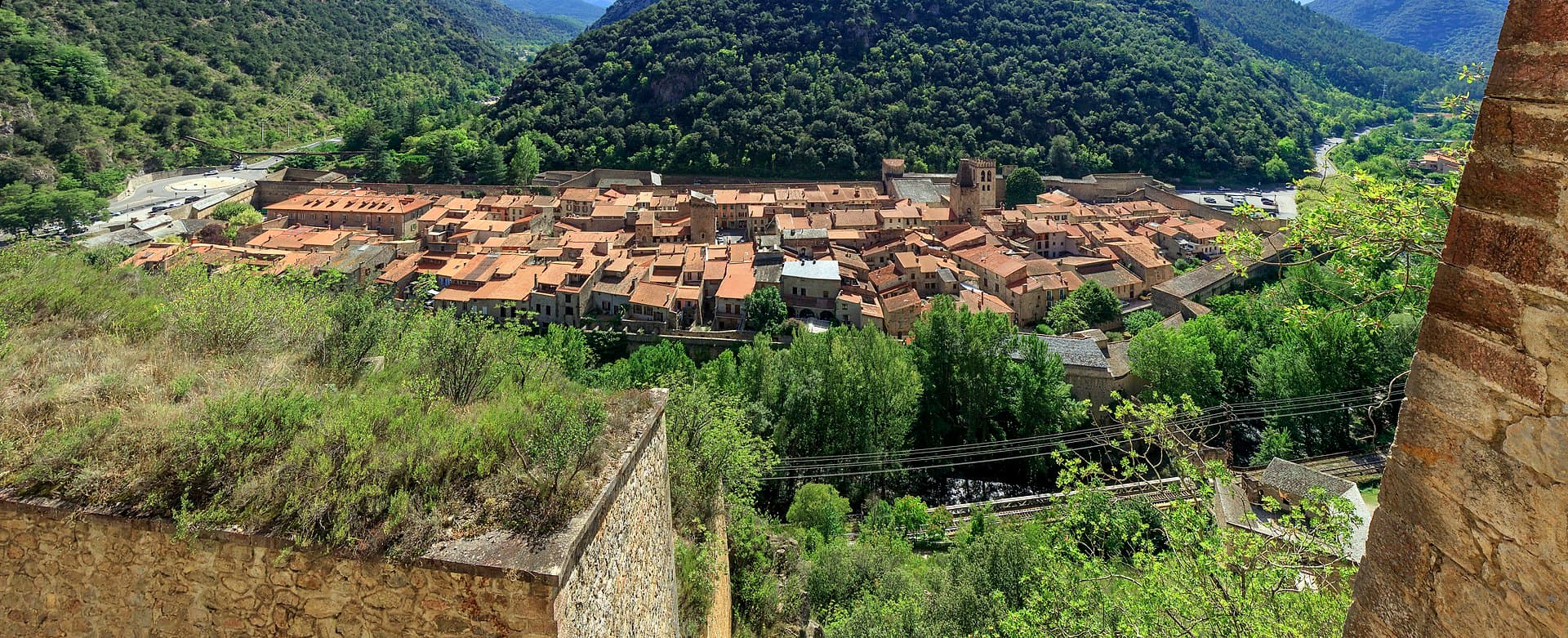 H. Zell / CC BY-SA 3.0, via Wikimedia Commons
“Where medieval walls murmur Catalan secrets.”
Not the postcards. The stories even locals don't know — whispered in your ear, right where they happened.
Beyond its military purpose, Fort Libéria held a secret within its stone walls, a place of confinement for a particular group of women.
The underground passage connecting the village to Fort Libéria is famously known as the 'Thousand Steps,' but the actual count tells a different story.
The name 'Villefranche' (free town) hints at a unique economic advantage offered to its early inhabitants.
Discover every secret of Villefranche-de-Conflent
Every address, every reveal in full — in your ear, right where it happened.
You pick your stops. You walk. The voice reveals what the others miss.
No tours available yet. Check back soon — we're preparing them.
Villefranche-de-Conflent, a fortified medieval village in the French Pyrénées-Orientales, sits at the confluence of the Têt, Cady, and Rotja rivers. Founded in 1092 by Guillaume Raymond, Count of Cerdagne, it was strategically built to defend the valleys. The village, constructed with local pink marble, is entirely encircled by impressive ramparts.
Recognized for its exceptional universal value, Villefranche-de-Conflent is a UNESCO World Heritage site, specifically for its Vauban fortifications, which include the village itself, Fort Libéria, and the Cova Bastera. It is also classified as one of the 'Most Beautiful Villages of France.' The village offers a tangible journey into the past, with its well-preserved architecture and narrow, evocative streets.
Beyond its historical significance, Villefranche-de-Conflent serves as a gateway to the Catalan Pyrenees Regional Nature Park and is the starting point for the iconic Train Jaune (Yellow Train). Visitors can explore artisan shops, sample local Catalan cuisine, and enjoy the lively atmosphere that brings the medieval town to life.
The origins of Villefranche-de-Conflent trace back to April 9, 1092, when it was founded by Guillaume Raymond, Count of Cerdagne. Its strategic location at the confluence of the Têt and Cady rivers, in a narrow valley, made it a crucial defensive outpost against the Count of Roussillon and a barrier to potential invaders heading towards the high plateaus. The initial defenses, including walls and watchtowers, were constructed by the end of the 11th century. Over the centuries, the village, then known as Villa Franca (free town) due to its tax privileges on cloth, changed hands multiple times between French and Spanish forces.
Following its definitive capture by the French in 1654, and the subsequent Treaty of the Pyrenees in 1659, King Louis XIV recognized the need for stronger fortifications. He entrusted the renowned military engineer Sébastien Le Prestre de Vauban with the task. Beginning in 1669, and continuing until 1676, Vauban undertook extensive work, raising and reinforcing the medieval walls, adding bastions and half-moons, and incorporating a unique two-level covered gallery system within the ramparts. He also oversaw the construction of Fort Libéria in 1681, a crucial defensive structure built on a rocky spur overlooking the village, addressing the vulnerability of the low-lying town.
Further modifications were made in the 18th and 19th centuries, including the addition of neo-classical monumental gateways, the Porte de France and Porte d'Espagne, and the construction of the underground 'Mille Marches' staircase under Napoleon III, connecting the village to Fort Libéria. In 2008, Villefranche-de-Conflent, along with Fort Libéria and the Cova Bastera (a fortified natural cave), was inscribed on the UNESCO World Heritage List as part of the 'Fortifications of Vauban.' Today, the village maintains a population of around 200-230 residents and continues to be a living testament to centuries of military architecture and Catalan heritage.
Begin your exploration by walking atop the imposing Ramparts of Villefranche-de-Conflent. These fortified walls, dating from the 11th century and significantly enhanced by Vauban in the 17th century, offer expansive views of the village and surrounding valleys. Enter through one of the two ancient gates, the Porte d'Espagne or the Porte de France, and wander the narrow, pedestrian-only streets of Saint Jacques and Saint Jean, admiring the 13th and 14th-century houses built with local pink marble. Look for the distinctive wrought-iron guild signs that adorn many of the artisan shops.
A visit to Fort Libéria is essential. This 17th-century military fortress, built by Vauban, sits high above the village. You can reach it by a 4x4 shuttle bus or, for the more adventurous, by ascending the 'Mille Marches' (Thousand Steps), an underground pink marble staircase with 734 steps. Inside the fort, explore barracks, a chapel, a crypt, and even a historic women's prison. For a different underground experience, visit the Grotte des Grandes Canalettes, a natural cave system a short distance from the village, featuring impressive stalactite and stalagmite formations and an audiovisual show. Another fortified cave, Cova Bastera, also part of the Vauban fortifications, is also nearby. Do not miss the 12th-century Church of Saint-Jacques, with its carved pink marble entrance.
Villefranche-de-Conflent is enjoyable for visitors from April through September, when average temperatures are mild to warm. July typically sees the warmest temperatures, around 73°F (23°C), while January is the coldest at 42°F (6°C). The rainiest months are generally May, June, and August. Visiting in the shoulder seasons, such as April, May, or September, can offer pleasant weather and fewer crowds. Summer months bring a lively atmosphere with torchlit night tours and craft markets. Even in November, despite cooler temperatures (around 36-52°F or 2-11°C), the village remains a good destination with cultural heritage to explore.
Villefranche-de-Conflent is accessible by train, with the Villefranche-Vernet-les-Bains SNCF railway station located at the village entrance. It is also the starting point for the scenic Train Jaune. By car, take the N20 then N116 from Toulouse or the N116 from Perpignan; parking is available near the ramparts. The village itself is compact and best explored on foot, with two main pedestrian streets, Rue Saint Jacques and Rue Saint Jean.
Entry to the ramparts and Fort Libéria is ticketed. Fort Libéria can be reached by foot via the 'Mille Marches' or by a 4x4 shuttle bus from the village. Several restaurants offer local and Catalan cuisine, with options ranging from traditional French to tapas. You will find artisan shops selling local crafts, pottery, and regional specialties. Public restrooms are available, and many establishments are pet-friendly.