Warmbad Villach
The thermal springs of Warmbad Villach have been a source of healing and relaxation for millennia.
Full story unlocks in the tour
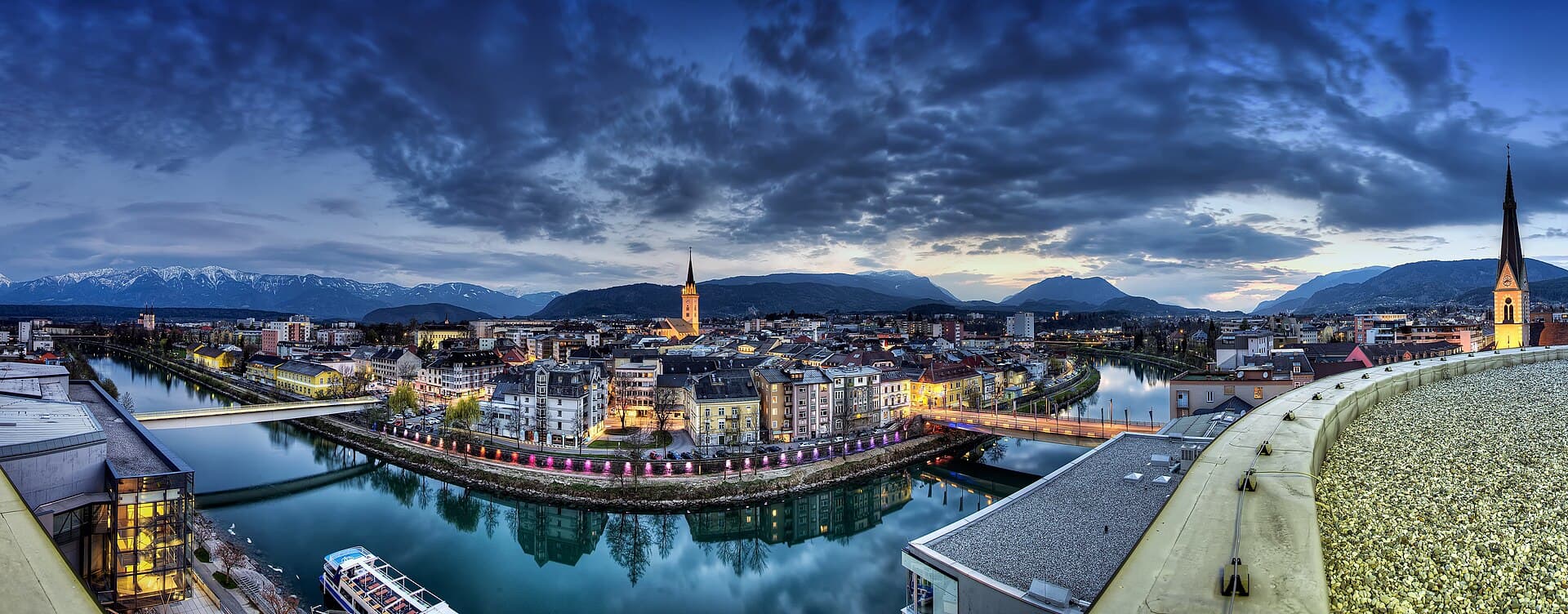 Roland Ster / CC BY-SA 3.0, via Wikimedia Commons
“Where Alpine peaks meet a Mediterranean rhythm.”
Not the postcards. The stories even locals don't know — whispered in your ear, right where they happened.
The thermal springs of Warmbad Villach have been a source of healing and relaxation for millennia.
While little remains of Villach's medieval fortifications, a specific historical event led to their near-total disappearance.
Villach's main square, Hauptplatz, holds a unique distinction among Austrian cities.
Discover every secret of Villach
Every address, every reveal in full — in your ear, right where it happened.
You pick your stops. You walk. The voice reveals what the others miss.
No tours available yet. Check back soon — we're preparing them.
Villach, the second-largest city in Carinthia and the seventh-largest in Austria, offers a blend of Alpine scenery and a distinct Mediterranean atmosphere. Situated on the Drava River, near the borders of Italy and Slovenia, it serves as a cultural and economic hub in southern Austria. The city is a significant traffic junction for the entire Alpe-Adria region. Surrounded by mountains and clear lakes, Villach provides opportunities for both relaxation and outdoor adventure, from hiking and water sports to exploring its inviting old town.
Villach's walkable streets, historic landmarks, and cultural events contribute to its welcoming character. The city has been recognized for its commitment to sustainable development, earning the title of 'Alpine Town of the Year' in 1997. Whether seeking a tranquil escape or an adventure-filled journey, Villach serves as a compelling base for experiencing the diverse landscapes and cultural treasures of southern Austria.
The earliest human traces in the Villach area date back to the late Neolithic period (3500–1800 B.C.). The region's strategic location near an important Roman road, leading from Italy to the Noricum province, led to the establishment of a Roman road station, likely named Santicum, near the hot springs in the present-day Warmbad quarter. This ancient route, cut into rock near Warmbad Villach, was a vital path from Italy to the East Alpine region, used from prehistoric times into the post-Roman era.
After the influx of Slavic tribes around 600 AD, the area became part of the Carantania principality. The first documented mention of Villach, as 'Pons Uillah' (at the bridge of Villach), appeared in a deed by King Carloman of Bavaria in 878, indicating an important crossing over the Drava River. In 1007, Emperor Henry II ceded the settlement to the newly established Bishopric of Bamberg, which would govern Villach for over 700 years until 1759.
Villach gained market rights in 1060, fostering its commercial prosperity, and was first explicitly identified as a city around 1240. The medieval period saw Villach become a significant trade center, specializing in Italian goods and local raw materials like iron and lead. However, the city faced significant challenges, including devastating earthquakes in 1348 and 1690, and several fires. The 16th century also saw Villach become a center of Protestantism in Carinthia, leading to Counter-Reformation measures and economic decline as many residents were forced to leave.
Empress Maria Theresa formally purchased Villach and its estates for one million florins in 1759, incorporating it into the Habsburg monarchy. During the Napoleonic Wars, the city was briefly part of the French Illyrian Provinces. The arrival of the Southern Railway line in 1864 transformed Villach into a crucial transport hub, spurring growth and expansion. In World War I, it served as the seat of the 10th Army command near the Italian front. Villach was heavily bombed 52 times during World War II due to its strategic importance as a railway hub, resulting in significant damage to buildings and infrastructure. Despite the destruction, the city rebuilt and evolved into the cultural and economic center it is today.
Begin your exploration in Villach's Hauptplatz, the main square, which features cobblestone surfaces and pastel-colored buildings that evoke a Mediterranean feel. Here, you can observe the Trinity Column and find various cafes and shops. Ascend the Stadtpfarrturm, the steeple of St. Jakob's Parish Church, which stands over 300 feet tall and is the highest in Carinthia. Climbing its 239 steps offers expansive views of the city, the Drau River, and the surrounding mountains.
For a unique historical perspective, visit the Relief Von Kärnten in Schillerpark, a monumental 1:10,000 scale model depicting the entire topography of Carinthia. Discover the remnants of Villach's old city wall behind 19th and 20th-century buildings on Hans Gasser Platz. The City Museum of Villach provides a comprehensive look at the city's history, from the Neolithic period to the present day.
Relax and rejuvenate at Kärnten Therme in Warmbad Villach, where natural thermal springs, known since Roman times for their healing properties, feed modern spa facilities. For outdoor enthusiasts, the Villach Alpine Road offers a scenic drive toward Dobratsch mountain, providing elevated views of the valley and a botanical garden with over 800 Alpine plant species. Nearby, Dobratsch Nature Park offers hiking trails and impressive vistas. Consider a visit to Lake Faak or Lake Ossiach for water sports and scenic beauty, both a short drive from the city center.
Villach is a year-round destination, with each season offering distinct experiences. For warm-weather activities like hiking and water sports, the best time to visit is from late June to early September, when temperatures are pleasant. Spring (April to June) brings blooming flowers and outdoor festivals, while autumn (September to October) showcases lively fall foliage. Winter transforms Villach into a setting for skiing and snow sports, with spas and thermal baths offering relaxation.
Villach is well-connected by road and rail. You can reach the city via the A2 Süd motorway from Vienna or the A10 Tauern motorway from Salzburg. Villach Central Station (Villach Hauptbahnhof) is a key railway hub in the Alps-Adriatic region, with direct connections from Vienna and other major cities. The nearest major airport is Klagenfurt Airport (KLU), approximately 63 km away, with Salzburg Airport (SZG) also a viable option at about 147 km.
Within the city, the historic center is pedestrian-friendly, making it ideal for walking. Public transportation is available for reaching attractions further afield. The local currency is the Euro (EUR). It's advisable to check the local event calendar, as Villach hosts various festivals throughout the year, such as the Villacher Fasching and Villacher Kirchtag. Packing layers is recommended, as mountain weather can change quickly.