Praia da Franquia
The tides here create a distinctive swimming experience.
Full story unlocks in the tour
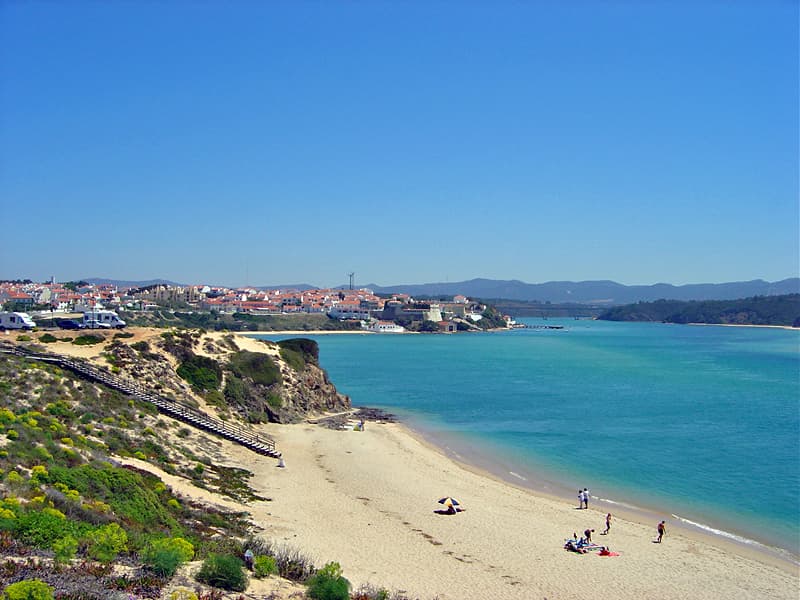 Francisco Santos (user: Xuaxo) / CC BY-SA 3.0, via Wikimedia Commons
“Where the Mira River meets the Atlantic, a coastal escape unfolds.”
Not the postcards. The stories even locals don't know — whispered in your ear, right where they happened.
The tides here create a distinctive swimming experience.
This fishing harbor holds a secret about its age.
A monument here commemorates an extraordinary journey.
Discover every secret of Vila Nova de Milfontes
Every address, every reveal in full — in your ear, right where it happened.
You pick your stops. You walk. The voice reveals what the others miss.
No tours available yet. Check back soon — we're preparing them.
Vila Nova de Milfontes, a captivating town on Portugal's Alentejo coast, offers a blend of serene river beaches and dramatic Atlantic shores. Situated at the mouth of the Mira River, within the Southwest Alentejo and Vicentine Coast Natural Park, it's a destination that enchants with its whitewashed houses, charming streets, and expansive natural beauty. This former fishing village has evolved into a popular holiday spot, particularly favored by Portuguese families, yet it retains an authentic, unhurried pace outside of the peak summer months.
The town's unique geography, where the calm Mira River meets the powerful Atlantic Ocean, provides a diverse landscape. Visitors can enjoy tranquil estuary beaches ideal for families, or venture to wilder, windswept stretches perfect for surfing and dramatic coastal walks. Beyond its appealing coastline, Vila Nova de Milfontes serves as an excellent base for exploring the wider Alentejo region, with its cork oak plains and picturesque villages.
Vila Nova de Milfontes was officially established in 1486 by a royal decree from King John II of Portugal. The aim was to foster economic growth along the Alentejo coast and provide a defensive outpost against pirate incursions from the Atlantic. This charter transformed a sparsely populated area at the mouth of the Mira River into a strategic fluvial-maritime port, facilitating maritime trade of goods like cereals, cork, honey, and wine.
However, its strategic coastal location also made it vulnerable. Between the 16th and 18th centuries, Vila Nova de Milfontes faced repeated threats and attacks from pirates. A particularly devastating corsair attack in 1590 nearly destroyed the village entirely. In response to these threats, King Philip II ordered the construction of the Forte de São Clemente between 1599 and 1602. This fort, also known as Milfontes Castle, was built to protect the village and the entrance to the Mira River.
While its early economy was rooted in fishing and maritime trade, Vila Nova de Milfontes also holds a unique place in aviation history. On April 7, 1924, it was the departure point for the first air crossing between Portugal and Macau, undertaken by pilots Brito Paes and Sarmento Beires. This monumental journey covered nearly 17,000 kilometers over 117 hours and 41 minutes, though it required two planes to reach Macau more than two months later.
In the 19th century, administrative reforms integrated Vila Nova de Milfontes into the municipality of Odemira. Today, with a population of around 5,660 residents as of the 2021 census, the town has largely transitioned from its reliance on fishing and cork production to a thriving tourism industry. Landmarks such as the 16th-century Igreja Matriz (Mother Church) and the Chapel of São Sebastião reflect its enduring cultural legacy.
Begin your exploration at the Forte de São Clemente, a 16th-century fortress that once guarded the Mira River estuary from pirate attacks. From its vantage point, you can take in expansive views of the river, the Atlantic, and the town itself. A walk along the Avenida Marginal leads to the Vila Nova de Milfontes Lighthouse, offering another panoramic perspective, especially captivating at sunset.
For beach enthusiasts, Praia da Franquia is the town's primary beach, offering calm, sheltered waters along the Mira River estuary, making it suitable for families. Across the river, accessible by a ferry during high season, lies Praia das Furnas, known for its clear waters and soft sands, with both river-facing and Atlantic-facing sections. North of town, Porto das Barcas is a small, traditional fishing port where you can observe daily fishing activities and enjoy fresh seafood at a nearby restaurant. Further afield, Praia do Almograve, about 8km from town, is celebrated for its dramatic scenery, large surfing waves, and golden sands.
The best time to visit Vila Nova de Milfontes is during spring (March to May) and early autumn (September to October). During these months, the weather is pleasant with mild temperatures, fewer crowds, and the surrounding Alentejo landscape is lush with wildflowers. The weather is reliably good for beach activities from mid-May until the end of September. While summers (July and August) are warm and bustling with Portuguese holidaymakers, the ocean breezes moderate the intense sun. Winters are mild but can be unpredictable with a higher chance of rain.
Vila Nova de Milfontes is approximately a 2.5-hour drive south of Lisbon. Renting a car is recommended for flexibility, especially if you plan to explore the surrounding Alentejo coast and nearby towns like Porto Covo or Zambujeira do Mar. Public bus services are available from Lisbon and other major Alentejo cities, with Rede Expressos and FlixBus offering routes.
Within the town, walking is the best way to get around the charming streets and reach local beaches. Bicycles are also a popular choice for shorter distances. During the summer, the town becomes lively, with a wide array of restaurants and bars, some offering nightlife. However, many establishments may close during the winter season. It's advisable to book accommodations in advance during peak summer months.