Roman Temple of Vic
This ancient Roman temple stood for centuries, yet its exact location remained a mystery until a surprising discovery in the late 19th century.
Full story unlocks in the tour
 Enric / CC BY-SA 4.0, via Wikimedia Commons
“Where Roman echoes meet medieval grace in Catalonia's heart.”
Not the postcards. The stories even locals don't know — whispered in your ear, right where they happened.
This ancient Roman temple stood for centuries, yet its exact location remained a mystery until a surprising discovery in the late 19th century.
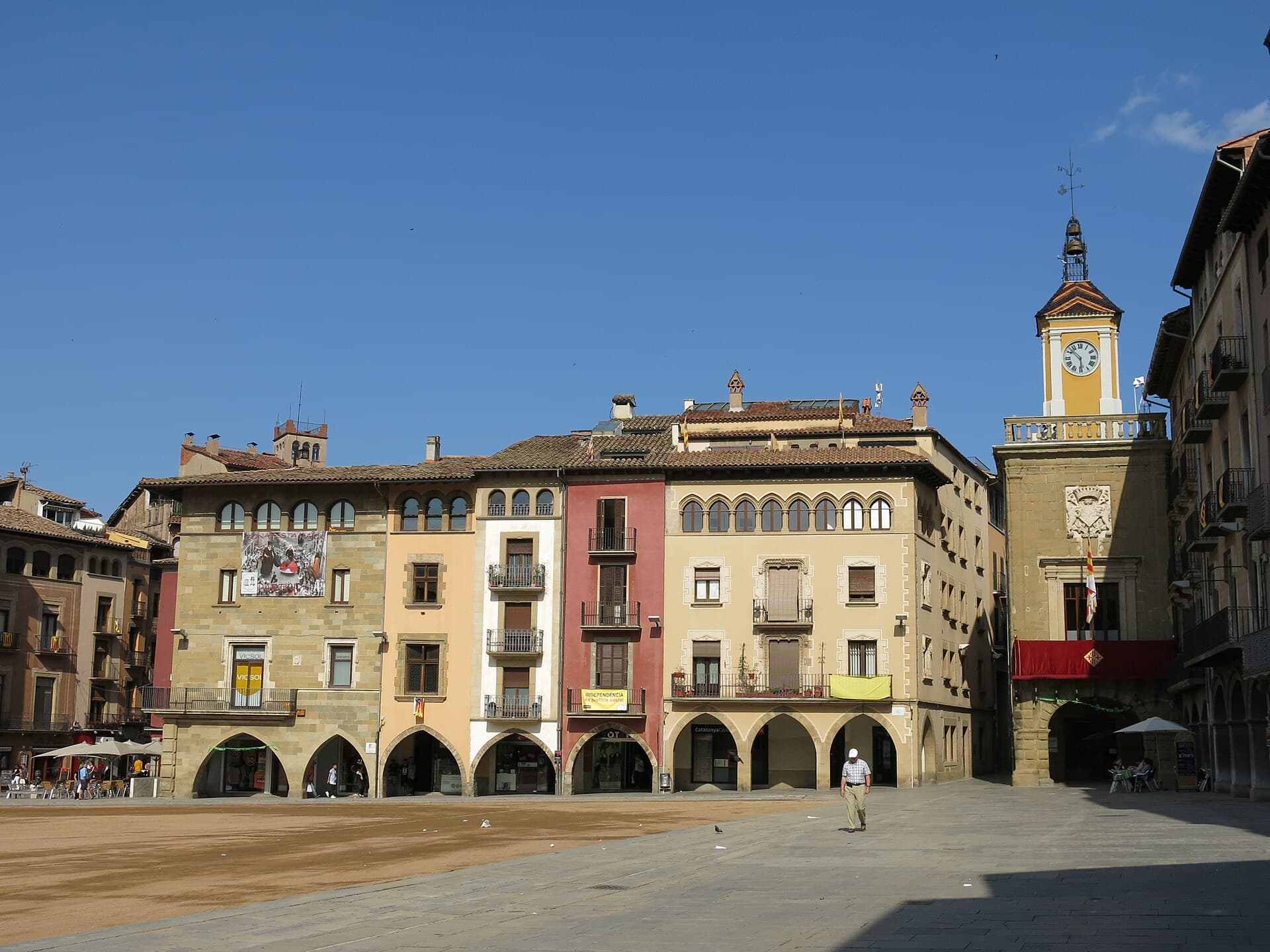
Unlike many European city squares, Vic's main plaza maintains a distinctive ground covering that has been preserved for centuries.
The striking murals inside Vic Cathedral have a dramatic past, having been destroyed and meticulously recreated.
Discover every secret of Vic
Every address, every reveal in full — in your ear, right where it happened.
You pick your stops. You walk. The voice reveals what the others miss.
No tours available yet. Check back soon — we're preparing them.
Vic, the capital of the Osona region in Catalonia, Spain, offers a journey through time, blending Roman origins with a well-preserved medieval core. Situated on the banks of the Meder River, this inland city provides a distinct contrast to the coastal bustle, offering a more tranquil and authentic Catalan experience.
The city's historical significance is evident in its architecture, from the unexpected Roman Temple to its imposing Neoclassical cathedral. Vic is a city designed for exploration on foot, with its narrow streets and a central square that has served as the city's hub for centuries.
Beyond its historical landmarks, Vic is a thriving cultural and gastronomic center, celebrated for its traditional markets and local cuisine, particularly its cured meats. It's a place where history, culture, and everyday life intertwine, creating a welcoming atmosphere for visitors seeking a deeper connection with Catalonia.
The origins of Vic trace back to the 1st century AD when the Romans established the tributary city of Auso, following their defeat of the ancient Iberian tribe, the Ausetani. This Roman settlement was strategically located on a hill near the Mèder River and served as an administrative and ecclesiastical center, even supporting a temple at its highest point.
Following the Saracen invasion in the early 8th century, the original Roman structures were largely destroyed. The city was later rebuilt around 878 by Count Wilfred the Hairy, who re-established the episcopal see. The new town was named Vicus Ausonensis, meaning 'suburb of Ausona,' which eventually evolved into the name Vic. During the Middle Ages, Vic flourished as a significant commercial and religious hub. The city was notably divided into two jurisdictions: one under the bishop and the other under the Lords of the Montcada Castle. This period saw the construction of the Romanesque cathedral, consecrated in 1038 under Bishop Oliba, and the development of the Mercadal (Market Square), which became the focal point of the growing city.
Vic experienced periods of stagnation due to late medieval crises, internal conflicts, and wars with France. However, the 18th century brought an economic and demographic upturn, leading to the construction of many civic and religious buildings, including the present-day cathedral. The city also played a role in the War of the Spanish Succession, supporting Archduke Charles of Austria. In the 19th century, Vic faced challenges from the Peninsular War and the Carlist Wars, alongside an economic crisis. Despite these historical upheavals, Vic has gradually regained its importance in Catalonia, preserving its enduring heritage while embracing modernity.
Begin your exploration at the Plaça Major, the heart of Vic, a grand arcaded square where a lively market has been held since the 9th century every Tuesday and Saturday. The square's unpaved, sandy surface is a unique traditional feature. Surrounding the square are various architectural styles, including the city hall and charming cafes.
Just a short walk from the main square, discover the Roman Temple of Vic. Dating from the 2nd century AD, this remarkably preserved structure was only uncovered in 1882 during the demolition of the Montcada Castle, which had enveloped it for centuries. The temple features a cella and an atrium with eight columns, and its interior often hosts art exhibits.
The Cathedral of St. Peter the Apostle (Catedral de San Pedro de Vic) showcases a blend of Romanesque, Gothic, Baroque, and Neoclassical styles. Notable features include the 11th-century Romanesque bell tower, the crypt, and the Gothic cloister. Inside, admire the powerful murals by Josep Maria Sert, which were repainted after being destroyed during the Spanish Civil War. Adjacent to the cathedral is the Episcopal Museum of Vic (Museu Episcopal de Vic), home to an impressive collection of Catalan Romanesque and Gothic art, including paintings and sculptures.
Other points of interest include the Pont de Queralt, an 11th-century Romanesque bridge, and the remains of Castell dels Montcada near the Roman Temple.
The best times to visit Vic are during spring (April to June) and early autumn (September to October). These months offer mild and pleasant weather, ideal for exploring the city's historical sites and enjoying outdoor activities without the peak summer crowds. Spring brings blooming flowers and cultural festivals, while autumn offers comfortable temperatures and harvest celebrations. Summers can be warm, with average highs in July around 85°F (29°C), making it suitable for those who enjoy warmer weather and local festivals. Winters are generally mild, with average lows in January around 30°F (-1°C), providing a quieter experience for museum visits and indoor attractions.
Vic is easily accessible by public transport from major cities like Barcelona and Girona. From Barcelona, you can take the e12 bus service (approximately 1 hour) or the Renfe Rodalies R3 train line (approximately 1 hour 15 minutes), with both stations conveniently located in the city center. If driving, take the C17 highway from the Barcelona area or the C-25 road from Manresa-Lleida or Girona. Free parking is available in public car parks about a 15-minute walk from the city center, and paid blue zone surface parking or underground car parks are also an option.
The city is highly walkable, making it easy to explore on foot. The local currency is the Euro (€). Catalan and Spanish are the languages spoken. For comprehensive information and guided tours, visit the Tourist Office, where you can also obtain a guide booklet or use QR codes for a self-guided route.