The Fork
A colossal fork rises from Lake Geneva, an unexpected silhouette against the mountains and water.
Full story unlocks in the tour
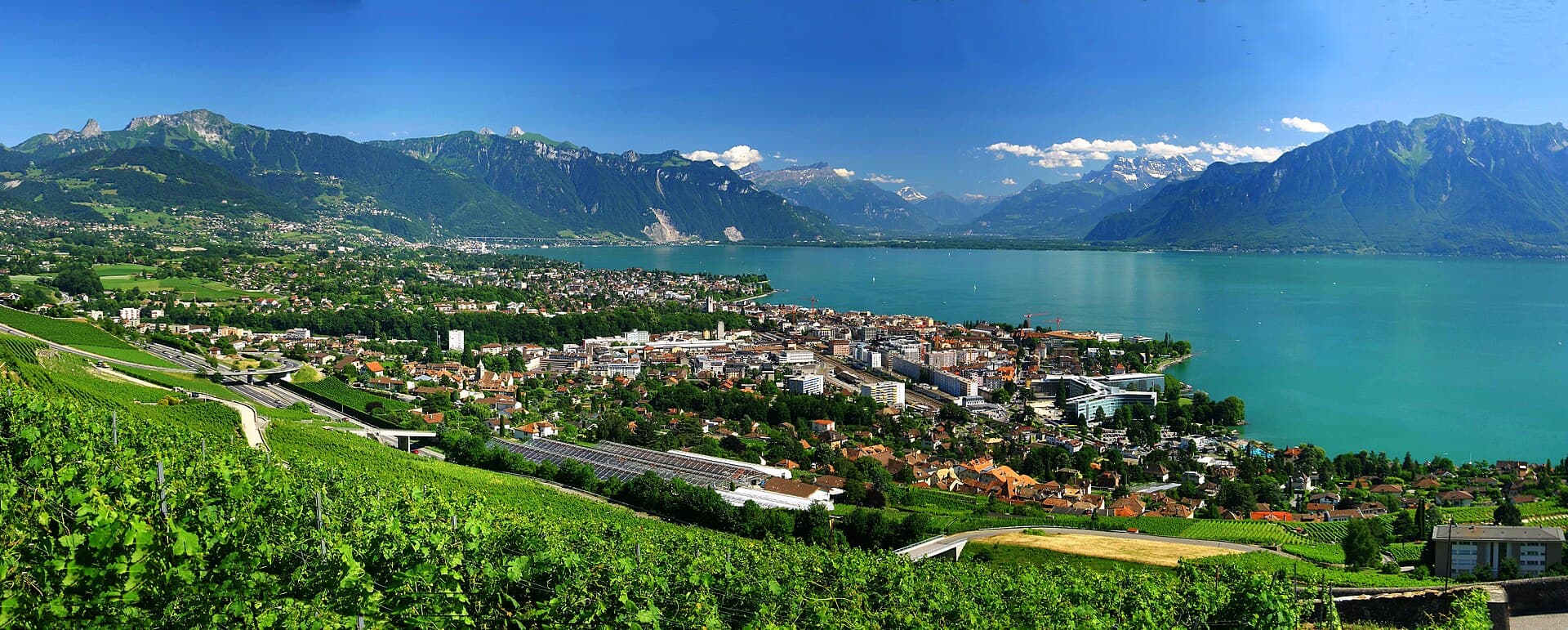 Foto-Falk / CC BY 3.0, via Wikimedia Commons
“Where the Alps embrace Lake Geneva, and enduring narratives unfold.”
Not the postcards. The stories even locals don't know — whispered in your ear, right where they happened.
A colossal fork rises from Lake Geneva, an unexpected silhouette against the mountains and water.
Charlie Chaplin, the silent film icon, spent his final quarter-century within a manor overlooking Lake Geneva.
Vevey's main square holds a particular table where a renowned philosopher once dined.
Discover every secret of Vevey
Every address, every reveal in full — in your ear, right where it happened.
You pick your stops. You walk. The voice reveals what the others miss.
No tours available yet. Check back soon — we're preparing them.
Vevey, a delightful town on the northern shore of Lake Geneva in the canton of Vaud, presents a fusion of natural splendor, cultural depth, and historical intrigue. Its gentle climate and scenic environment, offering vistas of the Alps, have long drawn artists, thinkers, and those seeking quietude. The town is part of Switzerland's French-speaking region, and while French is the primary language, English is broadly understood, particularly in larger cities and diverse cantons.
Vevey's appeal extends beyond its landscape. It is a place where significant cultural and industrial stories have unfolded, from the creation of milk chocolate to becoming the headquarters of a global food enterprise. The town's lakeside promenade, graced with palm trees and vivid flowers, invites unhurried walks, while its museums and festivals provide engaging experiences. Whether you are drawn to its artistic connections, culinary innovations, or simply the serene lakeside atmosphere, Vevey offers a distinctive Swiss encounter.
Vevey's history reaches back to the 2nd millennium BC, with evidence of a piloti settlement. Under Roman governance, it was known as Viviscus or Vibiscum and was first noted by the ancient Greek astronomer Ptolemy as Ouikos. Unlike many Roman cities that began as military encampments, Vevey originated as a civilian settlement and served as an important station on the strategic route connecting Italy and Gaul via the Great St. Bernard Pass.
During the Middle Ages, Vevey was a stop on the Via Francigena, a significant thoroughfare for travelers. It was successively governed by the bishopric of Lausanne and the Blonay family. In the 14th century, the House of Savoy granted the city its rights, encouraging commerce. The town came under Bernese administration in 1536, a period during which it embraced Reformation ideals and new administrative structures. In the 1660s, several English regicides, involved in the execution of King Charles I, found sanctuary and settled in Vevey under the protection of the Bernese government.
Vevey experienced a period of growth after the Vaud Revolution of 1798. In 1803, it became part of the new sovereign Canton of Vaud, joining the Swiss Confederation. The 19th century witnessed considerable industrial expansion, including mechanical engineering, food production (notably Nestlé), and tobacco. Vevey has been a significant center for the Swiss chocolate industry since the 18th century, with the Cailler factory established in 1819. Daniel Peter, with the assistance of Henri Nestlé, created milk chocolate in Vevey in 1875. The completion of the waterfront in 1842 marked the beginning of Vevey's evolution into a distinguished tourist destination. The town's gentle climate and scenic location continued to attract notable figures, including Charlie Chaplin, who resided here from 1952 until his passing in 1977.
Begin your exploration along the lakeside promenade, offering views of Lake Geneva and the Alps. Here, you will find the iconic Charlie Chaplin statue, commemorating the beloved comedian who spent his later years in Vevey. Just offshore, the distinctive Fork of Vevey emerges from the lake, an 8-meter stainless steel sculpture that is a popular photo opportunity and a symbol of the nearby Alimentarium.
Delve into the town's culinary connections at the Alimentarium, the world's first museum dedicated to food, founded by Nestlé. For film enthusiasts, Chaplin's World, located in his former manor house in Corsier-sur-Vevey, offers an immersive journey through his life and career, complete with recreated film sets. Wander through Vevey's Old Town, a network of narrow, pedestrian-friendly streets with fountains, statues, and historical buildings. The Grande Place hosts a lively market on Tuesdays and Saturdays. Consider a visit to the Musée Jenisch, home to fine art, or the Musée suisse de l'appareil photo (Swiss Camera Museum). For a unique perspective, take the funicular up Mont Pèlerin for sweeping views. The nearby Lavaux vineyards, a UNESCO World Heritage site, offer terraced landscapes ideal for walks and wine tasting.
Vevey offers a pleasant experience throughout the year due to its mild climate influenced by Lake Geneva. The most agreeable weather for warm-weather activities is from late June to mid-September, with average daytime temperatures around 22°C (72°F). May and September are often considered ideal, providing mild temperatures, blossoming flowers, and the Lavaux vineyards at their most beautiful, often with fewer crowds and better hotel rates than the peak summer months. While July can be warm, it also coincides with the Montreux Jazz Festival nearby, which can lead to higher hotel prices and larger gatherings. Winters are cool but moderate, with average temperatures around 0°C to 3°C (32°F to 37°F), creating a classic European winter atmosphere with occasional snow.
Vevey is readily accessible by public transport. The Vevey railway station is a central point with frequent train services to cities like Lausanne, Geneva, and Montreux. The station also serves as a terminus for local lines, including a funicular to Mont Pèlerin and a trolleybus line connecting to nearby towns. Several bus lines also operate from Vevey Gare, providing convenient local transportation. The city center is approximately 0.21 kilometers from the train station, easily reachable by bus, train, or taxi.
French is the primary language spoken in Vevey, as it is in the French-speaking canton of Vaud. However, English is broadly spoken, especially in tourist areas. The local currency is the Swiss Franc (CHF). While car rental services are not available directly at Vevey station, parking is provided. Be mindful of Switzerland's noise regulations, especially during quiet hours (typically 10 PM to 7 AM).