Vernazza's train station
The word for 'room' in Vernazza's local dialect isn't Italian.
Full story unlocks in the tour
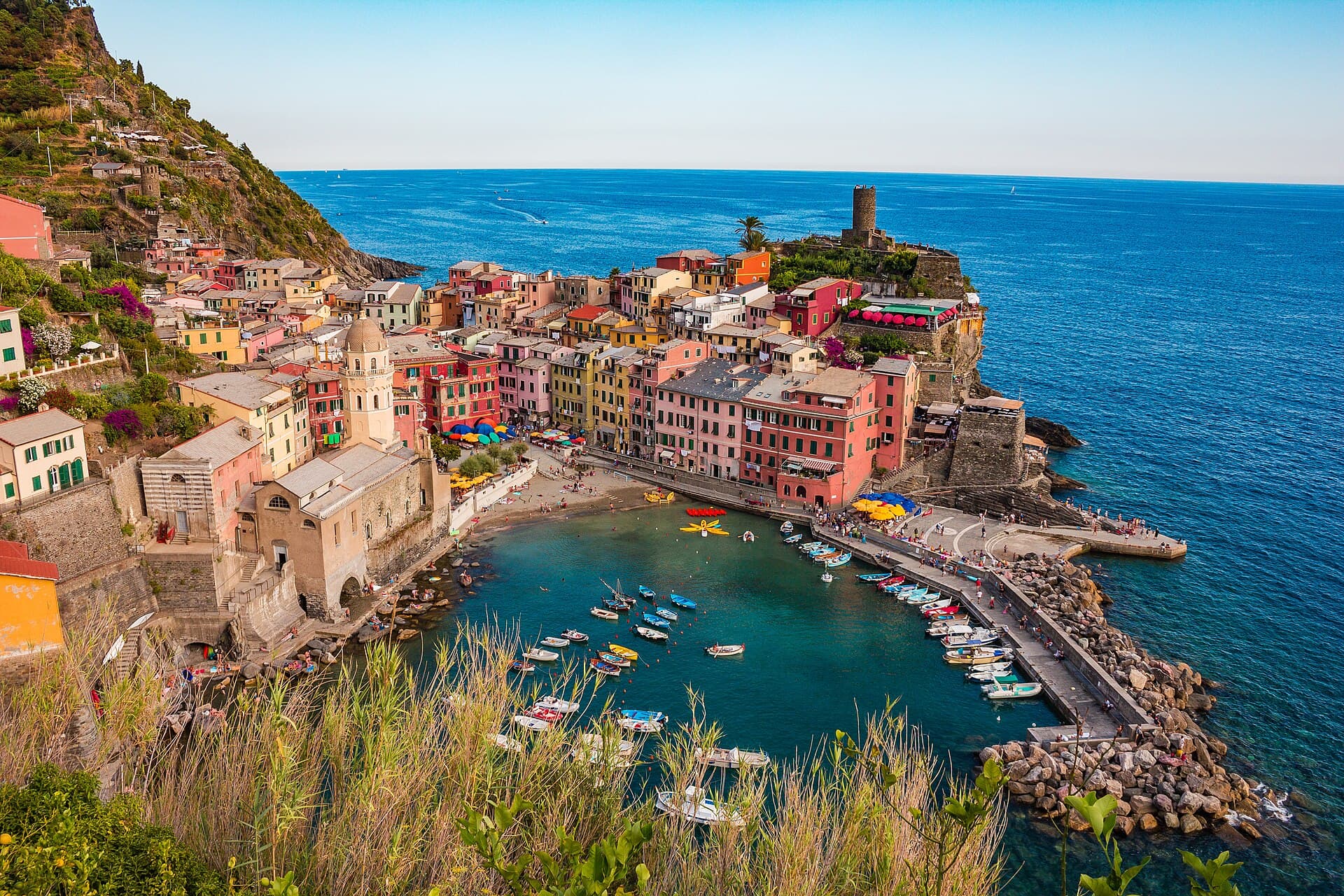 https://www.flickr.com/photos/150594450@N07/ / CC BY 2.0, via Wikimedia Commons
“Where colorful houses ascend from cliffs and the Ligurian Sea murmurs ancient stories.”
Not the postcards. The stories even locals don't know — whispered in your ear, right where they happened.
The word for 'room' in Vernazza's local dialect isn't Italian.
This seaside church has a curious origin story involving a lost and found relic.
Before the main square and breakwater existed, Vernazza's relationship with the sea was far more intimate.
Discover every secret of Vernazza
Every address, every reveal in full — in your ear, right where it happened.
You pick your stops. You walk. The voice reveals what the others miss.
No tours available yet. Check back soon — we're preparing them.
Vernazza, a luminous village in the Cinque Terre, presents a scene where pastel-colored houses rise directly from a small, natural harbor, creating a picturesque tableau. It is often considered the most visually appealing of the five Cinque Terre villages, offering an intimate perspective of the Ligurian coast. Without car traffic, Vernazza retains the authentic character of a traditional fishing village, inviting visitors to explore its narrow lanes, steep stairways, and charming piazza.
Beyond its visual appeal, Vernazza provides a balanced experience for travelers. It offers excellent local food, rewarding hiking trails, and unique swimming spots. Whether you arrive by train, stepping out into the heart of the village, or by boat, gazing up at the panoramic skyline, Vernazza captivates with its blend of natural beauty and centuries-old charm.
The first records of Vernazza as a fortified town date back to 1080, when it served as an active maritime base for the Obertenghi, a powerful Italian noble family. Its strategic location made it a crucial point of departure for naval forces defending against pirate raids. The village's name itself is thought to derive from the Latin adjective verna, meaning "native," or from the indigenous Vernaccia wine.
Vernazza's allegiance shifted to the Republic of Genoa in 1209, a pivotal moment that solidified its role as a commercial maritime hub. Genoa further fortified the port, building a shipyard and defenses against pirates, which allowed villagers to move from the hillsides to construct the seaside settlements seen today. The Doria Castle, with its cylindrical stone tower, was originally built by the Obertenghi in 1056 and later expanded by Genoa, serving as a crucial defensive fortress. The Church of Santa Margherita d'Antiochia, a prominent landmark, dates its foundations to 1318, with significant expansions throughout the 16th and 17th centuries.
The 15th century saw Vernazza focusing its defenses against persistent pirate attacks, leading to the erection of a fortifying wall. However, the mid-17th century brought a period of decline, impacting wine production and delaying infrastructure projects like the trail system and harbor breakwater. The 19th century marked a resurgence, with renewed wine production and the creation of new terraced hillsides, revitalizing the village's commerce. The arrival of the train line in 1874 connected Vernazza to Genoa and La Spezia, ending its relative isolation, though mass tourism didn't truly take hold until the 1980s, accelerating after the area became a UNESCO World Heritage Site in 1997. Today, tourism is the primary economic driver, though fishing, olive oil, and wine production remain integral to local culture.
On October 25, 2011, Vernazza was devastated by a catastrophic flood. The village was buried under mud and rocks, with ground floors of homes and businesses disappearing. Despite the extensive damage, the community, with external support, undertook an incredible effort to rebuild. One unexpected outcome of the flood was the creation of a new rocky beach, a testament to nature's powerful forces.
Begin your exploration in Piazza Marconi, the main square, which sits at the heart of the village, facing the marina. From here, the Church of Santa Margherita d'Antiochia, with its distinctive octagonal bell tower from the 17th century, is a prominent sight, its foundations laid directly on the rocks by the sea. Wander through the caruggi, the narrow, steep alleys and stairways that crisscross the village, revealing interesting statues, carvings, and doorways.
For expansive views, climb to the Doria Castle, a medieval fortress with a cylindrical stone tower that offers a 360-degree vista of Vernazza, the Mediterranean, and neighboring villages. Another remnant of medieval fortifications, the Belforte tower, now houses a restaurant and provides another excellent viewpoint. Vernazza offers two main beach areas: a small, sandy/pebble area right by the main piazza, ideal for a quick dip, and a more rugged, rocky cove accessible via a short tunnel near the main square, created after the 2011 flood. You can also stroll along the breakwater, admiring the sea and hillsides, or take a boat tour to see the village from the water.
For optimal weather and manageable crowds, plan your visit to Vernazza during May, June, or September. During these months, the weather is warm enough for swimming and hiking, and while busy, the village is not yet overwhelmed by peak season tourism. July and August bring the warmest temperatures (averaging highs of 78-80°F or 26-27°C) but also the largest crowds, making early starts essential to avoid congestion. The cooler months from October to April offer a quieter, more authentic experience, though some trails may be closed due to weather, and rain is more frequent in October and November.
Vernazza is a car-free village, so the most practical way to arrive is by train. The Vernazza train station is conveniently located at the top of Via Roma, the main street, providing easy access to the harbor, Piazza Marconi, and accommodations. Regional trains, specifically the Cinque Terre Express, connect all five villages, running frequently throughout the day. If traveling from other parts of Italy, you'll likely connect in La Spezia or Levanto.
Ferries also operate seasonally, connecting the Cinque Terre villages and offering a scenic way to view the coastline. While Vernazza has limited accommodation, booking early is advisable, especially during peak season. Many accommodations are privately owned, with a few small hotels offering sea views. Be prepared for steep, narrow stairs to reach many accommodations, and consider packing light.