Vercelli Cathedral
Within the Duomo's treasury lies a manuscript that speaks a language far from Italian, a relic of a distant land.
Full story unlocks in the tour
 Alessandro Vecchi / CC BY-SA 3.0, via Wikimedia Commons
“Where ancient history meets the rhythm of rice fields.”
Not the postcards. The stories even locals don't know — whispered in your ear, right where they happened.
Within the Duomo's treasury lies a manuscript that speaks a language far from Italian, a relic of a distant land.
This early Gothic masterpiece was built with an unexpected source of funding.
The striking Moorish Revival architecture of Vercelli's synagogue tells a story of newfound freedom and aspiration.
Discover every secret of Vercelli
Every address, every reveal in full — in your ear, right where it happened.
You pick your stops. You walk. The voice reveals what the others miss.
No tours available yet. Check back soon — we're preparing them.
Vercelli, a city in Italy's northern Piedmont region, presents layers of history visible in its streets and architecture. Situated along the Sesia River in the Po River Valley, between Turin and Milan, Vercelli has been an important crossroads for millennia. Known as Europe's rice capital, the surrounding landscape is characterized by expansive, often-flooded rice paddies that stretch to the horizon.
Beyond its agricultural significance, Vercelli offers a compact historic center with medieval towers, noble palaces, and a deep artistic heritage. It was an essential stop for pilgrims on the Via Francigena, the ancient route connecting Canterbury to Rome, and its cultural depth continues to surprise visitors.
Vercelli's origins trace back to prehistoric times, with evidence of habitation before the advent of writing. The Ligurians and later Celtic tribes dominated the area before the Romans arrived in the 2nd century BCE. Known as Vercellae, it became an important Roman municipium, strategically positioned on a road connecting Piacenza to the Alps. The nearby Campi Raudii were the site of two significant battles: Hannibal's first victory on Roman soil in 218 BCE and the Roman General Marius's defeat of the Cimbri in 101 BCE.
After the fall of the Roman Empire, Vercelli became a Lombard Duchy and later a county seat during the Carolingian Period. It emerged as a powerful independent republic in 1120, its medieval statutes notably abolishing serfdom in 1197. The city also hosted the world's first publicly funded university in 1228, which was a transfer of the University of Pavia and remained in Vercelli until the 14th century. Throughout the Middle Ages, Vercelli played a role in the struggles between Guelph and Ghibelline factions and was allied with the Lombard League against Barbarossa.
The city eventually fell under the control of the Visconti family of Milan in 1335 and then the House of Savoy in 1427. Vercelli faced occupations by the Spanish from 1638 to 1659 and briefly by the French in 1704, who dismantled its fortifications. After Napoleon's fall, Vercelli returned to Savoyard rule in 1814. In the 20th century, Vercelli became recognized as the European capital of rice, transforming its surrounding landscape and economy.
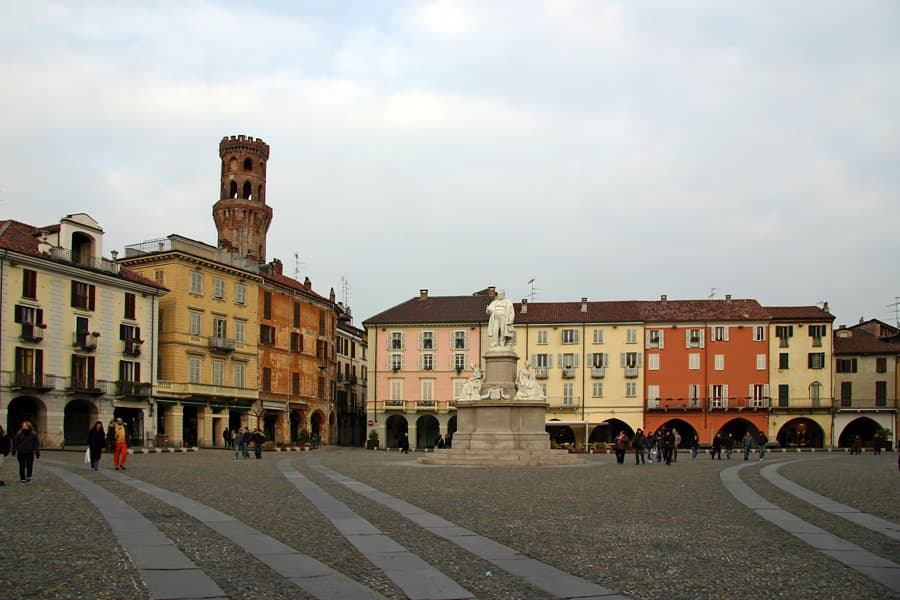
Begin your exploration in Piazza Cavour, the city's economic heart, surrounded by arcades and dominated by the 15th-century Torre dell'Angelo. Nearby, the Basilica di Sant'Andrea stands as a striking example of early Italian Gothic architecture, completed in 1227, with its distinctive polychrome marble and a detached 15th-century bell tower.
The Vercelli Cathedral, or Duomo di Sant'Eusebio, dedicated to Vercelli's first bishop, features a Baroque facade and houses a monumental silver crucifix dating back to around the year 1000. Within the cathedral complex, the Museo del Tesoro del Duomo displays a rich collection of sacred art and the unique Vercelli Book.
Do not overlook the Chiesa di San Cristoforo, often called the 'Sistine Chapel of Vercelli,' known for its frescoes by Gaudenzio Ferrari. The imposing Visconti Castle, dating from the 13th century, offers a glimpse into the city's medieval past. For a unique cultural experience, visit the Vercelli Synagogue, an impressive Moorish Revival-style building inaugurated in 1878.
Art enthusiasts will appreciate the Museo Borgogna, housed in a neoclassical home, featuring a collection of Piedmontese art from the Renaissance to the 19th century. The Luigi Bruzza Civic Archaeological Museum traces the evolution of Vercelli through over 600 artifacts. Finally, experience the expansive rice fields surrounding Vercelli, particularly picturesque when flooded between April and May, offering scenic routes for cycling.
The best times to visit Vercelli are during the spring (April to June) and autumn (September to October). During these months, the weather is mild and pleasant, ideal for exploring the city's historical sites and engaging in outdoor activities. Spring, particularly April and May, offers the unique spectacle of flooded rice fields, creating a 'checkered sea' effect. Autumn brings the rice harvest and a focus on local food festivals. Summers can be hot and humid, while winters are typically cold, damp, and often foggy.
Vercelli is easily accessible by train and road, with Milan Malpensa Airport being the nearest major airport, about an hour's drive away. Once in Vercelli, many of the city's attractions are within walking distance due to its compact size. For longer distances, local buses, taxis, or rented bicycles are available.
The local currency is the Euro (€), and ATMs are widely available throughout the city. Credit and debit cards are generally accepted. When visiting churches and historical sites, it is respectful to observe local customs and traditions. Learning a few basic Italian phrases like "grazie" (thank you) and "per favore" (please) can enhance your experience. Be sure to savor the local cuisine, especially rice-based dishes like panissa, and the renowned wines of the Piedmont region.