Our Lady's Tank
The tranquil pond, site of the first apparition, holds a surprising secret about its waters.
Full story unlocks in the tour
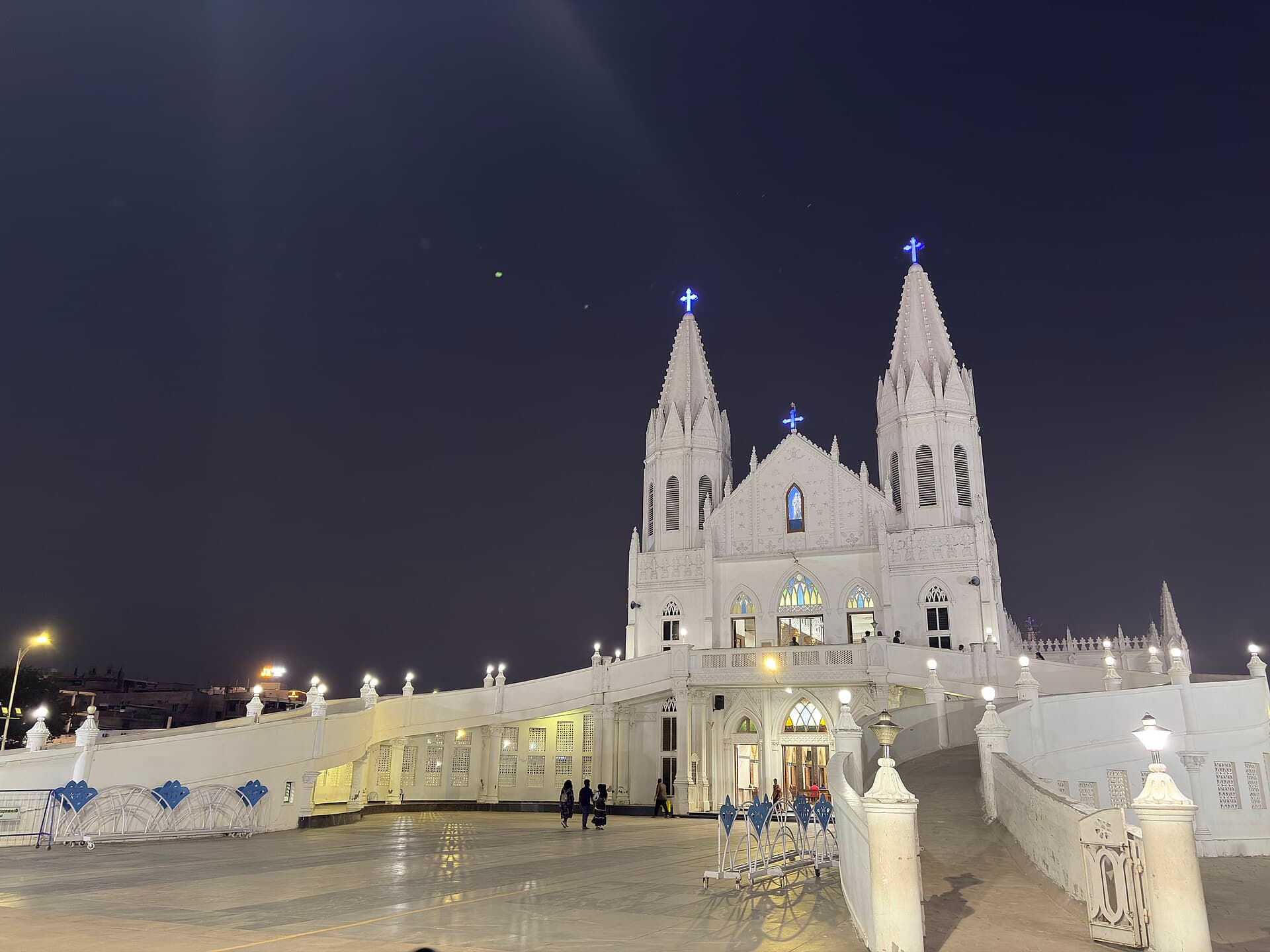 Rejoy2003 / CC BY-SA 4.0, via Wikimedia Commons
“Where the Bay of Bengal cradles profound devotion.”
Not the postcards. The stories even locals don't know — whispered in your ear, right where they happened.
The tranquil pond, site of the first apparition, holds a surprising secret about its waters.
Beyond its striking Gothic architecture, the main altar of the Basilica reveals an unexpected artistic detail.
The museum's collection of offerings is far more varied and personal than one might anticipate from a religious shrine.
Discover every secret of Velankanni
Every address, every reveal in full — in your ear, right where it happened.
You pick your stops. You walk. The voice reveals what the others miss.
No tours available yet. Check back soon — we're preparing them.
Velankanni, a coastal town in Tamil Nadu, India, stands as a significant pilgrimage destination, frequently referred to as the 'Lourdes of the East'. Situated on the Coromandel Coast, along the Bay of Bengal, it draws millions of devotees annually from diverse faiths, all seeking blessings and healing at the Basilica of Our Lady of Good Health. The town's atmosphere blends deep spiritual devotion with the gentle rhythm of daily life, its culture shaped by a unique synthesis of local Indian traditions and Catholicism.
Beyond its religious importance, Velankanni offers a distinct allure with its bustling markets, traditional cuisine, and a scenic coastline. The town's identity is deeply intertwined with the sea and the narratives of miraculous apparitions that led to the establishment of its revered shrine. Whether drawn by faith or the appeal of its serene beaches, Velankanni provides a transformative journey, where history, spirituality, and natural beauty converge.
The history of Velankanni stretches back to the 16th century, rooted in oral traditions of Marian apparitions. The first reported apparition occurred around May 1570, when a local shepherd boy, while delivering milk, encountered the Virgin Mary holding the infant Jesus near a pond beneath a banyan tree. She requested milk for her child, and upon his return, the boy discovered his milk pot miraculously refilled. This location is now known as 'Our Lady's Tank' (Matha Kulam).
A second apparition is said to have taken place in 1597, involving a boy with a limp who sold buttermilk. The Virgin Mary, again with the child Jesus, appeared and asked him to deliver a message to a gentleman in the next town, requesting a chapel be built in her honor at that spot. The boy, miraculously cured of his lameness, ran to deliver the message.
The third significant event, occurring in the late 17th century, involved Portuguese sailors caught in a severe storm in the Bay of Bengal. They prayed to the Blessed Virgin Mary, vowing to construct a church wherever they safely landed. The storm subsided, guiding their ship to Velankanni on September 8th, the Feast of the Nativity of Mary. In gratitude, they built a small chapel, fulfilling their promise.
Initially a thatched chapel, the shrine gained prominence and became a parish church in 1771. Portuguese influence is evident in the Gothic and Portuguese architectural styles of the Basilica. The structure underwent renovations in 1920 and 1933, with extensions added to the southern and northern parts. In 1962, Pope John XXIII elevated the Marian shrine to the status of a minor basilica, recognizing its spiritual significance and the influx of pilgrims. He famously called it the 'Lourdes of the East'. The Dicastery for the Doctrine of the Faith confirmed Pope Francis' approval of the devotion to Our Lady of Good Health at the Basilica in August 2024.
Today, the Basilica complex includes three chapels, a Church Museum, an Offering Centre, and the Stations of the Rosary. The town itself, once a port that traded with Rome and Greece, gradually lost its commercial importance to Nagapattinam but blossomed as a spiritual hub. Velankanni was among the areas severely impacted by the 2004 Indian Ocean tsunami, though the rising waters did not enter the main shrine.
The primary attraction in Velankanni is the Basilica of Our Lady of Good Health, a prominent Roman Catholic shrine. Its striking white exterior and red-tiled roofs display Gothic and Portuguese architectural styles. Inside, the main altar is adorned with porcelain plates depicting biblical scenes. The Basilica complex includes several chapels, a Priest's Residence, and the Church Museum, which exhibits the diverse offerings made by devotees, including gold and silver replicas of body parts, vehicles, and even a miniature church crafted from coins. Many pilgrims engage in acts of devotion, such as walking on their knees along the 'Holy Path' or having their heads tonsured.
Beyond the main Basilica, visit Our Lady's Tank (Matha Kulam), the pond where the first apparition of Mother Mary is believed to have occurred. The Morning Star Church, near the beach, offers another serene space for reflection with its graceful architecture. The Velankanni Beach itself provides a tranquil setting for strolls and observing local fishermen. Along the path to the church, you will find the Stations of the Cross and Stations of the Rosary, featuring sculptures depicting the life of Jesus and Mother Mary respectively. The town also features a lively local market where you can find religious artifacts, rosaries, and local handicrafts.
The ideal time to experience Velankanni is during the winter months, from December to February, when the weather is pleasantly cool, with average temperatures ranging from 20-28 degrees Celsius. This period is perfect for sightseeing, attending mass, and exploring the beaches. The shoulder seasons of October to November and March to May are also moderate, with temperatures between 25-35 degrees Celsius, offering a good option for those wishing to avoid peak crowds. The annual Feast of Our Lady of Good Health is a major event, celebrated from August 29 to September 8, drawing millions of pilgrims. While this is a profound spiritual experience, anticipate large crowds and higher accommodation rates.
Velankanni is accessible by various modes of transport. The nearest airport is Tiruchirappalli International Airport (Trichy), approximately 155-165 km away, with taxi services available to Velankanni. Velankanni has its own railway station, connected to Nagapattinam, which is about 12 km away. Regular buses and taxis operate from Nagapattinam to Velankanni. By road, Velankanni is well-connected to major southern cities like Chennai, Tiruchirappalli, and Pondicherry via state and private bus services.
When visiting the Basilica and other religious sites, modest attire is highly recommended. For women, traditional Indian wear like sarees or salwar kameez with a dupatta is preferred, covering shoulders and knees. Men are expected to wear full-length trousers or dhoti with shirts. While not strictly required, covering one's head in the church is considered a sign of respect. Many devotees walk barefoot as an act of devotion, so comfortable, easy-to-remove footwear is advisable. Mass timings vary by day and language; daily masses are conducted in multiple languages, including Tamil, English, Telugu, Malayalam, Konkani, and Hindi.