Keret House
Imagine a house so narrow, you might miss it if you blink.
Full story unlocks in the tour
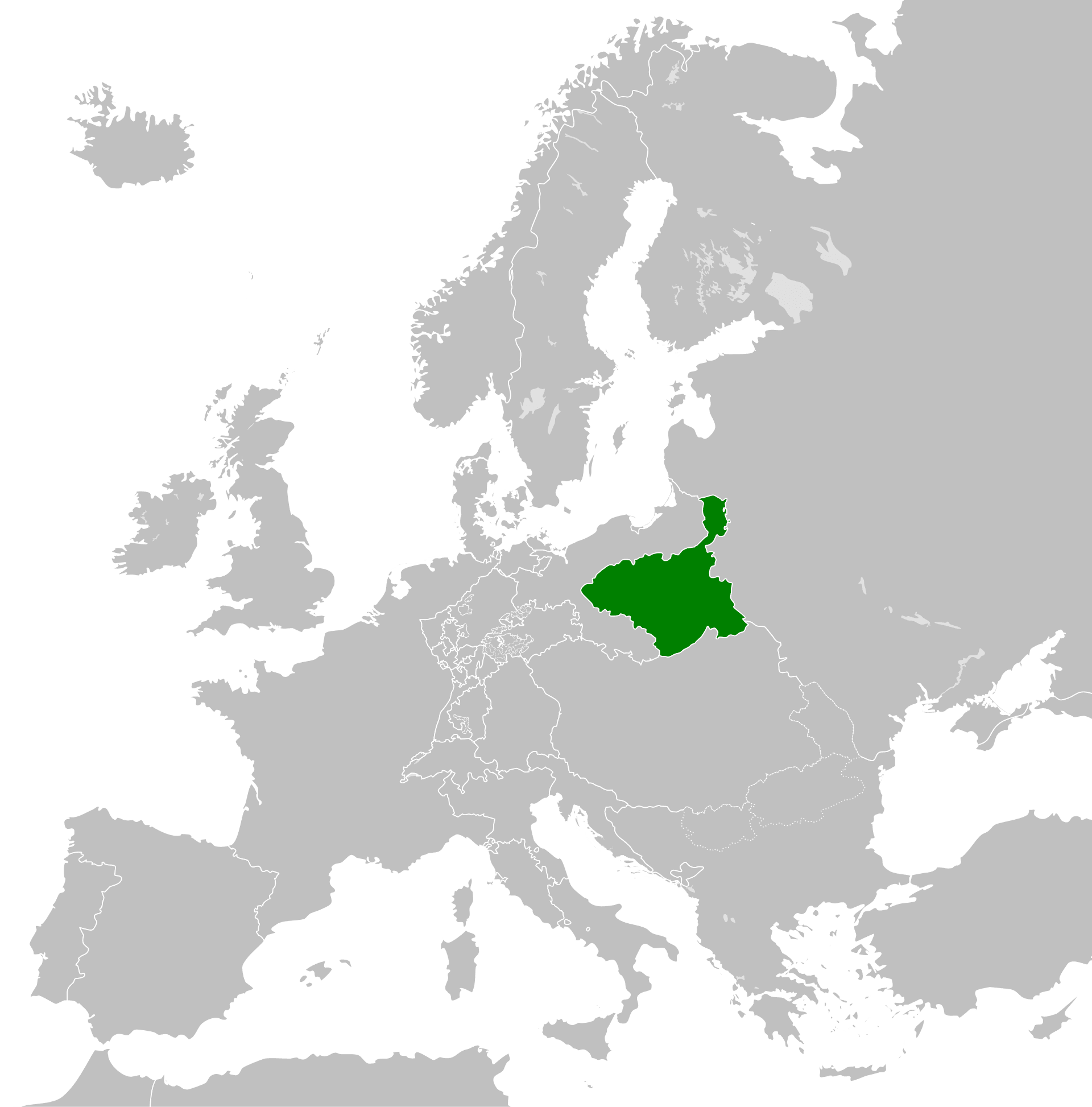 TRAJAN 117 This W3C-unspecified vector image was created with Inkscape . / CC BY-SA 3.0, via Wikimedia Commons
“Warsaw: A phoenix city, perpetually defying the storms.”
Not the postcards. The stories even locals don't know — whispered in your ear, right where they happened.
Imagine a house so narrow, you might miss it if you blink.
This towering landmark, a gift from a complicated past, holds more than just offices and museums.
Warsaw's guardian isn't a knight or a king, but a mythical creature from the depths.
Discover every secret of Varsovie
Every address, every reveal in full — in your ear, right where it happened.
You pick your stops. You walk. The voice reveals what the others miss.
No tours available yet. Check back soon — we're preparing them.
Warsaw, the capital and most populous city of Poland, stands as a testament to resilience and rebirth. Situated on the Vistula River in east-central Poland, it is a metropolis with an official population of 1.86 million residents within a greater metropolitan area of 3.27 million. Known as the "Phoenix City," Warsaw has repeatedly risen from the ashes of war, a history reflected in its motto, "Contemnit procellas" ("It defies the storms").
Beyond its powerful narrative of survival, Warsaw is a city of contrasts—blending historic, meticulously reconstructed Old Town streets with modern glass skyscrapers and Soviet-era architecture. It's a major political, economic, and cultural hub, offering a diverse range of experiences from world-class museums and theaters to expansive green spaces. Whether you're drawn to its poignant history, its contemporary scene, or its numerous parks and gardens, Warsaw continually surprises with its dynamism and cultural richness.
## From Fishing Village to Royal Capital Warsaw's origins trace back to a small fishing settlement on the banks of the Vistula River in the 13th century. By the early 14th century, it had become one of the seats of the Dukes of Masovia, eventually becoming the capital of Masovia in 1413. The town's economy flourished through crafts and trade.
In 1526, Masovia was incorporated into the Kingdom of Poland, and Warsaw quickly grew in importance. The city's prominence solidified in 1596 when King Sigismund III Vasa moved the Polish capital and his royal court from Kraków to Warsaw, making it the capital of the Polish state by 1611. This period saw the construction of elegant townhouses and the Royal Castle, transforming Warsaw into a political and cultural center.
## Eras of Conflict and Enlightenment Warsaw endured significant destruction during the Swedish and Transylvanian invasions of the mid-17th century. However, the mid-18th century brought a cultural golden age and significant modernization, with Warsaw becoming the center of the Polish Enlightenment during the reign of King Stanisław II August Poniatowski. The first lay school was opened, and the Polish theater and numerous printing establishments thrived.
Poland ceased to exist as a political entity in 1795, with its territories partitioned between Russia, Austria, and Prussia. Warsaw became the capital of a newly emergent Polish Kingdom in 1815, though it remained under Russian dominance. After regaining its sovereign independence in 1918, Warsaw was once again named the national capital.
## The Scars of World War II and Remarkable Reconstruction The 20th century brought unimaginable devastation. Nazi Germany's invasion in 1939 led to Warsaw's subjugation, and by 1943, the liquidation of the Warsaw Ghetto resulted in the district being largely wiped out. The most catastrophic period came with the Warsaw Uprising in 1944, a fierce resistance effort against German occupation. In retaliation for the uprising, Adolf Hitler ordered the city razed, with nearly 90% of its historic center systematically destroyed by fire and dynamite.
Despite the near-total destruction, the people of Warsaw, known as Varsovians, returned in 1945 and embarked on one of Europe's most ambitious reconstruction projects. The Warsaw Reconstruction Office (BOS) was established in February 1945 to oversee this monumental task. Much of the Old Town, including the Royal Castle, was painstakingly rebuilt to its pre-war appearance, often relying on 18th-century paintings by Bernardo Bellotto as blueprints. This remarkable effort, completed by 1953 for many key areas, led to Warsaw's Old Town being designated a UNESCO World Heritage site in 1980.
Begin your exploration in Warsaw's Old Town, a UNESCO World Heritage site meticulously reconstructed after wartime devastation. Wander through the Old Town Market Square, admire the colorful tenement houses, and visit the Royal Castle, once home to Polish kings. Climb the Bell Tower at St. Anne's Church for expansive views of the Old Town and Castle Square.
Delve into Warsaw's profound history at the Warsaw Uprising Museum, which powerfully chronicles the 1944 uprising, and the POLIN Museum of the History of Polish Jews, located within the former Jewish Ghetto, honoring a thousand years of Jewish heritage in Poland. For a different perspective, visit the Palace of Culture and Science, a Soviet-era landmark offering an observation deck on its 30th floor with sweeping city views.
Escape the urban bustle in Łazienki Park, a sprawling royal park featuring the iconic Palace on the Isle and a monument to Frédéric Chopin, where free concerts are held in summer. Consider a stroll along the Vistula River boulevards or explore the alternative Praga district, known for its Koneser Center and the Polish Vodka Museum.
The best time to visit Warsaw is during late spring (May to early June) or early autumn (September). These shoulder seasons offer mild temperatures, comfortable conditions for sightseeing, and fewer crowds than the peak summer months. May brings blooming parks and events like the Night of Museums. September offers pleasant weather and colorful foliage.
Summer (July and August) is active with festivals and outdoor activities, but also sees higher temperatures, more tourists, and the possibility of afternoon thunderstorms. Winters are cold and can be harsh, but the city transforms with Christmas markets and festive lights, offering significantly cheaper hotel prices.
Warsaw is a very walkable and bike-friendly city, especially in warmer months. Public transport, including a metro, trams, and buses, is efficient and easy to navigate; tickets can be purchased from machines at stops or on board. Consider using apps like Citymapper or Jakdojade for real-time transit information.
While generally safe, it's always wise to use common sense, particularly in crowded public spaces and when walking alone at night. Warsaw's weather can be unpredictable, so packing layers is advisable. Taxis are relatively affordable, and it's recommended to use those with a taximeter and ensure the correct fare (daytime: taryfa 1, nighttime/Sunday: taryfa 2) is applied. Poland's shopping ban means most stores are closed on Sundays, so plan accordingly.