Place des Lices
This lively market square once hosted a more confrontational kind of assembly.
Full story unlocks in the tour
 Foxpry / CC BY-SA 3.0, via Wikimedia Commons
“Where ancient stones recount the sagas of dukes and bold sea voyages.”
Not the postcards. The stories even locals don't know — whispered in your ear, right where they happened.
This lively market square once hosted a more confrontational kind of assembly.
Examine a 16th-century half-timbered building for a curious pair of sculpted visages.
The most ancient section of Vannes was not always contained within the city walls.
Discover every secret of Vannes
Every address, every reveal in full — in your ear, right where it happened.
You pick your stops. You walk. The voice reveals what the others miss.
No tours available yet. Check back soon — we're preparing them.
Vannes, a city in Brittany, France, offers a passage through time with its meticulously preserved medieval architecture and seaside allure. Situated on the Gulf of Morbihan, where the Marle and Vincin rivers converge with the sea, Vannes presents a fusion of historical depth and maritime splendor. Its old town, largely reserved for pedestrians, is defined by paved lanes, venerable monuments, and a collection of lively half-timbered houses. Vannes functions as an administrative and cultural nucleus for the Morbihan department, maintaining an intimate atmosphere despite its prominence.
The city's essence is shaped by its ancient defenses, the active port, and a lively cultural landscape. From wandering along the ramparts to exploring animated markets, Vannes provides a varied array of experiences. It is a place where every turning seems to narrate a story, making it a captivating destination for those drawn to history, culture, and coastal panoramas.
The beginnings of Vannes extend back over two millennia, established by the Veneti, a seafaring Celtic tribe who made it their capital. The Veneti were renowned for their naval skill, overseeing trade routes to Britain. Following Julius Caesar's conquest of Gaul in the 1st century BC, the settlement was reconstructed and renamed Darioritum, becoming a pivotal Roman administrative center in Armorica. Early fortifications were erected in the 3rd century to guard against incursions, laying the foundation for the city's future defensive structures.
In the 5th century, Vannes became a bishopric, solidifying its status as a religious hub, and the Council of Vannes was convened there in 461. After the Roman Empire's decline, the ancient city was largely forsaken, and the medieval town began to grow within new defenses, eventually adopting the name Venetis. By the mid-9th century, Nominoë, the first ruler of an autonomous Brittany, established Vannes as his residence.
Vannes truly flourished in the 14th and 15th centuries when Duke John IV selected it as the capital of the Duchy of Brittany. During this period, the city's ramparts were substantially reinforced and expanded to enclose a larger area, including the active port district. Duke John IV also built the Château de l'Hermine, which served as a ducal dwelling. The city played a critical role in the Breton Wars of Succession, changing hands multiple times. A momentous event in 1532 saw King François I reside in Vannes to prepare the treaty for the Union of Brittany and France, which formally integrated Brittany into the Kingdom of France.
While Louis XIV later disregarded and even dismantled portions of the ramparts and the Château de l'Hermine to fund his wars, the city continued to evolve. In the late 17th century, the exile of Breton parliamentarians to Vannes spurred new construction of grand residences, extending the town beyond its walls. The 19th century brought further urban development with the arrival of railways in 1862 and the establishment of new public edifices like the town hall and prefecture. Vannes largely avoided significant destruction during the Second World War, allowing its historical character to persist. Today, it stands as a testament to its long and varied past, with its medieval core and proximity to the Gulf of Morbihan attracting visitors.
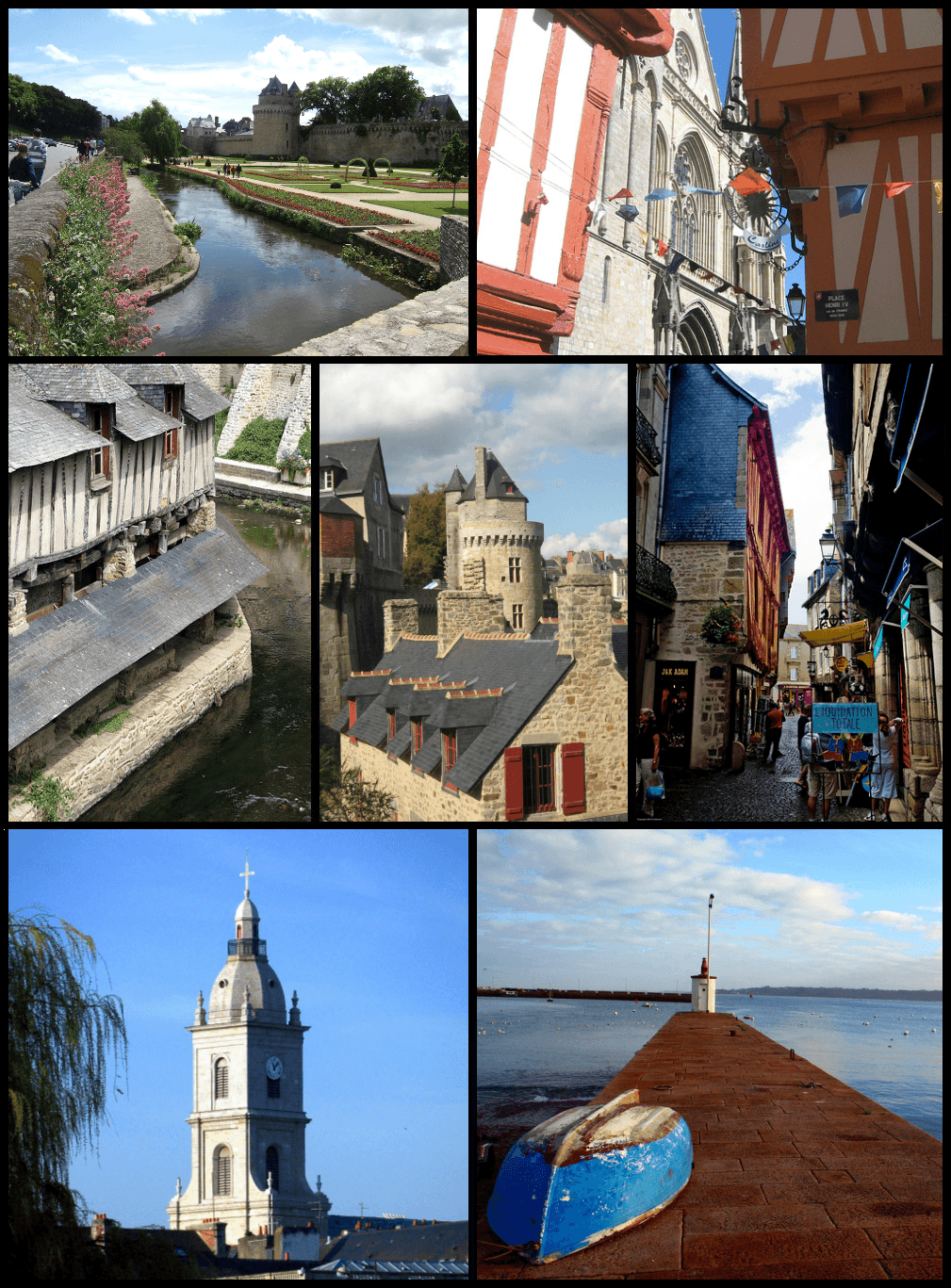
The medieval old town of Vannes is a primary draw, defined by its well-maintained ramparts, which are among the last remaining fortifications in Brittany. A walk along these walls offers expansive views and leads to the picturesque Ramparts Garden, with its meticulously kept flowerbeds and canal. The Porte Saint-Vincent serves as a grand entrance into the historic center.
Within the old town, explore the narrow, paved lanes lined with approximately 170 half-timbered houses, many painted in vivid colors. Place Henri IV is particularly noteworthy for its concentration of these historic buildings. The Cathédrale Saint-Pierre, a Gothic and Romanesque basilica, stands prominently, housing the relics of Saint Vincent Ferrier since 1419 and serving as a pilgrimage site.
La Cohue, a medieval hall that once housed market stalls and the ducal courthouse, now functions as the Vannes Fine Arts Museum, exhibiting contemporary works. The Port de Vannes, an animated harbor, is ideal for a walk, offering views of sailboats and access to boat tours of the Gulf of Morbihan. For a glimpse into everyday medieval life, seek out the surviving public washhouses (lavoirs) along the river by the ramparts.
Beyond the city walls, the Saint-Patern quarter, the oldest part of Vannes, features more half-timbered houses and a charming atmosphere. The Château-Gaillard, the former Vannes Castle, now houses the Museum of History and Archaeology, with a collection of prehistoric objects from the region.
The ideal time to visit Vannes for warm-weather pursuits is from late spring to early autumn, specifically from late June to mid-September. During these months, the weather is pleasant, and the city is animated with festivals and outdoor events. Summer, particularly July and August, offers average daytime temperatures around 21-23°C and fewer rainy days, making it a favored time for exploration. Spring and autumn provide milder temperatures and fewer crowds, which can be appealing for a more tranquil visit. While winters are mild, with average temperatures around 7-8°C, they can be breezy and experience more frequent, though light, rainfall.
Vannes is readily accessible, with TGV train connections from Paris taking approximately 2.5 hours. By car, the city is well-connected via the N165 motorway. The closest airports are Lorient Bretagne Sud, about 50 minutes away, and Nantes Atlantique, approximately 1.5 hours away.
Within the city, the historic center is largely pedestrianized, making it perfect for exploration on foot. Public transport is available, and the Kicéo app can assist with bus schedules. Accommodation options are concentrated in the historic center, near the port, or close to main transport hubs. When dining, anticipate finding excellent seafood, with fresh oysters from the Gulf of Morbihan being a local delicacy. Markets are held on Wednesdays and Saturdays at Place des Lices, offering local produce and specialties. It is customary to say "Bonjour" or "Bonsoir" when entering establishments.