Umeå Rådhus (Town Hall)
The towers of Umeå's Town Hall don't quite align.
Full story unlocks in the tour
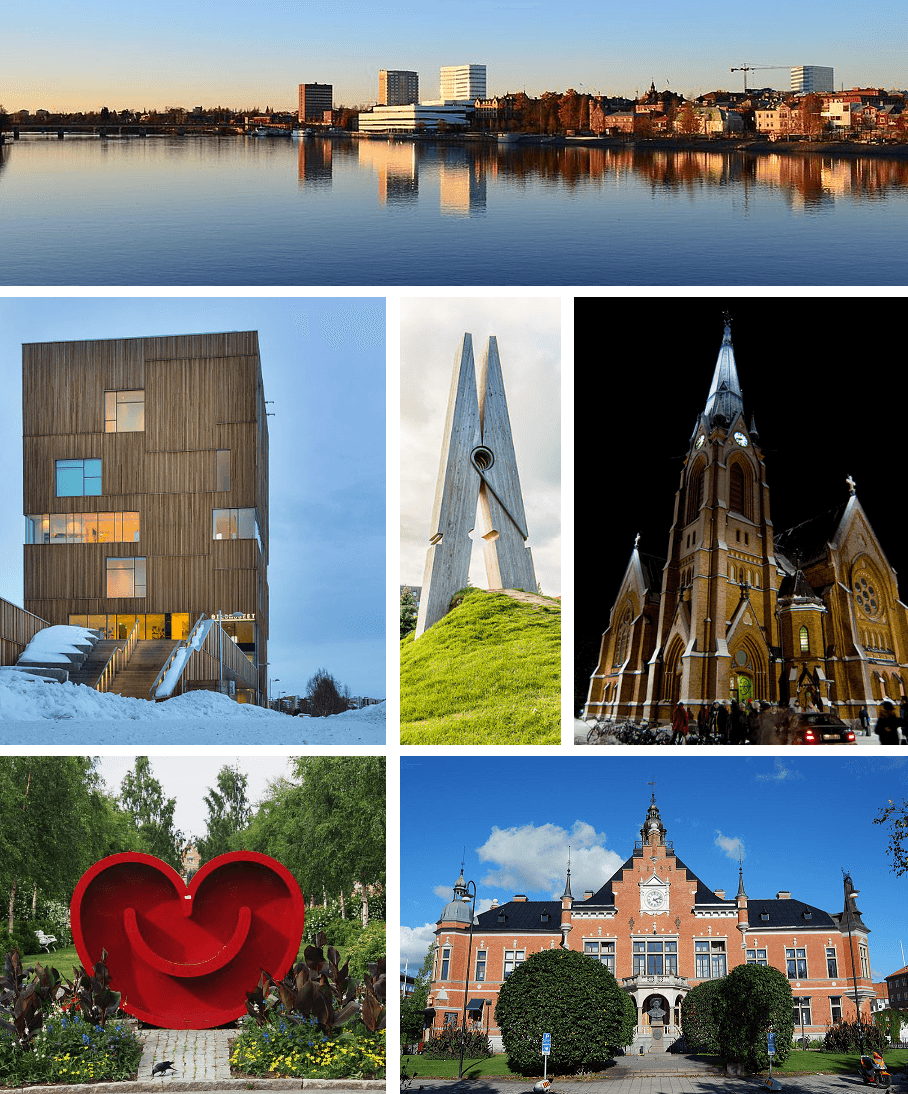 Jonipoon / CC BY-SA 4.0, via Wikimedia Commons
“Where birch trees line wide avenues and culture thrives under the midnight sun.”
Not the postcards. The stories even locals don't know — whispered in your ear, right where they happened.
The towers of Umeå's Town Hall don't quite align.
A local delicacy in Umeå redefines the very idea of pizza.
The Ume River holds a surprising connection to the city's designation.
Discover every secret of Umeå
Every address, every reveal in full — in your ear, right where it happened.
You pick your stops. You walk. The voice reveals what the others miss.
No tours available yet. Check back soon — we're preparing them.
Umeå, the largest city in northern Sweden, rests upon the Ume River, approximately 15 kilometers from the Gulf of Bothnia. Known as the "City of Birches" (Björkarnas Stad), its broad avenues are famously bordered by thousands of birch trees. This verdant canopy is a direct consequence of a catastrophic fire in 1888 that consumed much of the city, leading to a rebuilding plan that incorporated the trees as a protective barrier.
Umeå functions as a dynamic university town, with Umeå University established in 1965, contributing to its youthful atmosphere and swift expansion. With a significant student population, the city fosters a lively cultural environment and was even designated the European Capital of Culture in 2014. It is a place where contemporary energy meets natural splendor, offering a blend of urban experiences and convenient access to forests, lakes, and the coastline.
Beyond its reputation as a cultural and educational center, Umeå provides an entry point to the unique landscapes of northern Sweden. Its subarctic climate means long, snowy winters and relatively brief, pleasant summers, complete with the phenomenon of the midnight sun. The city's dedication to sustainability and local produce also shapes its culinary scene, where traditional ingredients like reindeer, moose, and regional cheeses frequently appear.
The Umeå river valley has been inhabited for at least three millennia, with rock carvings near Norrforsen dating back to approximately 3,000 BCE. Evidence of Bronze Age settlements and cultivation exists, indicating a period when barley and wheat were grown, and moose and beaver were hunted further inland. The first written mention of Umeå appeared in the 14th century, though permanent settlements by nomadic Sami people predated this at various locations in northern Sweden.
Umeå initially developed as a parish, featuring a wooden church and a trading post in what is now known as Backen or Kyrkbacken. Its strategic location by the Ume River and near the coast likely encouraged settlement. For centuries, it served as a collection of scattered parishes, a trading hub for Sami merchandise, and the last inhabited area before the northern wilderness. However, a proper town failed to materialize, and Umeå lost its town privileges in the 1590s.
King Gustavus Adolphus re-established Umeå as a town in 1622, granting it city status and trading privileges as part of a broader strategy to assert control over northern territories and regulate trade. By 1638, the town had grown to about 40 houses, and it became the administrative center of Västerbotten County. The city faced significant challenges in the early 18th century, suffering from Russian attacks and being burned to the ground in 1720 during the Russian Pillage. A large-scale restoration of the city's infrastructure began after these conflicts.
In 1874, urban planning was improved, but a major turning point arrived on June 25, 1888, when a devastating fire swept through the eastern parts of the town. The blaze left at least 2,300 of its 3,000 inhabitants without homes. In the aftermath, a crucial decision was made: almost 3,000 silver birch trees were planted along wide avenues to act as firebreaks, preventing future fires from spreading. This initiative earned Umeå its enduring nickname, "Björkarnas Stad," or the "City of Birches."
The 20th century brought renewed growth, particularly with the establishment of Umeå University in 1965. This transformed Umeå into a dynamic center of education and research, accelerating its development and doubling its housing stock between 1980 and 2010. Today, Umeå continues to be one of Sweden's fastest-growing cities, with plans to reach 200,000 inhabitants by 2050.
Begin your exploration at the Västerbottens Museum, a comprehensive free museum that delves into the history of Västerbotten County, including Sami culture and ancient artifacts like 4,000-year-old skis. Adjacent to the museum is an open-air section. For contemporary art, visit Bildmuseet, part of Umeå University's Arts Campus. This museum, housed in a striking wooden building, offers world-class exhibitions and was awarded European Museum of the Year in 2014.
Walk through Umedalen Sculpture Park, located five kilometers from the city center, which features a diverse collection of outdoor sculptures. Architecture enthusiasts will appreciate the blend of modern and traditional buildings, including the Umeå Rådhus (Town Hall) with its distinctive asymmetrical towers. Discover Väven Cultural Centre, a birch-inspired architectural landmark by the river that houses museums, a library, cinema, and restaurants.
Music lovers should make time for Guitars – The Museum, which showcases an extensive private collection of vintage guitars and the stories behind them. For a glimpse into local life and natural beauty, head to Nydalasjön Lake, a popular recreation area offering swimming, beaches, and trails. In winter, it transforms into a spot for ice fishing and cross-country skiing.
Umeå presents distinct experiences across its four seasons. For warm-weather activities and long daylight hours, the ideal time to visit is from early July to mid-August, when average daily highs are around 67°F (19°C) and the sun barely sets. The city comes alive in summer with riverside bars and outdoor activities. Winter, from November to March, offers opportunities for dog sledding, skiing, and potentially seeing the Northern Lights, with average January lows around 11°F (-12°C). Autumn brings vivid colors and chances for foraging wild berries.
Umeå Airport (UME) offers domestic and international flights, with direct connections from Stockholm taking about an hour. Alternatively, trains from southern Sweden, including Stockholm, can take 6-10 hours, with faster direct options available. Buses also serve Umeå, with companies like Ybuss and FlixBus. Once in the city, Umeå is compact and easy to traverse on foot, by bike, or via its public bus system. The city maintains 246 kilometers of bike paths, used year-round, even in winter.
Public restrooms are available in central Umeå at locations like Rådhustorget, Renmarkstorget, and within the MVG and Utopia malls. For currency exchange, Forex is located at Renmarkstorget 7. If visiting in winter, prepare for cold temperatures with thermal layers, a heavy windproof coat, and insulated boots. Summers are milder, but a light jacket is advisable for evenings.