Savudrija Lighthouse
The oldest beacon on the Adriatic coast holds a romantic, yet sorrowful, secret.
Full story unlocks in the tour
 Sailko / CC BY 3.0, via Wikimedia Commons
“Where ancient stones meet the Adriatic breeze.”
Not the postcards. The stories even locals don't know — whispered in your ear, right where they happened.
The oldest beacon on the Adriatic coast holds a romantic, yet sorrowful, secret.
Beneath the waves, just north of Umag, lies a Roman settlement with a dramatic past.
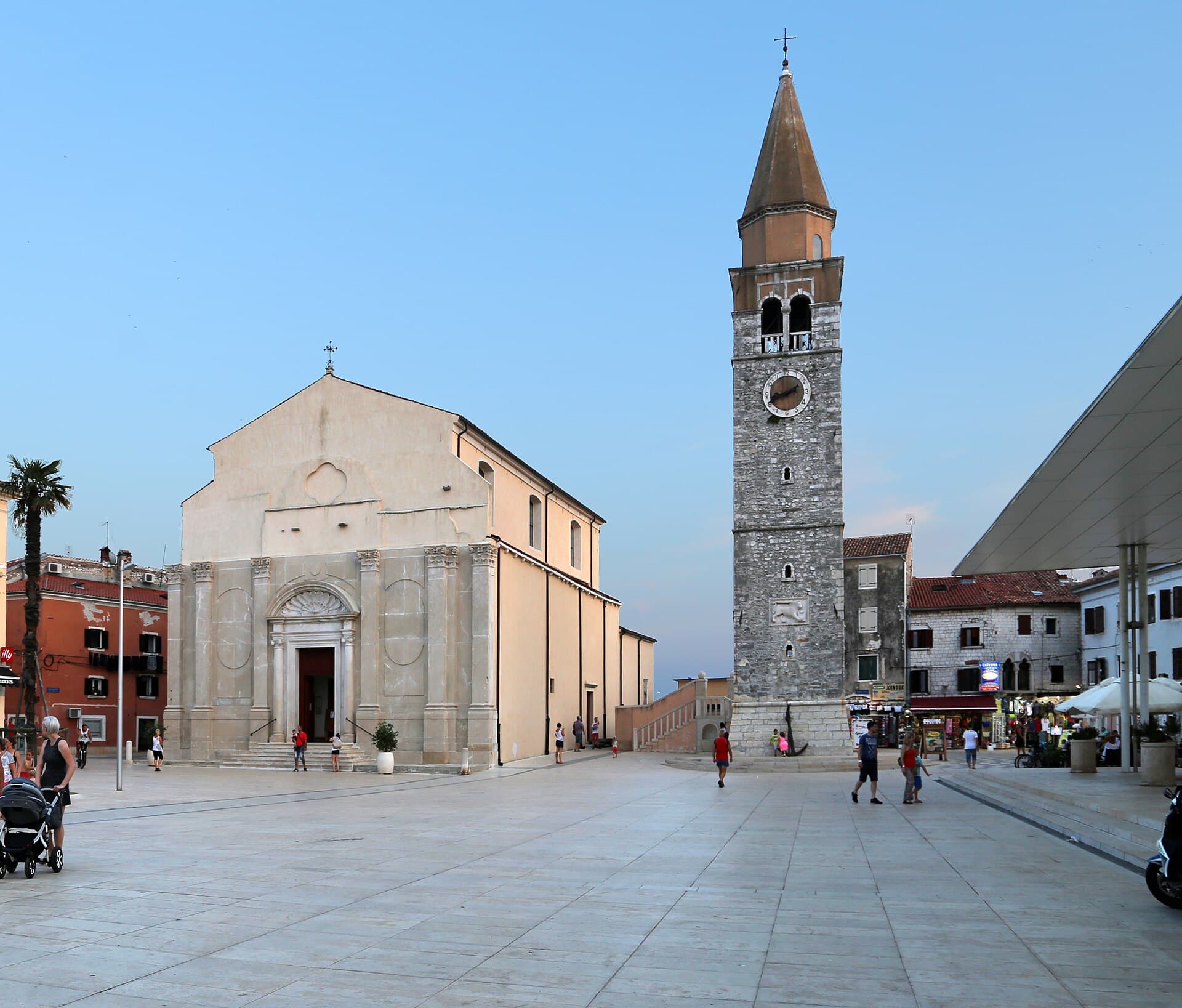
Observe the bell tower of Umag's main church, and you'll notice a detail that speaks of shifting power.
Discover every secret of Umag
Every address, every reveal in full — in your ear, right where it happened.
You pick your stops. You walk. The voice reveals what the others miss.
No tours available yet. Check back soon — we're preparing them.
Umag, Croatia's westernmost city, serves as a welcoming threshold to the Istrian peninsula, presenting a harmonious blend of ancient narratives, Mediterranean allure, and contemporary leisure. Its name, possibly derived from the Latin "humus" (fertile) and "magum" (cultivated field), hints at the region's agricultural abundance, particularly its acclaimed olive groves and vineyards. With a coastline extending 45 kilometers, Umag unfurls a varied landscape of clear blue waters and evocative bays.
Beyond its natural splendor, Umag possesses a distinct character, appealing to those who appreciate a measured pace without sacrificing access to modern comforts. While it may not possess the dramatic flair of some Istrian towns, its practicality as a base for exploring northern Istria, Slovenia, and Italy is undeniable. The city is also a recognized center for sports, famously hosting the ATP Croatia Open tennis tournament each July, drawing international players and enthusiasts alike.
The history of Umag reaches back to the early Stone Age, with traces of settlements from the Copper and Iron Ages inhabited by the Histri tribe. In 177 CE, the Romans overcame the Histri, leaving a lasting imprint of luxurious villas, commercial structures, and everyday artifacts. During this flourishing Roman period, Umag existed as an island, separated from the mainland by a narrow channel and fortified by defensive walls.
Umag is first recorded in the 7th century as Humagum during Byzantine dominion. Over the centuries, it saw various rulers, including the Lombards, Byzantines, and Franks. A significant event transpired in 876 CE when Umag was attacked and nearly destroyed by Croats, specifically the Neretva pirates led by Ban Domagoj. In the 10th century, town walls, a gate, and a drawbridge were constructed, further strengthening its defenses.
Umag came under Venetian authority in the 13th century, remaining so until the late 18th century. This era left a distinct architectural and cultural mark upon the town, evident in its Renaissance and Baroque buildings. Following the decline of the Venetian Republic, Umag briefly experienced French rule under Napoleon, then fell under the powerful Austro-Hungarian Empire for a century. After World War I, it became part of Italy, and after World War II, it was part of Zone B of the Free Territory of Trieste under Yugoslav administration, finally becoming part of modern Croatia in 1954.
The 19th century brought transformations, including the removal of the outer defensive ring that once protected the newer part of Umag, known as the Borgo. The town also gained its seaside promenade during this period. Rapid tourism development in the latter half of the 20th century transformed Umag into a significant economic and tourist center in northwestern Istria. Today, the town proudly celebrates its layered history and cultural traditions, inviting visitors to explore its landmarks and experience its Mediterranean atmosphere.
Begin your exploration in Umag's Old Town, where narrow, winding streets pass Venetian-style houses and partially preserved 10th-century town walls and defense towers. The Umag Town Museum, housed in a 14th-century former fortress known as the Bishop's Tower, displays archaeological finds from the Roman period and beyond.
Visit the Parish Church of the Assumption of Virgin Mary and St. Peregrine, a Baroque church with an unfinished facade and a bell tower dating back to 1651. Nearby, the Church of St. Roche, constructed in 1507 after a plague epidemic, features a distinctive 18th-century painted wooden ceiling.
Just north of Umag, the Savudrija Lighthouse, built in 1818, stands as the oldest lighthouse on the Adriatic coast. For a unique historical experience, visit the Sipar Archaeological Site, where at low tide, you can observe the submerged remains of a Roman town. Umag is also known for its inviting beaches, such as Laguna Stella Maris and Aurora Beach, offering clear waters for swimming and water sports.
Umag experiences a warm temperate climate with long, sun-drenched summers and mild winters. The ideal time to visit for beach activities and swimming is from late June to late August, when average daily temperatures hover around 30-31°C and water temperatures reach 23°C or above. July is typically the warmest and driest month. If you prefer to avoid the peak summer crowds while still enjoying pleasant weather, the shoulder seasons of May, June, and September are perfect for walking, cycling, and exploring. October is also suitable for culinary journeys and road trips.
Umag is readily accessible, particularly from northern Europe, owing to its proximity to the Slovenian border. It is well-connected by road, with bus services from major Croatian cities and nearby European destinations. The closest airports are in Pula, Croatia (approximately 1 hour drive), and Trieste, Italy (about 1 hour 20 minutes drive). Venice is also reachable by hydrofoil during the summer, with a journey spanning a few hours. The official language is Croatian, but English and Italian are widely spoken. The currency in Croatia is the Euro. While credit cards are broadly accepted, it is wise to carry some cash for smaller purchases at local shops and cafes. Umag provides a variety of accommodation options, including hotels, resorts, campsites, and private apartments.