Ulm Minster
Ulm holds the world's tallest church steeple, yet its construction was not a smooth, continuous process.
Full story unlocks in the tour
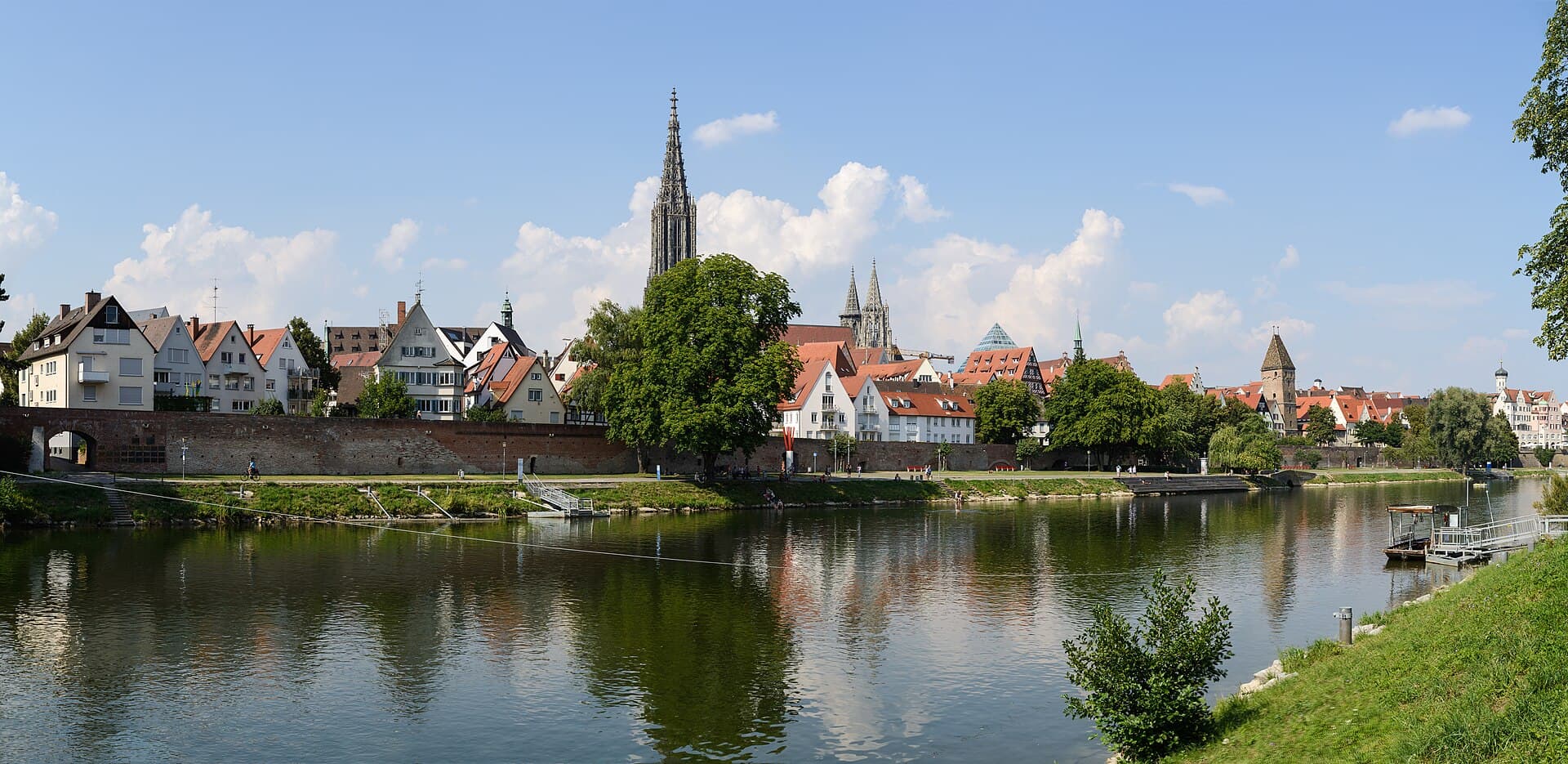 Uoaei1 / CC BY-SA 4.0, via Wikimedia Commons
“Where towering spires meet winding waterways and a genius took his first breath.”
Not the postcards. The stories even locals don't know — whispered in your ear, right where they happened.
Ulm holds the world's tallest church steeple, yet its construction was not a smooth, continuous process.
This charming district of half-timbered homes and narrow passages holds a curious detail about its past residents and their unique mode of transport.
Ulm features a leaning tower, but its tilt is not its only peculiarity; its name also carries an intriguing story.
Discover every secret of Ulm
Every address, every reveal in full — in your ear, right where it happened.
You pick your stops. You walk. The voice reveals what the others miss.
No tours available yet. Check back soon — we're preparing them.
Ulm, a city in the German state of Baden-Württemberg, rests on the left bank of the Danube River, where it converges with the smaller Blau and Iller rivers. With a population of approximately 130,000, it ranks as Germany's 60th-largest city. Ulm is perhaps most recognized as the birthplace of Albert Einstein in 1879, though his family relocated when he was an infant.
This former Free Imperial City, established around 850 AD, blends a medieval legacy with contemporary industry and science. It serves as an economic center, home to the University of Ulm and the Ulm University of Applied Sciences, and a significant hub for various sectors including pharmaceuticals, motor vehicles, and electronics. Ulm's strategic placement on important trade routes, particularly those leading to Italy, contributed to its prosperity in the Middle Ages.
## From Royal Domain to Imperial City Ulm's earliest discernible settlements date back to the early Neolithic period, around 5000 BC. The city first appeared in written records on July 22, 854 AD, when King Louis the German signed a document in the royal palace of "Hulma." Its initial importance stemmed from its status as a Königspfalz, a royal accommodation for medieval German kings and emperors. In 1181, Frederick Barbarossa declared Ulm an Imperial City, granting it self-governing status within the Holy Roman Empire.
## Medieval Prosperity and Reformation Ulm flourished in the 14th and 15th centuries, becoming a center for merchants and artisans, particularly noted for its high-quality textiles like linen and fustian. This economic success fostered a unique urban culture, leading to the signing of the Großer Schwörbrief (Great Oath Letter) in 1397, an agreement between patricians and trade guilds that functioned as an early city constitution. The 15th and 16th centuries marked a zenith for art in Ulm, with prominent painters and sculptors like Hans Multscher and Jörg Syrlin the Elder. In 1530, Ulm embraced the Protestant Reformation.
## Wars, Division, and Rebirth The centuries following the Reformation saw periods of decline due to religious conflicts, shifts in trade routes, and the devastation of the Thirty Years' War. During the War of the Spanish Succession (1701–1714), Ulm faced repeated invasions by French and Bavarian soldiers. In 1803, it lost its Imperial City status and was absorbed into Bavaria, then ceded to Württemberg in 1810. This division led to the creation of Neu-Ulm on the opposite bank of the Danube. The 19th century saw Ulm become a fortress city, and the long-stalled construction of the Ulm Minster was finally completed in 1890. While much of the medieval city center was destroyed by bombing during World War II, Ulm rebuilt and evolved into an important industrial and economic center.
The Ulm Minster (Ulmer Münster) stands as the city's most prominent landmark, featuring the world's tallest church steeple at 161.53 meters (530 feet). Visitors may ascend 768 steps to an observation deck at 143 meters for sweeping views of Ulm, Neu-Ulm, and on clear days, the distant Alps. Inside, admire the intricately carved oak choir stalls from the 15th century and ancient stained-glass windows.
The Fishermen's and Tanners' Quarter (Fischerviertel) offers a delightful contrast with its narrow passages, half-timbered houses, and the canals of the Blau River. Seek out the famously leaning 'Schiefes Haus' (Crooked House), now a hotel, and the Metzgerturm (Butcher's Tower), another leaning medieval structure.
The Ulm Town Hall, with its elaborate exterior paintings, presents another historical highlight. For a deeper exploration of local history and art, visit the Museum Ulm, which houses the world's oldest known animal sculpture, the prehistoric 'Lion-Man.' Just beyond the city, the Rococo library of Wiblingen Abbey offers another rewarding visit. Remember to see the Albert Einstein Memorial Fountain, commemorating Ulm's most famous son.
The best time to visit Ulm is during the summer months, from June to August. Temperatures average around 18.7°C (65.7°F) with highs reaching 23-24°C (73-75°F), creating comfortable conditions for exploration. While summer experiences more rainfall, often as brief thunderstorms, there are extended daylight hours and numerous outdoor events, including the famous Nabada water parade in July. Spring (March-May) and autumn (September-November) offer moderate temperatures and fewer crowds.
Ulm is readily accessible by road and rail, with a major railway line connecting it to cities like Paris, Stuttgart, Munich, and Vienna. The city center is walkable, and public transport is available. The currency used is the Euro (€), and German is the official language. While many in the tourism sector speak English, learning a few basic German phrases is always appreciated. The city's population is around 132,708 in 2026. Many attractions, including the Ulm Minster, are centrally located. Consider purchasing a local city card for potential discounts on attractions and public transport. Check opening hours for specific sights in advance, as some may vary seasonally. For clear views from the Minster, aim for a day with favorable weather.