Udine Castle Hill
The hill supporting Udine Castle has an astonishing origin, far older than any medieval fortress.
Full story unlocks in the tour
 Gian77 / CC BY-SA 3.0, via Wikimedia Commons
“Udine: Venetian echoes in a Friulian heart.”
Not the postcards. The stories even locals don't know — whispered in your ear, right where they happened.
The hill supporting Udine Castle has an astonishing origin, far older than any medieval fortress.
This iconic Venetian Gothic building in Piazza Libertà holds a secret about its construction that extends beyond its renowned architect.
Udine's 'most beautiful Venetian square on the mainland' has borne many names, reflecting centuries of shifting power.
Discover every secret of Udine
Every address, every reveal in full — in your ear, right where it happened.
You pick your stops. You walk. The voice reveals what the others miss.
No tours available yet. Check back soon — we're preparing them.
Udine, a city in Italy's northeastern Friuli-Venezia Giulia region, offers a blend of Venetian elegance and a distinct Friulian character. Positioned between the Adriatic Sea and the Alps, Udine provides a relaxed, local atmosphere without the throngs of more famous Italian destinations. Its historic center is easily walkable, revealing inviting piazzas, arcaded streets, and architectural details that speak to its enduring past.
The city serves as a cultural and economic center, known for its unique regional cuisine and a proud, independent spirit where the Friulian language is often heard alongside Italian. Udine's strategic location near the borders of Austria and Slovenia has shaped its history and cultural identity, making it an intriguing destination for those seeking an authentic Italian experience with a borderland soul.
The area where Udine stands has been inhabited since the Neolithic age, with archaeological findings suggesting human presence even during Roman rule. The city's documented history begins in 983 AD, when Emperor Otto II gifted the Utinum castle to the Patriarchs of Aquileia, who would later make Udine one of their primary residences in the 13th century. This period saw Udine develop into a significant economic and trading center, with the establishment of a market in 1223.
A pivotal shift occurred in 1420 when Udine was conquered by the Republic of Venice, initiating a new era of cultural synthesis that profoundly influenced the city's architecture and urban design. Udine remained under Venetian control for nearly four centuries, becoming the second-largest city within the Venetian state. This Venetian influence is still evident today in its elegant squares and Venetian Gothic buildings.
The 16th century brought significant challenges, including a civil war, a devastating earthquake in 1511 that damaged many structures, and a subsequent plague. Despite these setbacks, the city rebuilt, with the current Udine Castle being constructed between 1517 and 1567 on the ruins of an earlier fortress. After the fall of Venice in 1797, Udine experienced periods of French and Austrian rule, eventually being annexed to the Kingdom of Italy in 1866.
During World War I, Udine served as the headquarters of the Italian High Command from 1915 to 1917, earning it the nickname "Capitale della Guerra" (War Capital). The city suffered heavy bomb damage during World War II but was largely spared from the severe earthquake that struck Friuli–Venezia Giulia in 1976. Today, Udine continues to thrive as a city that harmoniously blends its enduring historical past with contemporary Italian culture.
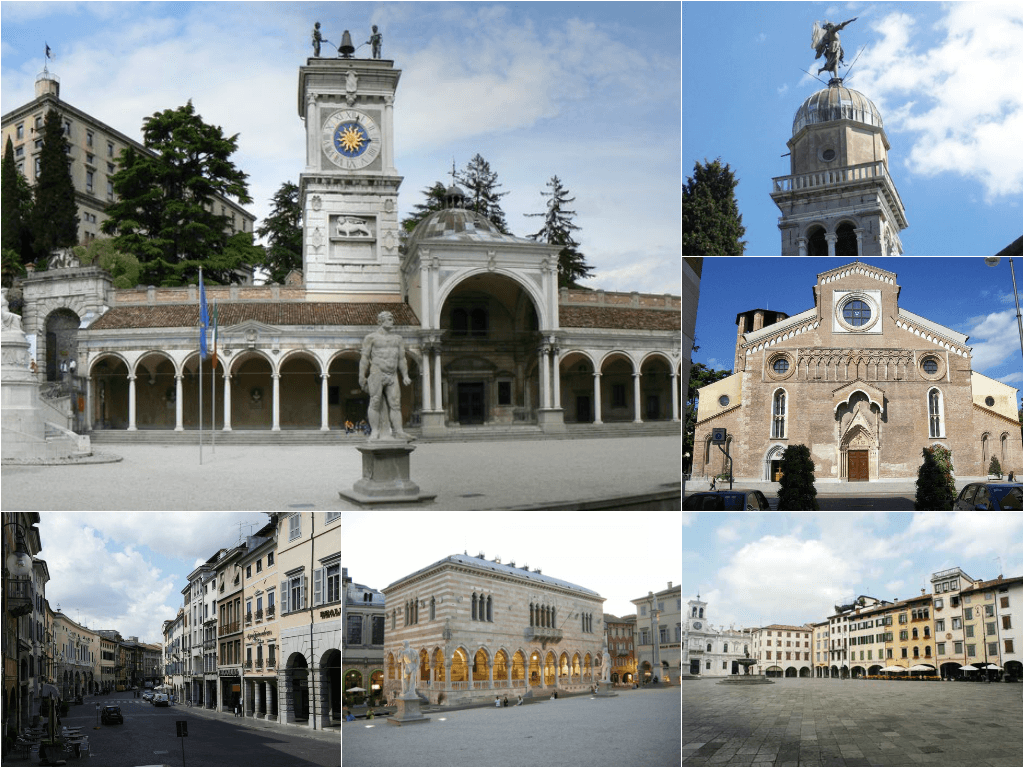
Begin your exploration at Piazza della Libertà, often called "the most beautiful Venetian square on the mainland." Here, you'll find the striking Loggia del Lionello, a Venetian Gothic palace constructed between 1448 and 1457, adorned with white and pink marble. Opposite it stands the Renaissance-era Loggia di San Giovanni with its iconic Torre dell'Orologio (Clock Tower), featuring bronze bell-strikers. The square also displays the Carrara Fountain, columns with the Venetian Lion and the Statue of Justice, and statues of Hercules and Cacus.
Ascend to Udine Castle, situated on an ancient artificial hill, for sweeping views of the city and the Julian Alps. The castle, rebuilt in the 16th century, houses the Civic Museums, including an Archaeological Museum, an Ancient Art Gallery with works by Giovanni Battista Tiepolo, and the historic Parliament Hall. Do not miss the Duomo di Udine, a Gothic cathedral dating back to 1236, featuring an impressive interior with frescoes by Giovanni Battista Tiepolo and Maffeo Verona. Nearby, the Oratorio della Purità also showcases Tiepolo's frescoes. Wander through Piazza San Giacomo (Piazza Matteotti), a lively square lined with cafes and the Chiesa di San Giacomo. For a taste of local life and shopping, explore Via Mercatovecchio, one of the city's oldest and most active streets.
The best times to visit Udine are during late spring (mid-April to mid-June) and early autumn (September to October). During these months, the weather is pleasantly warm with mild temperatures, making it ideal for walking and exploring the city's outdoor attractions. While some rainy days can be expected, these periods offer comfortable conditions and fewer tourists than the peak summer season. Summers can be hot and humid, with a chance of afternoon thunderstorms.
Udine is a compact and walkable city, making it easy to explore its historic center on foot. The city is well-connected by regional trains from major Italian cities like Venice, Trieste, and Treviso. For those arriving by air, Trieste-Friuli Venezia Giulia International Airport (TRS) is approximately 39 kilometers away, with bus connections to Udine. Venice Marco Polo Airport (VCE) and Treviso Antonio Canova Airport (TSF) are also viable options, located about 100-104 kilometers away.
Public transportation within Udine is efficient, though many key sights are within walking distance. For a truly local experience, consider spending an evening at an osteria for a tajut (a small glass of wine) and traditional Friulian dishes like frico (a savory cheese and potato pie), cjarsons (stuffed pasta), or musetto with brovada (pork sausage with marinated turnips). Udine is generally considered very safe, but standard precautions should be observed in busier areas.