Monument to Afanasy Nikitin
This monument to Tver's most famous traveler might owe its existence to a diplomatic fib.
Full story unlocks in the tour
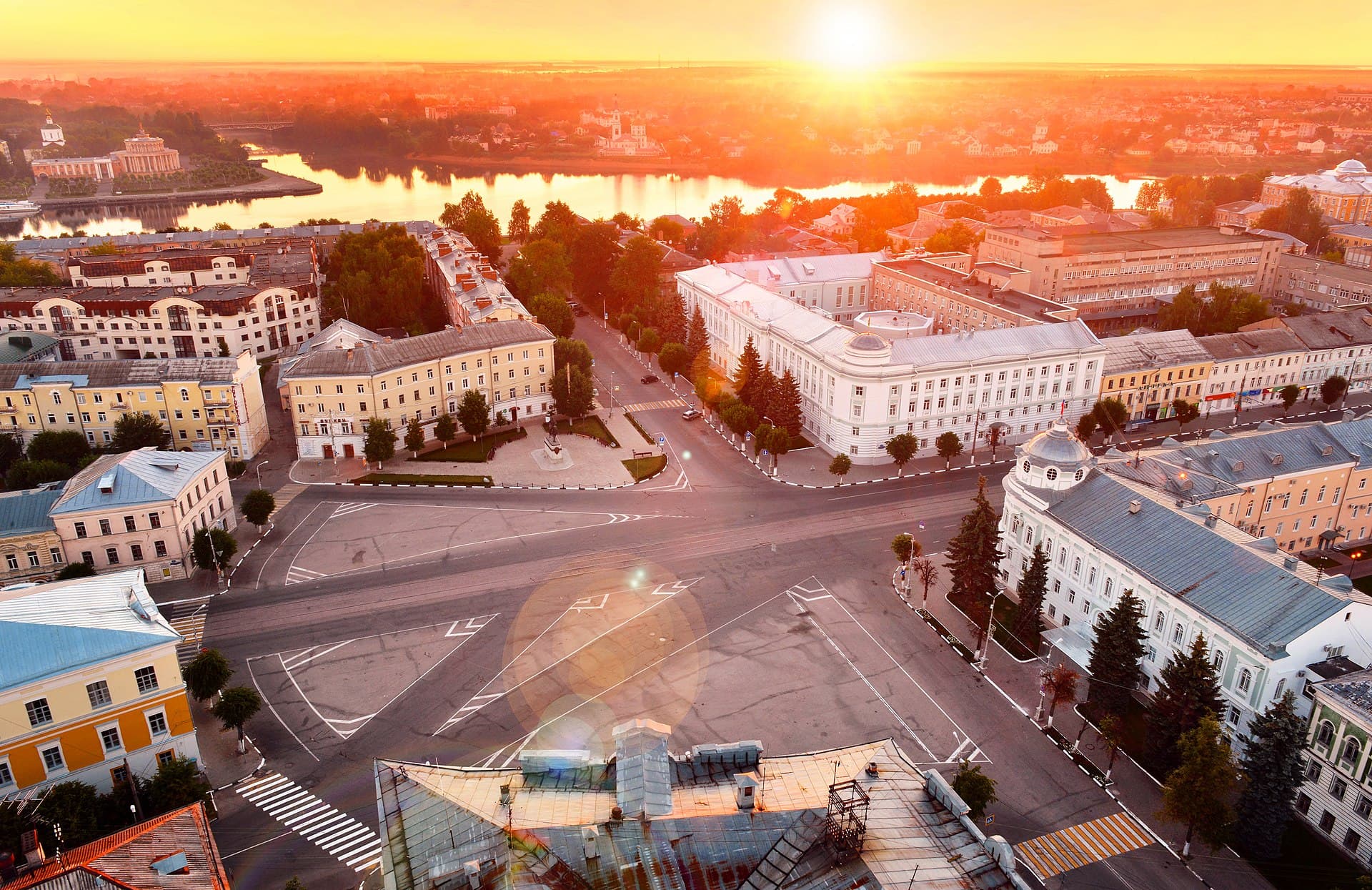 Ветер Тверских Крыш / CC BY-SA 4.0, via Wikimedia Commons
“Where imperial elegance meets the quiet flow of the Volga.”
Not the postcards. The stories even locals don't know — whispered in your ear, right where they happened.
This monument to Tver's most famous traveler might owe its existence to a diplomatic fib.
Beneath the tranquil greenery of the City Garden lies a secret that speaks to Tver's ancient power.
One of Tver's more unusual architectural nicknames reflects a pivotal moment in Soviet history.
Discover every secret of Tver
Every address, every reveal in full — in your ear, right where it happened.
You pick your stops. You walk. The voice reveals what the others miss.
No tours available yet. Check back soon — we're preparing them.
Tver, a city where three rivers converge—the Volga, Tvertsa, and Tmaka—offers a compelling blend of imperial grandeur and provincial allure. Positioned strategically between Moscow and St. Petersburg, it served as a crucial stopover for Russian royalty and nobility, a legacy still visible in its elegant architecture. The city's distinct urban layout, with its radial street system emanating from a central square, has drawn comparisons to St. Petersburg and even Versailles.
Once a formidable rival to Moscow for dominance in medieval Rus', Tver's historical significance is palpable. Despite periods of destruction and rebuilding, the city has preserved a singular character, marked by its riverside promenades and a quiet, unhurried atmosphere. From the stories of intrepid travelers to the architectural directives of empresses, Tver invites exploration into a rich, layered past.
Tver's official founding date is accepted as 1135, though historical debate exists, with some archaeological findings suggesting an earlier settlement. Initially a minor trading post, it quickly rose to prominence. In 1247, Tver became the capital of a powerful principality, entering a long-standing rivalry with Moscow for political leadership in Rus'. Its strategic location on trade routes and its relative distance from the Golden Horde contributed to its rapid growth and prosperity. Under Prince Mikhail Yaroslavich (1271-1318), Tver flourished, with crafts developing, churches being built, and chronicle writing commencing.
However, Tver's ambition led to conflict. In 1327, a significant anti-Horde uprising in the city was brutally suppressed with the help of Moscow, severely undermining Tver's power. In 1485, Moscow's forces seized Tver, formally annexing it and ending its political independence. The city faced further devastation during the Times of Troubles in 1612, when Polish-Lithuanian interventionists practically destroyed it, reducing its population significantly.
The 18th century marked a new chapter for Tver. A catastrophic fire in 1763 razed much of the city, including its Kremlin. Empress Catherine the Great, recognizing Tver's strategic location on the route between the old and new capitals, ordered its complete reconstruction. A special architectural team, led by Pyotr Nikitin, rebuilt the city according to a unified plan in the Classical style, creating the distinctive three-ray layout that still defines its center today. The magnificent Imperial Travel Palace, built between 1764 and 1766 as a resting place for the imperial family, became a central landmark of this reconstruction.
In 1931, Tver was renamed Kalinin in honor of Soviet statesman Mikhail Kalinin, a name it bore until 1990 when its historic name was restored. The city suffered severe damage during World War II under German occupation in 1941 but was subsequently restored.
Begin your exploration at the Imperial Travel Palace, an architectural marvel originally built for Catherine the Great. This elegant complex, combining Classical and Baroque styles, now houses the Tver Regional Art Gallery, featuring an extensive collection of Russian art. Adjacent to the palace is the City Garden, a green oasis offering pleasant strolls and views of the Volga. This park occupies the historical site of the Tver Kremlin.
A short walk will lead you to the Monument to Afanasy Nikitin, a prominent 15th-century Tver merchant and one of the first Europeans to journey to India. The bronze statue, set on a boat-shaped platform, stands on the Volga embankment, symbolizing his distant travels. Continue along the scenic Volga River embankments, offering evocative views and a chance to experience the city's tranquil riverside atmosphere. Do not miss the Old Bridge, a symbol of Tver, with its distinctive openwork silhouette.
For a deeper dive into local life, visit the Museum of Tver Daily Life, housed in a historic merchant's house, showcasing 18th and 19th-century Tver. The Cathedral of the White Trinity (1564), built of limestone, is one of the few pre-Petrine buildings remaining in Tver and the oldest stone building in the city. For a singular local experience, explore the Goat Museum, which celebrates the city's unusual unofficial symbol and its historical connection to goat leather production.
The Botanical Garden of Tver State University, the northernmost botanical garden with an exhibition of steppe plants, offers a diverse collection of trees, shrubs, and herbaceous plants, including a pond dating back to the 18th century.
The most pleasant time to visit Tver is during the summer months, from late June to mid-August. During this period, average daytime temperatures range from 19°C to 25°C, providing comfortable conditions for outdoor activities and exploration. While July is the warmest month, it also sees the highest number of rainy days, so packing a light jacket or umbrella is advisable. Spring (April-May) and autumn (September-November) offer milder temperatures and colorful landscapes, though the weather can be more variable. Winters (December-February) are cold and snowy, with average temperatures around -4°C to -6°C.
Tver is easily accessible from Moscow by train, with journeys ranging from one to three hours, depending on the train type. High-speed Sapsan trains offer the fastest option, taking just over an hour. Within the city, buses and trams provide convenient public transportation, and taxis and bike rentals are also available.
The local currency is the Russian Ruble (RUB). It is important to note that credit and debit cards issued by foreign banks may not work in local terminals or ATMs. It is highly recommended to carry sufficient cash in major currencies (USD or EUR) for exchange at official bank branches, or to rely on cash for most transactions. While Tver is generally considered a safe city for tourists, standard precautions apply. Tap water is not recommended for drinking. Accommodation prices can increase during summer and on weekends, so booking in advance is advisable during peak seasons.