Casa del Fundador Gonzalo Suárez Rendón
The walls of this historic mansion hold a secret that time itself tried to erase.
Full story unlocks in the tour
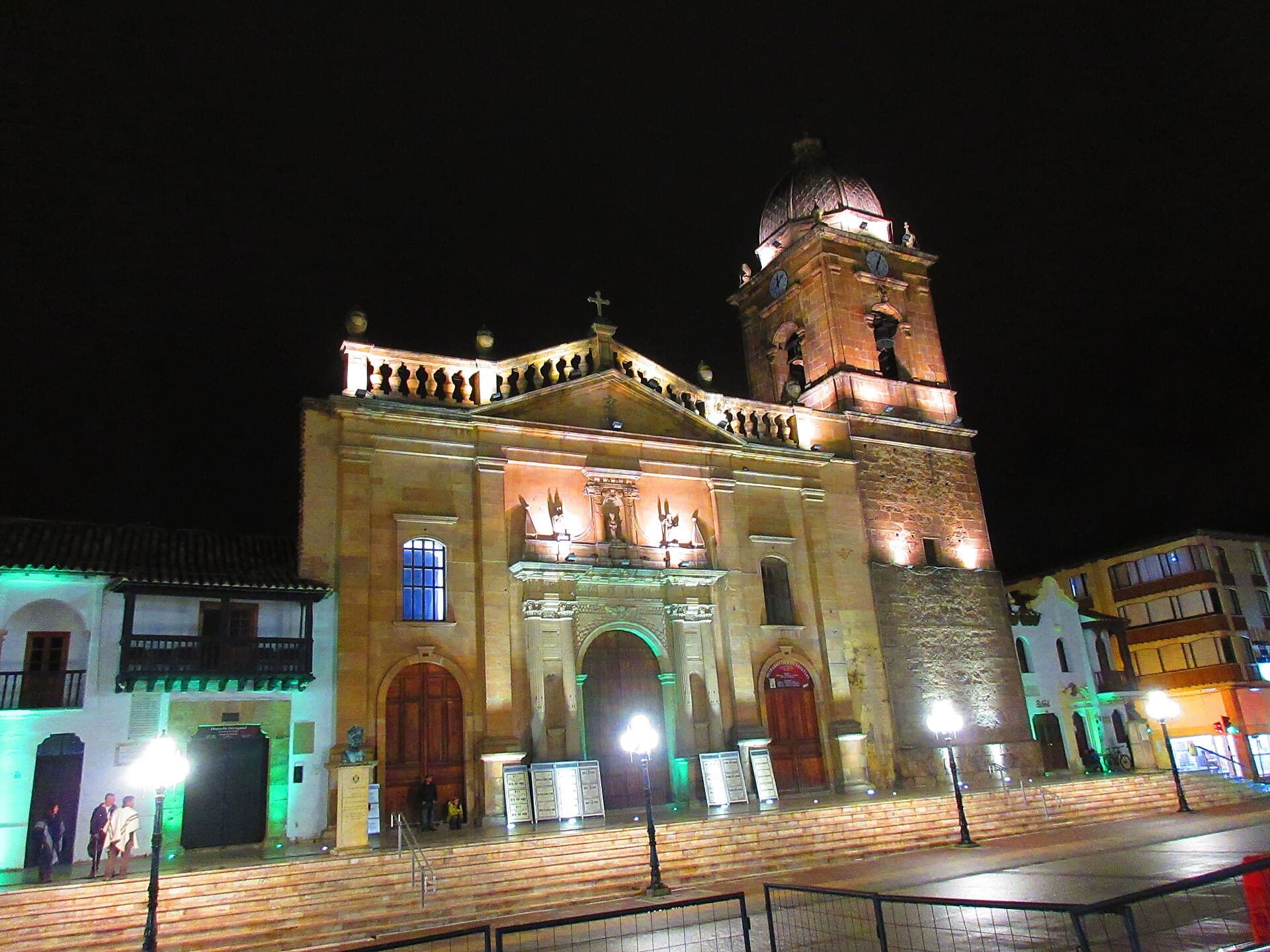 Edisonalv / CC BY-SA 4.0, via Wikimedia Commons
“Where colonial echoes meet Andean skies.”
Not the postcards. The stories even locals don't know — whispered in your ear, right where they happened.
The walls of this historic mansion hold a secret that time itself tried to erase.
Look up in this colonial home, and you might spot creatures that never roamed the Andes.
Beyond its gilded altars, this church guards a solemn secret of Colombia's fight for freedom.
Discover every secret of Tunja
Every address, every reveal in full — in your ear, right where it happened.
You pick your stops. You walk. The voice reveals what the others miss.
No tours available yet. Check back soon — we're preparing them.
Tunja, the capital of the Boyacá department, rises high in the Eastern Ranges of the Colombian Andes, an elevation of 2,820 meters (9,250 feet) above sea level. This university city, with a population exceeding 170,000, offers a blend of colonial heritage and a cool highland climate. While some travelers may pass through, Tunja invites exploration for its well-preserved colonial mansions, venerable churches, and a beautiful main plaza. It serves as a central transportation hub within Boyacá, making it a convenient base for discovering nearby towns.
The city's historical significance extends beyond its colonial architecture. Tunja played a pivotal role in Colombia's struggle for independence, with the nearby Puente de Boyacá being the site of a decisive victory against the Spanish in 1819. The city's cultural importance is further enriched by its indigenous Muisca roots, as it was originally the Muisca settlement of Hunza. Tunja's unique blend of pre-Columbian history, colonial allure, and a lively academic atmosphere makes it a compelling destination for those seeking a deeper understanding of Colombia's past and present.
## From Muisca Heart to Colonial Capital Tunja's story begins long before the arrival of the Spanish, rooted in the Muisca civilization. The area was originally the settlement of Hunza, named after the Muisca ruler Hunzahúa. Archaeological discoveries in the region date back to approximately 150 BCE, indicating a long history of human habitation. The Muisca, who spoke Chibcha, developed their own intricate religion, calendar, and mythology. According to Muisca myths, the capital of the northern Muisca was moved to Hunza by the cacique Goranchacha.
The arrival of the Spanish marked a significant turning point. On August 20, 1537, Spanish conquistador Gonzalo Jiménez de Quesada captured the Muisca cacique Quemuenchatocha. Modern Tunja was officially founded by Captain Gonzalo Suárez Rendón on August 6, 1539, establishing a main plaza and allocating land for a church and public buildings. The city was declared a city in 1541. Religious orders soon followed, with Franciscans arriving in 1550, Dominicans a year later, Augustinians in 1585, and Jesuits in 1611, contributing to the city's numerous churches and convents.
Tunja prospered during the 17th century, becoming an important urban center in the region. The city played a role in the independence movements, proclaiming the Republic of Tunja on December 9, 1811, and declaring absolute independence from Spain. However, the Spanish recaptured the city in 1816. A crucial moment in Colombian history unfolded near Tunja: the Battle of Boyacá on August 7, 1819. This decisive victory for Simón Bolívar's forces over the Spanish paved the way for Colombia's independence. Throughout the 19th century, despite periods of stagnation in its agricultural and artisanal economy, Tunja maintained its political significance as the capital of the Boyacá department. Today, Tunja's well-preserved colonial architecture stands as a testament to its complex past.
Begin your exploration in the Plaza de Bolívar, the city's main square, encircled by colonial buildings. Here, you will find the Metropolitan Cathedral Basilica of Tunja, the oldest cathedral in Colombia, with construction beginning in 1567. A short walk from the plaza leads to the Casa del Fundador Gonzalo Suárez Rendón, the house of the city's founder, now a museum showcasing 16th-century aristocratic life and featuring original frescoes. Another notable mansion, the Casa de Don Juan de Vargas, also features intriguing ceiling paintings.
Tunja is home to numerous historic churches. The Iglesia de Santo Domingo, built in 1560, is considered by many to be the most beautiful active church in the city, recognized for its elaborate gilded Baroque and Mudejar carvings and paintings by Gregorio Vásquez de Arce y Ceballos. The Chapel of Santa Clara la Real, believed to be the first convent in New Granada, displays a rich blend of indigenous and Catholic imagery. For a significant historical site, visit Puente de Boyacá, located about 16 km south of Tunja. This reconstructed colonial-era bridge commemorates the Battle of Boyacá, a pivotal event in Colombia's independence.
Tunja experiences a subtropical highland climate, characterized by little temperature variation throughout the year, with average daily temperatures around 19°C (66°F). The best times to visit for warm-weather activities and general outdoor tourism are from mid-December to early March and from mid to late June. These periods generally offer clearer skies and less rainfall. The wettest months are typically April and October. Keep in mind that December and January, as well as Easter, are peak tourist seasons in Colombia, so expect higher prices and plan to book accommodations in advance.
Tunja is approximately a 2 to 3-hour bus ride from Bogotá, with many buses passing through the city as it lies on the main highway to the Caribbean region. The Juana Velasco de Gallo Transport Terminal, opened in 2019, is about four blocks from Plaza de Bolívar and serves as the main hub for intermunicipal and regional buses. The city center is easily walkable. Tunja is considered one of the safest cities in the Americas, with a low homicide rate. However, like any city, it's always wise to be aware of your surroundings, especially at night. Accommodations range from luxury homes to apartments, with the Historic Center being a recommended area to stay due to its concentration of colonial heritage, shops, and restaurants.