The Souk El Berka
This bustling jewelry market in the Medina once held a surprising, darker past.
Full story unlocks in the tour
 T A / CC BY-SA 2.0, via Wikimedia Commons
“Where ancient echoes meet modern whispers, a city unfolding at the edge of the Mediterranean.”
Not the postcards. The stories even locals don't know — whispered in your ear, right where they happened.
This bustling jewelry market in the Medina once held a surprising, darker past.
Beyond its world-renowned mosaics, the museum's very walls tell a story of shifting power.
One of Tunis's most revered landmarks has a foundation built on more than just stone.
Discover every secret of Tunis
Every address, every reveal in full — in your ear, right where it happened.
You pick your stops. You walk. The voice reveals what the others miss.
No tours available yet. Check back soon — we're preparing them.
Tunis, the capital and largest city of Tunisia, rests on the northern African coast, an evocative crossroads between the western and eastern basins of the Mediterranean Sea. It is a city of contrasts, where the labyrinthine alleyways of the ancient Medina converge with the wide boulevards of the Ville Nouvelle, a legacy of French colonial planning. This dynamic urban center, home to approximately 2.4 million people, serves as Tunisia's economic, cultural, and administrative heart.
From its origins as a Libyan settlement in the 9th century BCE, Tunis has been shaped by a succession of empires and cultures—Phoenician, Roman, Byzantine, Arab, Ottoman, and French—each leaving an indelible mark on its architecture, traditions, and spirit. Today, Tunis invites exploration, offering a journey through millennia of history, from the Roman ruins of nearby Carthage to the lively souks of its UNESCO-listed Medina.
Tunis traces its origins back to the 9th century BCE, founded by Libyans who later ceded the site of Carthage to the Phoenicians. Both Tunis and Carthage faced destruction in 146 BCE during the Third Punic War between Carthage and Rome. However, Tunis saw a resurgence under Roman rule, though its true prominence emerged with the Muslim conquest in the 7th century CE. The city became the capital under the Aghlabids (800–909 CE) and reached its zenith of prosperity during the Ḥafṣid dynasty (1236–1574 CE), evolving into a significant religious, intellectual, and economic hub.
During the 16th century, Tunis experienced a period of contention, with Holy Roman Emperor Charles V taking possession in 1535, followed by its capture by the Turks in 1539. The city was briefly retaken by the Spanish (1573–1574) before definitively falling under Ottoman rule, where it remained until the French protectorate was established in 1881. The French occupation, lasting until 1956, brought significant expansion and redevelopment, introducing European-style boulevards and infrastructure. Tunis was occupied by German forces during World War II from November 1942 to May 1943, before being liberated by Allied troops. Upon Tunisia's independence in 1956, Tunis was officially named the national capital.
Throughout its long history, Tunis has served as a strategic location, attracting immigrants and becoming a vital center for merchants and government officials. It even hosted the headquarters of the Arab League from 1979 to 1990 and the Palestine Liberation Organization (PLO) from the 1970s to 2003, highlighting its role in international politics. Today, Tunis continues to balance its profound historical legacy with contemporary developments, facing challenges while remaining a dynamic city.
The Medina of Tunis, a UNESCO World Heritage Site since 1979, is the oldest section of the city, with its origins tracing back to the 7th century around the foundational Al-Zaytuna Mosque. This fortified mini-city, originally enclosed by walls and 12 gates (five of which remain today), developed into a sprawling maze of narrow streets and alleyways. It was during the Almohad and Hafsid periods (12th-16th centuries) that the Medina truly flourished, becoming one of the greatest and wealthiest cities in the Islamic world. This era saw the construction of many of the palaces, mosques, and madrasas that still stand today, reflecting a blend of Ifriqiyan, Andalusian, and Oriental architectural influences, often incorporating elements from older Roman and Byzantine monuments.
Within its ancient confines, the Medina is home to over 700 historical monuments. Its souks, or markets, are lively centers of commerce, selling everything from traditional chechia hats and carpets to spices and jewelry. Despite the encroachment of modern housing and some demolitions in the 1930s and 40s, conservation efforts have preserved much of its medieval character. Even today, approximately 2,000 people call the Medina home, keeping its traditional markets and artisan workshops alive.
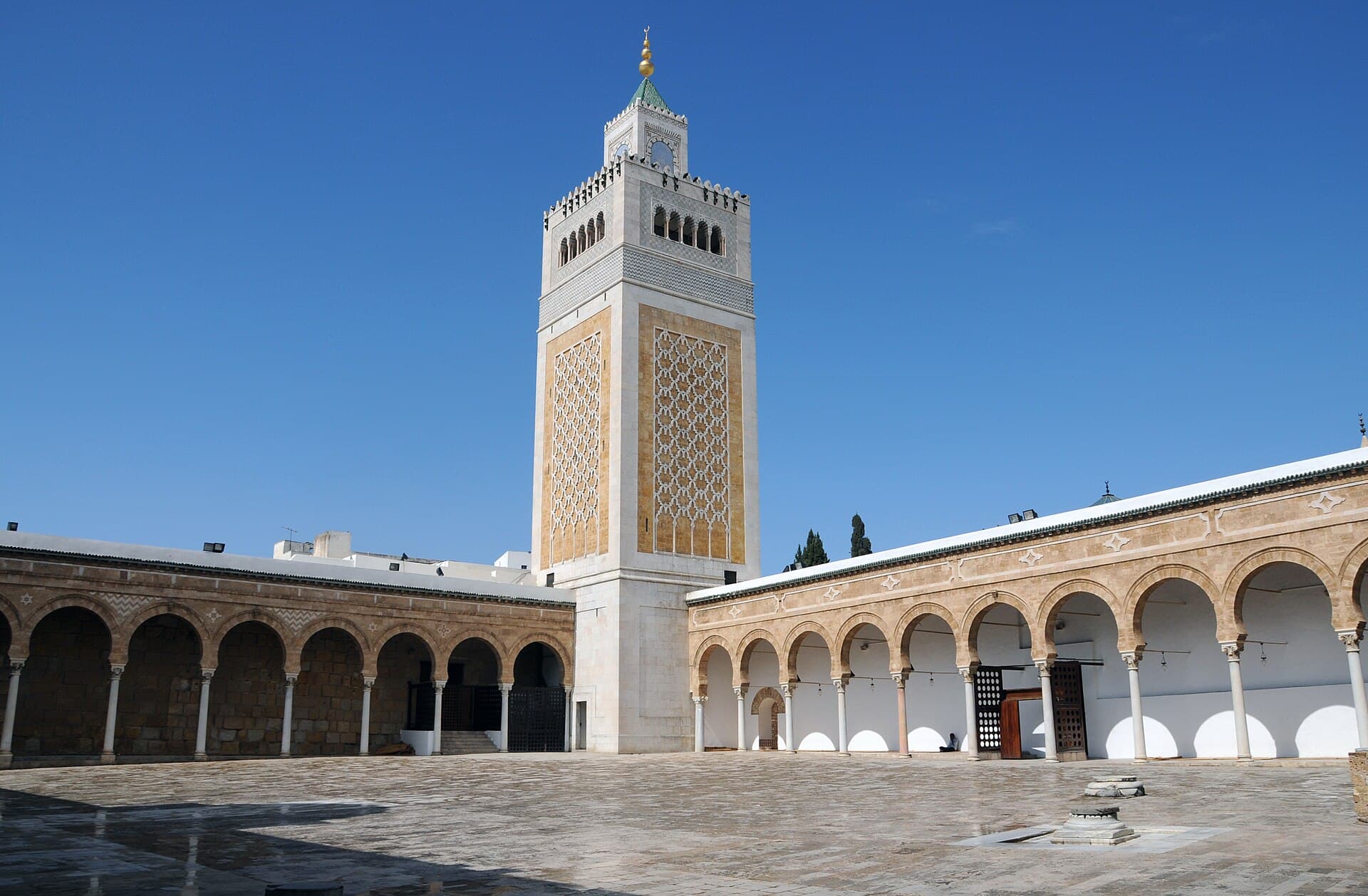
Begin your exploration in the Medina of Tunis, a UNESCO World Heritage site and a labyrinth of narrow streets, historic buildings, and bustling souks. Here, you can wander through the various specialized markets, from the perfumers of Souk el Attarine to the colorful textiles of Souk des Étoffes. Do not miss the Al-Zaytuna Mosque, the oldest and most venerated monument in Tunis, though non-Muslims are generally restricted to the central courtyard.
Just outside the Medina, explore the Ville Nouvelle, or New City, characterized by wide boulevards like Avenue Habib Bourguiba, a legacy of the French protectorate. Here you will find the Cathedral of St. Vincent de Paul, a striking architectural contrast to the surrounding Islamic heritage.
A short trip from the city center will take you to the Bardo National Museum, housed in a former beylical palace. It holds one of the world's largest collections of Roman mosaics, alongside artifacts spanning Tunisia's history from prehistoric times to the Islamic era. For a glimpse into 19th-century Tunisian aristocratic life, visit the Dar Ben Abdallah Museum, a beautifully preserved palace showcasing traditional arts and crafts.
No visit to Tunis is complete without a day trip to the ancient ruins of Carthage, once a powerful trading empire and a major rival to Rome. Explore sites like the Antonine Baths, the largest Roman baths outside of Rome. Afterwards, head to the picturesque village of Sidi Bou Said, known for its distinctive white and blue houses and cliffside views of the Mediterranean.
The best times to visit Tunis are during spring (March to May) and autumn (September to November). During these seasons, temperatures are mild and pleasant, ranging from 16°C to 25°C, making it ideal for exploring archaeological sites and the city's cultural attractions. There are also fewer crowds compared to the peak summer months. Summer (June to August) brings intense heat, often exceeding 30°C, which can be challenging for sightseeing, though it is popular for beach activities along the coast. Winter (January, February, November, December) is the least busy and cheapest time to visit, with cooler temperatures.
The official currency of Tunisia is the Tunisian Dinar (TND), subdivided into 1,000 millimes. It is a closed currency, meaning it is illegal to import or export dinars, so you will need to exchange money upon arrival. Major credit and debit cards are accepted in larger hotels, restaurants, and shops, but cash is preferred for smaller businesses and markets.
Getting around Tunis is facilitated by a public transport network including the Metro Léger (light rail) and buses, operated by Transtu. The Metro Léger has six lines connecting the city center to various neighborhoods, with a single ride costing around 0.680 TND (approximately $0.22 USD). The TGM suburban train offers a scenic route along the coast, connecting central Tunis to Carthage and Sidi Bou Said. Yellow metered taxis are widely available and affordable, though it is advisable to ensure the driver uses the meter or agree on a fare beforehand. Ride-hailing apps like Bolt are also available in Tunis.
Tunis is generally considered safe for tourists, but it is wise to be aware of your surroundings, especially in crowded areas like the Medina, where pickpocketing can occur. Dress modestly, particularly when visiting religious sites, covering shoulders and knees. Drink bottled water and avoid ice cubes, and be cautious with raw fruits and vegetables unless peeled. In case of emergencies, save these numbers: Police (197), Ambulance (190), Fire (198), and Tourist Police (71 107 701).