Tromsø City Center
Tromsø earned the moniker 'Paris of the North' in the 19th century, and not just for its worldly atmosphere.
Full story unlocks in the tour
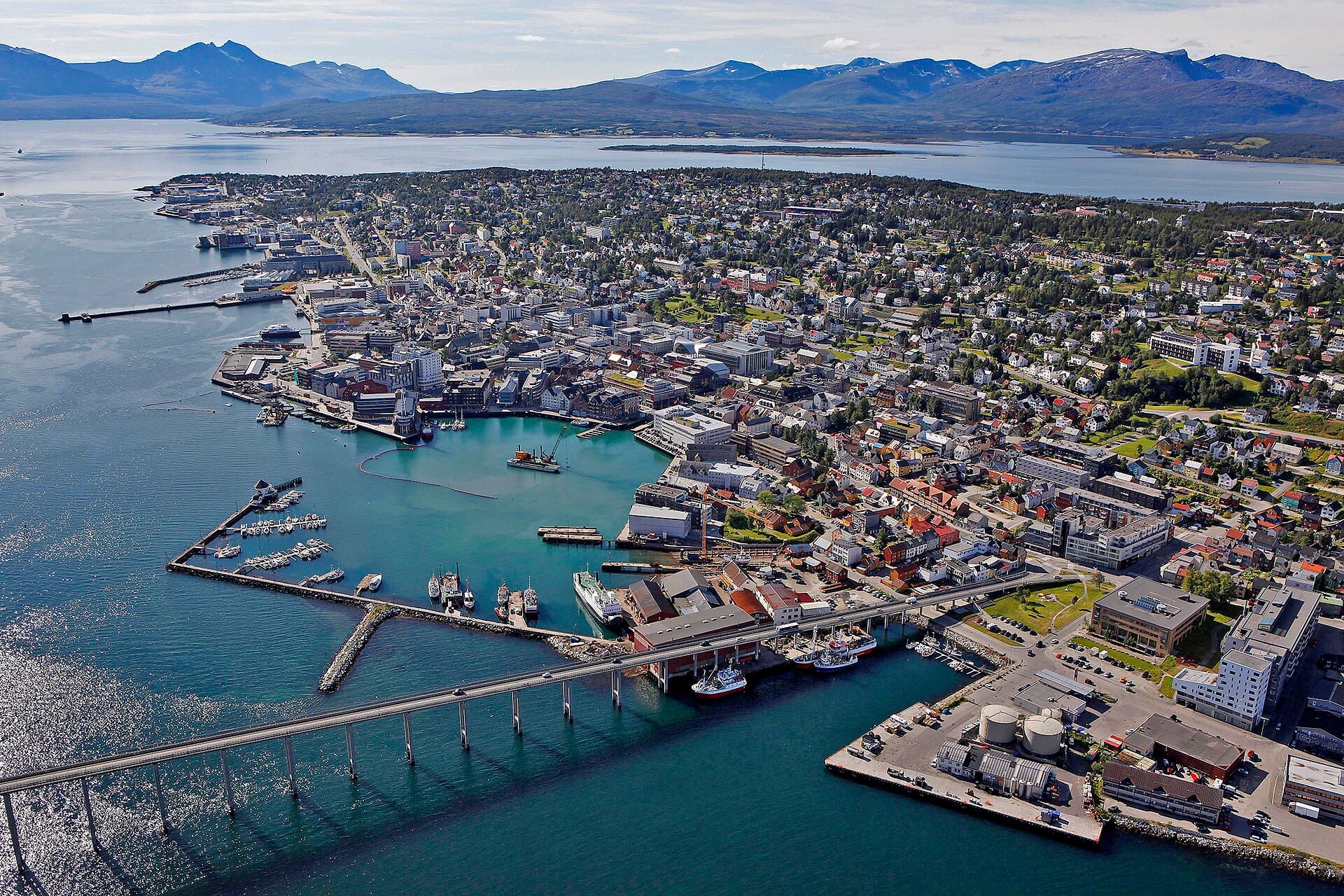 The Municipality of Tromsø from Tromsø, Norway / CC BY 2.0, via Wikimedia Commons
“Where the Arctic light paints the sky and urban life flourishes against a wild expanse.”
Not the postcards. The stories even locals don't know — whispered in your ear, right where they happened.
Tromsø earned the moniker 'Paris of the North' in the 19th century, and not just for its worldly atmosphere.
This iconic triangular church, a fixture on postcards, is not actually a cathedral in the traditional sense.
In the heart of Tromsø, a small, unassuming hut has been a local institution for over a century.
Discover every secret of Tromsø
Every address, every reveal in full — in your ear, right where it happened.
You pick your stops. You walk. The voice reveals what the others miss.
No tours available yet. Check back soon — we're preparing them.
Tromsø, the largest city in Northern Norway, rests approximately 350 kilometers (217 miles) above the Arctic Circle. Despite its far northern latitude, the city experiences milder temperatures than other areas at the same parallel, a benefit of the warming influence of the Gulf Stream. This Arctic capital, with a population approaching 80,000, extends across the island of Tromsøya, portions of the mainland, and the eastern side of Kvaløya island, all connected by a network of bridges and tunnels.
Known as the 'Gateway to the Arctic,' Tromsø is a lively cultural center, presenting a singular blend of outdoor excursions, cultural happenings, and a dynamic culinary landscape. It is a place where one can observe the ethereal Northern Lights in winter and experience the continuous daylight of the Midnight Sun in summer. The city's distinct character is further enhanced by its collection of old wooden houses, some dating back to 1789, creating a truly captivating destination.
The history of human habitation in the Tromsø region extends back to the end of the Ice Age, with archaeological evidence reaching as far back as 10,000 years. The area was initially home to the Sami people, Norway's indigenous population, and later to Norse cultures, with records indicating a Norse presence from the early Medieval era.
In 1250, Tromsø was established as a settlement, though it did not receive its official city charter until 1794 from King Christian VII. At this time, the population numbered only about 80 individuals, not including children under 14. The city's expansion was significantly propelled by the establishment of the diocese of Hålogaland in 1804. Throughout the 19th century, Tromsø prospered as a center for Arctic hunting, trapping, fishing, and trade, drawing international visitors and earning it the designation 'Paris of the North' due to the unexpected refinement and fashion sense of its inhabitants.
Tromsø's strategic location also rendered it a pivotal starting point for numerous Arctic expeditions by renowned explorers such as Roald Amundsen and Fridtjof Nansen in the early 20th century, cementing its reputation as the 'Gateway to the Arctic.' During World War II, Tromsø served as a refuge for Norway's exiled government and a base for Allied Forces. Notably, the German battleship Tirpitz was sunk near Tromsø by the British Royal Air Force during the conflict.
The mid-20th century brought significant infrastructure development, including the construction of the Tromsø Bridge in 1960, connecting the island to the mainland, and the opening of the Fjellheisen cable car in 1961. The distinctive Arctic Cathedral was completed in 1965, and the University of Tromsø, the world's northernmost university, opened in 1972. Today, Tromsø continues to be an essential center for Arctic research, education, and tourism.
Tromsø offers a range of sights and activities, weaving together Arctic nature with urban culture. The Arctic Cathedral (Ishavskatedralen), with its distinctive triangular form inspired by Arctic landscapes, stands as a prominent landmark. While striking from a distance, it also hosts concerts. For sweeping views of the city, islands, and fjords, take the Fjellheisen cable car up Mount Storsteinen. You can ascend by cable car and even descend the 1,203 Sherpa steps.
Delve into the city's past at the Polar Museum, which chronicles Tromsø's history as a center for Arctic hunting and expeditions, including those of celebrated polar explorers. The Polaria experience center provides insights into Arctic wildlife and features an aquarium with seals. For a singular botanical experience, visit the Arctic-Alpine Botanic Garden, the world's northernmost botanical garden, displaying plants from polar and alpine regions. The Tromsø University Museum focuses on nature, Sami culture, and natural history. Take time for a walk through the city center to admire the historic wooden houses, some dating back to 1789.
Tromsø welcomes visitors year-round, with distinct experiences offered by its extreme natural phenomena. For observing the Northern Lights, the optimal period spans from September to March, with peak viewing from November to February due to maximum darkness during the polar night. The polar night in Tromsø generally lasts from late November to mid-January, when the sun does not ascend above the horizon, creating a singular twilight glow. Winter also presents activities like whale watching (October to January), dog sledding, and snowmobiling.
For the Midnight Sun, plan your visit from late May to late July, when the sun remains above the horizon for 24 hours. This period is ideal for hiking, kayaking, and enjoying extended outdoor activities in continuous daylight. Shoulder seasons (April-May and September-October) offer fewer crowds and moderate prices, with opportunities to see the Northern Lights in early spring or autumn.
Tromsø Airport (TOS) is situated approximately 6 kilometers from the city center on Tromsøya island. You have several options for reaching the city: taxis are the swiftest, while public buses (lines 40, 42, and 24) are more economical, taking around 15-25 minutes. The Airport Express bus (Flybussen) offers a direct route, aligning with flight schedules and stopping at major hotels in about 20 minutes.
Norway's currency is the Norwegian Krone (NOK), and credit cards are widely accepted. Tap water in Tromsø is of high quality and safe to drink, so bringing a reusable bottle is recommended. The standard voltage is 230 V with Type F power sockets. Weather can shift rapidly, so layered clothing and a rain jacket are advisable, especially when venturing into the mountains or by the sea. If reserving tours, inquire if thermal suits or boots are provided, as temperatures in areas outside the city can be significantly colder.