Trim Castle Keep
The central tower of Trim Castle isn't just massive; its unique design held a secret that made it incredibly difficult to conquer.
Full story unlocks in the tour
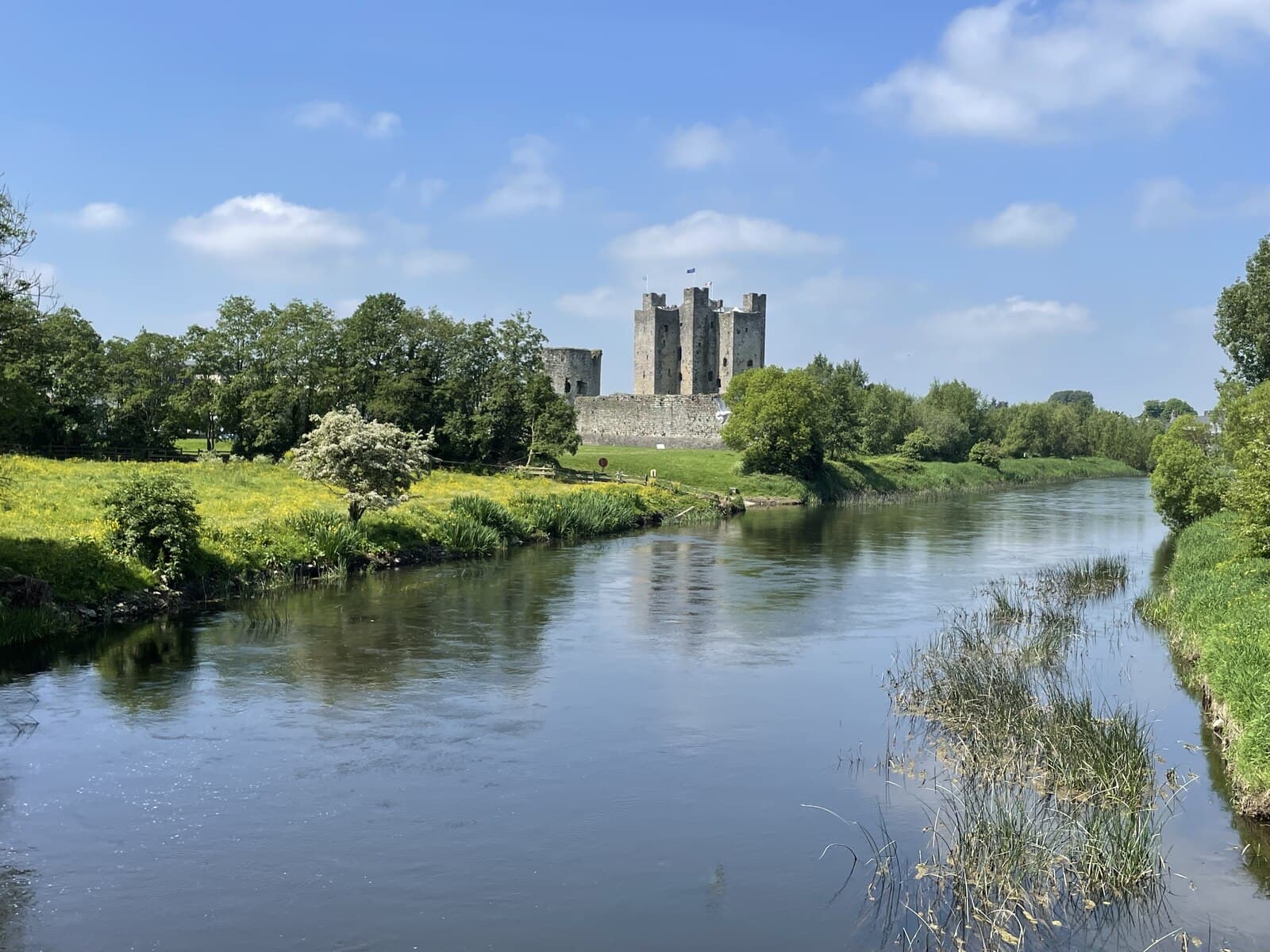 Nigel Thompson / CC BY-SA 2.0, via Wikimedia Commons
“Where Norman might meets ancient Irish echoes along the Boyne.”
Not the postcards. The stories even locals don't know — whispered in your ear, right where they happened.
The central tower of Trim Castle isn't just massive; its unique design held a secret that made it incredibly difficult to conquer.
This imposing ruin, once part of a thriving abbey, was a site of extraordinary devotion, attracting pilgrims from across Ireland for a particular reason.
The town's courthouse, a grand 19th-century building, stands on a site with a much older, and surprising, connection to the river.
Discover every secret of Trim
Every address, every reveal in full — in your ear, right where it happened.
You pick your stops. You walk. The voice reveals what the others miss.
No tours available yet. Check back soon — we're preparing them.
Trim, a designated Heritage Town in County Meath, Ireland, offers a tangible journey into the country's medieval past. Resting on the banks of the River Boyne, the town is dominated by the imposing silhouette of Trim Castle, the largest Anglo-Norman castle in Ireland. Beyond the castle walls, Trim unfolds with a collection of ancient ruins, historic churches, and a delightful town center, all reflecting centuries of Irish life.
Known as 'Baile Átha Troim' in Irish, meaning 'Town of the Ford of the Elder Trees,' Trim's strategic location at a crossing point on the Boyne has shaped its development since early Christian times. From the legendary founding of a monastery by St. Patrick to its pivotal role as a Norman stronghold, Trim has witnessed significant historical events. Today, it invites visitors to explore its well-preserved heritage, offering a blend of grand historical sites and the intimate character of a traditional Irish town.
The town's compact nature makes it ideal for exploration on foot, with self-guided trails leading to its most significant landmarks. Whether you are drawn to the sheer scale of its medieval fortifications, the quiet contemplation of ancient abbeys, or the stories embedded in its streets, Trim provides a rich and accessible experience of Ireland's layered history.
The origins of Trim stretch back to an ancient ford across the River Boyne, a strategic crossing point that gave the town its Irish name, 'Baile Átha Troim' or 'Town of the Ford of the Elder Trees.' Legend suggests that St. Patrick and his nephew, St. Loman, established a church here in the 5th century on land granted by the son of the High King. This early ecclesiastical site flourished, though it was repeatedly burned in the early Middle Ages.
The town's trajectory changed dramatically with the Anglo-Norman conquest of Ireland. In 1172, King Henry II granted the Lordship of Meath to Hugh de Lacy, a powerful Norman baron. De Lacy, aiming to counterbalance the influence of Richard de Clare (Strongbow), chose Trim as the center of his new lordship. He initially constructed a wooden castle with a spiked stockade on the site of an earlier ringfort. This initial fortification was attacked and burned by Ruaidrí Ua Conchobair, the Gaelic High King of Ireland, in 1174.
Undeterred, de Lacy and later his son Walter embarked on a massive rebuilding project, constructing the stone fortress that stands today. Over a period of 30 years, they built Trim Castle, which became the largest Anglo-Norman castle in Ireland. The central three-story keep, with its unique cruciform shape and twenty corners, was a formidable defensive structure completed by the 1220s. The castle remained in the de Lacy family until 1308, after which it passed through various wealthy owners, including Geoffrey de Geneville and Roger Mortimer.
In the later medieval period, Trim became an important frontier town, hosting parliaments on seven occasions in the 15th century. However, by the 16th century, the castle began to decline. It was refortified during the Irish Confederate Wars in the 1640s, but in 1649, Oliver Cromwell's army occupied it after the garrison fled. The castle was granted to the Wellesley family in the 1680s, and eventually sold to the Dunsany Plunketts, who left the grounds open. The Irish Government acquired Trim Castle in 1993, undertaking a significant restoration before opening it to the public in 2000.
Beyond the castle, Trim's history is etched in other structures. The Yellow Steeple, a prominent ruin overlooking the town, was once the bell tower of St. Mary's Augustinian Abbey, dating to 1368. This abbey was a significant pilgrimage site. The town's medieval walls, built between 1289 and 1290, once enclosed 23 hectares, with the Sheep Gate being the only surviving original gateway. The 19th century saw the construction of the Trim Courthouse and the Wellington Monument, honoring Arthur Wellesley, the Duke of Wellington, who spent part of his childhood nearby.
Begin your exploration at the Trim Visitor Centre, where you can gather maps and information, and even experience a medieval armory exhibition. Just outside, the colossal Trim Castle awaits. As Ireland's largest Anglo-Norman castle, it offers self-guided tours of its grounds and a guided tour of the unique cruciform-shaped keep, providing access to its interior. Do not miss the impressive curtain walls and the Barbican Gate.
Across the River Boyne, the striking Yellow Steeple dominates the skyline. This 40-meter tall ruin is the most prominent remnant of St. Mary's Augustinian Abbey, a significant medieval pilgrimage site. Nearby, the Sheep Gate is the only surviving medieval gateway to the town, offering a glimpse of Trim's once-fortified past.
Follow the Trim Castle River Walk for scenic views of the castle and surrounding ruins, or take the Trim Historic Trail to discover other landmarks like St. Patrick's Church, the Wellington Monument, and the site of the Tomb of the Jealous Man and Woman. A short drive downstream leads to the ruins of Newtown Trim, including a medieval cathedral and two monasteries, representing a failed attempt to establish a rival town.
The ideal time to visit Trim for general outdoor activities is from late June to late August, with a peak in the third week of July, when temperatures are comfortable and days are clearer. The warm season extends from June to September, offering average daily high temperatures above 63°F. For those seeking to avoid larger crowds while still enjoying mild weather and longer daylight hours, late spring (April and May) and early autumn (September and October) are also excellent choices. Some attractions may have reduced hours or close in the winter months, so it is advisable to check in advance during that period.
Trim is located in County Meath, approximately 25 miles from Dublin, making it accessible for day trips or longer stays. If driving from Dublin, take the M50 ring road and then the M3, exiting onto the R154 to Trim. Public parking is available in Trim Town Centre, with pay-and-display options from 9:00 to 18:00, Monday to Saturday, at an hourly rate of €1.00. An all-day parking option for €3.00 is available at Emmet Street Car Park, a short walk from Trim Castle.
The Trim Visitor Centre, located adjacent to the castle grounds, is an excellent starting point for your visit, offering maps, brochures, and information on local accommodations and dining. Guided tours of Trim Castle are available, and it is recommended to check their schedule, especially for winter visits, as this is the only way to see inside the keep. Comfortable walking shoes are advisable for exploring the castle grounds and the town's historic trails.