Chiesa di Sant'Agostino
This 14th-century church holds a secret about finding true love.
Full story unlocks in the tour
 ChrisO / CC BY-SA 3.0, via Wikimedia Commons
“Where ancient trade winds carry the scent of salt, the call of the sea, and the enduring Sicilian spirit.”
Not the postcards. The stories even locals don't know — whispered in your ear, right where they happened.
This 14th-century church holds a secret about finding true love.
The iconic windmills of Trapani's salt pans are not merely decorative.
Observe the architecture along Trapani's main thoroughfare, and you might notice an unexpected detail.
Discover every secret of Trapani
Every address, every reveal in full — in your ear, right where it happened.
You pick your stops. You walk. The voice reveals what the others miss.
No tours available yet. Check back soon — we're preparing them.
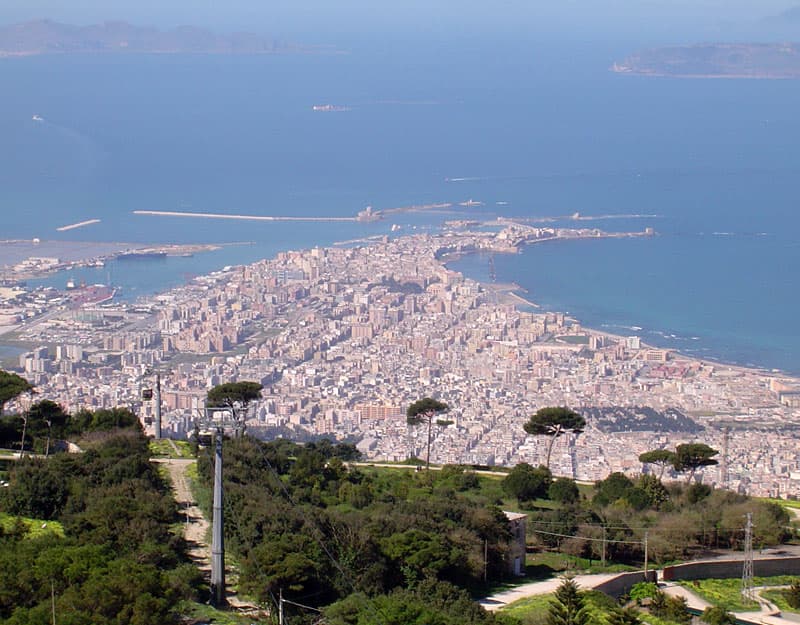
Trapani, a city shaped like a sickle along Sicily's western coastline, presents a singular blend of history, natural splendor, and a leisurely pace of life. Its strategic position, where the Tyrrhenian and Mediterranean seas converge, has made it a significant port for millennia, shaping its culture, cuisine, and urban landscape. The city's historic core, with its narrow, winding lanes and Baroque architecture, invites wanderers to uncover layers of its past beneath the warm Sicilian sun.
Beyond its architectural allure, Trapani acts as a gateway to some of western Sicily's most captivating experiences. From the ancient salt pans with their distinctive windmills to the nearby Egadi Islands and the medieval hilltop settlement of Erice, the city serves as an ideal base for exploring the region's diverse offerings. Trapani's identity is profoundly linked to the sea, evident in its fishing heritage, celebrated seafood cuisine, and the enduring customs that continue to define daily existence.
The earliest settlement at Trapani, known in antiquity as Drepana (Greek for "sickle" due to its harbor's shape), began as a port for the Elymian center of Eryx (modern Erice) around the 5th century BC. Its strategic location quickly drew the attention of powerful civilizations. Carthage gained control in 260 BC, transforming it into a vital naval base against Rome. However, Roman dominion was established after the Battle of the Aegates Islands in 241 BC during the First Punic War.
Following the decline of Roman authority, Trapani experienced various phases of early medieval control, a common pattern across much of western Sicily. A significant period of renewed development commenced in the 9th century with the Islamic conquest of the island. Under Arab governance, Trapani's harbor grew in importance within the broader economic and maritime networks of the central and western Mediterranean. The Arabs introduced a system of narrow, winding streets and cul-de-sacs, characteristic of a medina, which can still be observed in the historic center today. The Normans seized Trapani in 1077, continuing to foster its maritime trade and port.
Under subsequent dynasties, particularly Aragonese and Spanish rule, Trapani thrived as a major economic center in western Sicily. Its port supported a range of activities, including fisheries, the processing and export of sea salt from the surrounding salt pans, coral working, and extensive maritime trade. The city's defenses were considerably strengthened, with the Castello della Colombaia substantially rebuilt in 1320 under Frederick III of Aragon. Trapani faced difficulties in the 1600s, including revolts, diseases, and hunger, but its population expanded significantly in the 1700s. The city suffered severe damage during Allied bombings in World War II. In the post-war era, Trapani has grown, with its economy shifting towards services, commerce, and tourism, while still maintaining its traditional fisheries and salt production.
Begin your exploration in Trapani's historic center, a compact area easily traversed on foot, where Baroque buildings line thoroughfares like Corso Vittorio Emanuele. The Cattedrale di San Lorenzo Martire, with its impressive ceiling, stands as a notable architectural example. Be sure to observe the Torre dell'Orologio (Clock Tower), part of the oldest city gate, designed in 1596. For a window into the city's past, visit the Agostino Pepoli Regional Museum, housed in a former Carmelite convent, which displays art from the 13th to 19th centuries, including sculptures, local craftsmanship, and items related to tuna fishing.
A walk along the Mura de Tramontana, a remaining section of the old Spanish city walls, provides sweeping views of the sea, particularly at sunset. At the westernmost point of the peninsula, the Torre di Ligny, a 17th-century watchtower, now contains a museum of prehistory and marine archaeology. Just beyond the city, the Saline di Trapani e Paceco Nature Reserve is a compelling destination. Here, traditional windmills stand amidst shallow basins where sea salt has been gathered for centuries, creating a distinctive and often pink-hued landscape, especially evocative at dusk. The Salt Museum, situated in a 17th-century mill in Nubia, offers insight into this ancient industry.
The most pleasant times to visit Trapani for warm and sunny weather are May, June, and September. During these months, temperatures are agreeably warm, ranging from 72-79°F (22-26°C) in September, with comfortable sea temperatures. July and August are ideal for beach activities, though temperatures can be quite high, occasionally exceeding 104°F (40°C) during heatwaves. The clearer part of the year in Trapani typically extends from mid-June to early September. While some rain can occur in May, June, and September, July is usually the driest month.
Trapani is a modest, relaxed city with a population of approximately 55,000-70,000 residents. The historic center is largely flat and easily navigated on foot, though some paving can be uneven outside the old town. Trapani–Birgi Airport (TPS) connects the city with various Italian and European destinations. Alternatively, Palermo's Falcone–Borsellino Airport (PMO) is about a two-hour bus or train ride away. Ferries depart regularly from Trapani's port to the nearby Egadi Islands, making them readily accessible for day trips. Public buses are available for local transit, and taxis and ride-sharing services also operate. English information is often provided, and the tourism infrastructure is generally well-organized.