Pont Neuf
Despite its name, the Pont Neuf is Toulouse's oldest bridge. Yet, its construction was far from swift.
Full story unlocks in the tour
 Frédéric Neupont / CC BY-SA 4.0, via Wikimedia Commons
“Where ancient bricks glow pink and aerospace dreams take flight.”
Not the postcards. The stories even locals don't know — whispered in your ear, right where they happened.
Despite its name, the Pont Neuf is Toulouse's oldest bridge. Yet, its construction was far from swift.
This grand Romanesque basilica holds a surprising distinction beyond its architectural splendor.
A wine bar in Toulouse offers a taste of history that extends far beyond vintage bottles.
Discover every secret of Toulouse
Every address, every reveal in full — in your ear, right where it happened.
You pick your stops. You walk. The voice reveals what the others miss.
No tours available yet. Check back soon — we're preparing them.
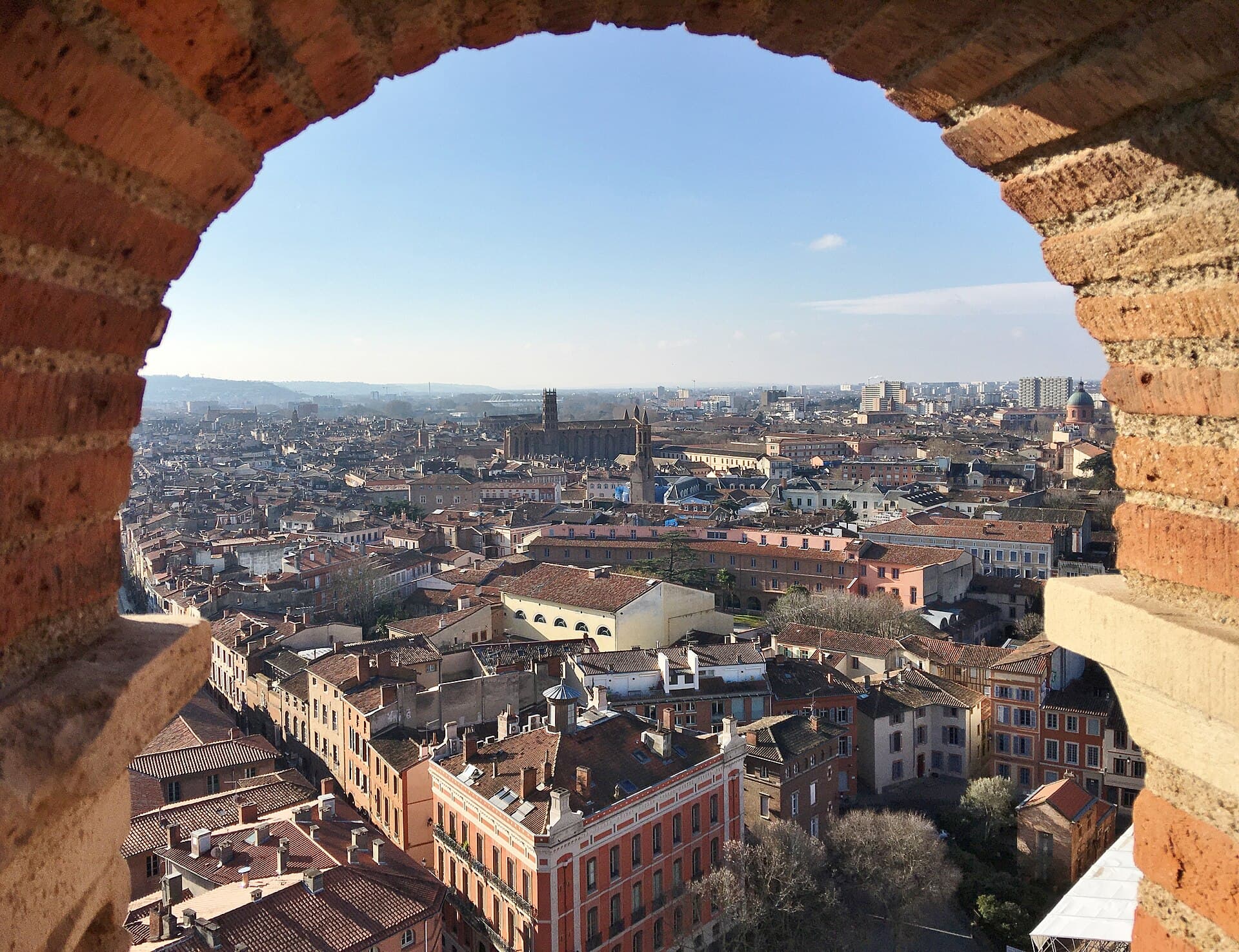
Toulouse, often known as 'La Ville Rose' (The Pink City), captivates with its distinctive architecture built from rose-hued terracotta bricks. This southern French metropolis, the fourth-largest city in France, offers a unique blend of ancient history and cutting-edge innovation. Situated on the banks of the Garonne River, Toulouse is a city where medieval churches stand comfortably alongside modern aerospace research centers, and ancient Occitan traditions intertwine with the hum of global collaboration.
The city's warm, inviting glow, especially at sunrise and sunset, is a result of the iron-rich clay used in its traditional brick construction, a practice dating back to Roman times. Beyond its visual appeal, Toulouse pulses with a relaxed southern French rhythm, shaped by pleasant weather, leisurely lunches, and a proud local identity. It's a place where you can savor traditional cassoulet in a cozy brasserie one evening and, the next, explore interactive space exhibits.
The history of Toulouse stretches back over two millennia, evolving from a Gallic settlement into a significant center of Southern France. Archaeological evidence indicates human habitation in the area as early as the 8th century BC, with the city's strategic location on the Garonne River facilitating trade between the Pyrenees, the Mediterranean, and the Atlantic.
Under Roman rule, the settlement, then known as Tolosa, flourished as a prosperous city in Roman Gaul. In the 5th century, Toulouse became the capital of a vast Visigothic Kingdom, extending from the Loire to Gibraltar, a period that laid foundational elements for the city's Christian culture and political importance. Following the Frankish conquest, Toulouse experienced a period of decline before re-emerging as the center of the powerful County of Toulouse in the 8th century, maintaining a degree of independence from the French crown for an extended period.
The 13th century marked the founding of the University of Toulouse in 1229, making it one of Europe's oldest universities, established under unique circumstances to combat heresy following the Albigensian Crusade. The city's economic fortunes saw a golden age from the mid-15th to mid-16th centuries, fueled by the lucrative trade of woad, a plant used to produce blue dye. Wealthy merchants from this era constructed numerous stately mansions, many of which still stand today.
In more modern times, Toulouse has cemented its reputation as a global leader in aerospace. It is home to the headquarters of Airbus, the largest national space center in Europe (CNES's Toulouse Space Centre), and numerous other significant aerospace companies. This blend of deep historical roots and cutting-edge industry defines the city's multifaceted character.
Begin your exploration at the Place du Capitole, a grand square flanked by cafés and dominated by the imposing Capitole building, which houses both the town hall and the Théâtre du Capitole. Inside, the Salle des Illustres is a highlight, often open for free entry. A short walk leads to the Basilica of Saint-Sernin, a UNESCO World Heritage Site and one of Europe's largest Romanesque buildings, notable for its distinctive octagonal bell tower and Romanesque sculpture.
Explore the serene Couvent des Jacobins, a striking example of Southern Gothic architecture with its unique palm tree-like column. For art enthusiasts, the Musée des Augustins, housed in a 14th-century monastery, offers a collection spanning from the Middle Ages to the early 20th century. Contemporary art can be found at Les Abattoirs, a museum located in a former 19th-century slaughterhouse.
Stroll along the Canal du Midi, another UNESCO World Heritage site, which connects Toulouse to the Mediterranean Sea and offers pleasant walking and cycling paths. The Pont Neuf, despite its name, is the oldest bridge in Toulouse and offers picturesque views of the Garonne River. For a glimpse into Toulouse's aerospace prowess, consider a visit to the Cité de l'Espace, an interactive space museum, or the Aeroscopia museum.
The best times to visit Toulouse are during the spring (April to June) and autumn (September to October). These months offer pleasant temperatures, sunny days, and fewer crowds, creating ideal conditions for sightseeing and outdoor activities. Spring sees the city's parks and riverbanks come alive with blooming flowers, while autumn provides a beautiful backdrop as leaves change color in the nearby Pyrenees foothills. While summer (July and August) is lively with festivals, it can be warmer and more crowded. Winter (October to March) is milder than much of Europe and offers lower accommodation rates, with cultural events and the chance to enjoy Toulouse's signature dish, cassoulet.
Toulouse-Blagnac Airport (TLS) is located about 7 kilometers (4.3 miles) from the city center. You can reach the city center by tram (T2 line), which takes approximately 35 minutes and costs around €1.70. Alternatively, an airport shuttle bus runs every 16-20 minutes, with a journey time of 20 to 45 minutes depending on traffic. A single shuttle ticket costs €8.50 and is valid across the entire public transport network.
Within Toulouse, the public transport network, Tisséo, is efficient and comprehensive, comprising two metro lines (A and B), two tram lines, and an extensive bus network. A free electric shuttle bus, the Navette Centre Ville Gratuite, operates in the historic center every day except Sunday, running every 10 minutes. For those who enjoy cycling, VélôToulouse offers a public bike-sharing service with numerous stations across the city.