The Brutus Stone
A simple granite boulder set into Totnes's Fore Street carries a fabled claim to the very genesis of Britain.
Full story unlocks in the tour
 Caromiajardine / CC BY-SA 4.0, via Wikimedia Commons
“Where ancient myths meet a singular contemporary spirit on the River Dart.”
Not the postcards. The stories even locals don't know — whispered in your ear, right where they happened.
A simple granite boulder set into Totnes's Fore Street carries a fabled claim to the very genesis of Britain.
This enduring structure has served many purposes, from monastic quarters to judicial chambers, and once welcomed a notable figure from English history for pivotal discussions.
Beyond its function as a transport nexus, the railway station once displayed a bold, politically charged declaration, impossible to ignore for thousands of daily travelers.
Discover every secret of Totnes
Every address, every reveal in full — in your ear, right where it happened.
You pick your stops. You walk. The voice reveals what the others miss.
No tours available yet. Check back soon — we're preparing them.
Totnes, a market town in Devon, England, is a place where centuries of human endeavor intertwine with a distinctive contemporary culture. Situated at the head of the River Dart estuary, it is recognized for its independent spirit, a steadfast commitment to sustainability, and a lively community that embraces alternative lifestyles. The town's unique character has garnered it descriptions such as 'the capital of new age chic' by Time magazine and one of the 'Top 10 Funky Towns' by British Airways Highlife magazine.
From its Norman castle surveying the town to its medieval high street, Totnes offers a journey through time. The town's independent shops, diverse eateries, and bustling markets reflect a strong local economy and a preference for ethical and locally sourced goods. Whether exploring its ancient landmarks or enjoying its modern-day offerings, Totnes presents a memorable experience.
## From Saxon Stronghold to Norman Conquest Totnes' recorded history begins in 907 AD, when King Edward the Elder fortified the area, establishing it as a burh – a fortified settlement designed to defend against Viking incursions. Its strategic location at the highest navigable point of the River Dart, where an ancient path allowed river crossings at low tide, made it an ideal center for trade and defense. Between 959 and 1100 AD, Totnes even minted its own coins, signaling its significance as a trading hub.
The Norman Conquest profoundly reshaped Totnes. William the Conqueror granted the settlement to Judhael of Totnes, a Breton knight, who likely oversaw the construction of the original motte-and-bailey castle around 1087. This classic Norman fortification, with its elevated man-made mound and enclosed courtyard, remains today, now cared for by English Heritage. Judhael also established a Benedictine priory, on the site where St Mary's Church now stands.
## Medieval Prosperity and Tudor Transformations By the 12th century, Totnes had grown into a significant market town, benefiting from its position on major South West roads and easy access to the River Dart. Its increasing wealth led King John to grant Totnes a royal charter in 1206, making it the second town in Britain to receive such an honor. This charter empowered the town to create its own laws and establish a merchant's guild, further invigorating its trade. During the 13th and 14th centuries, Totnes Castle underwent major remodeling, including the construction of the circular stone keep visible today.
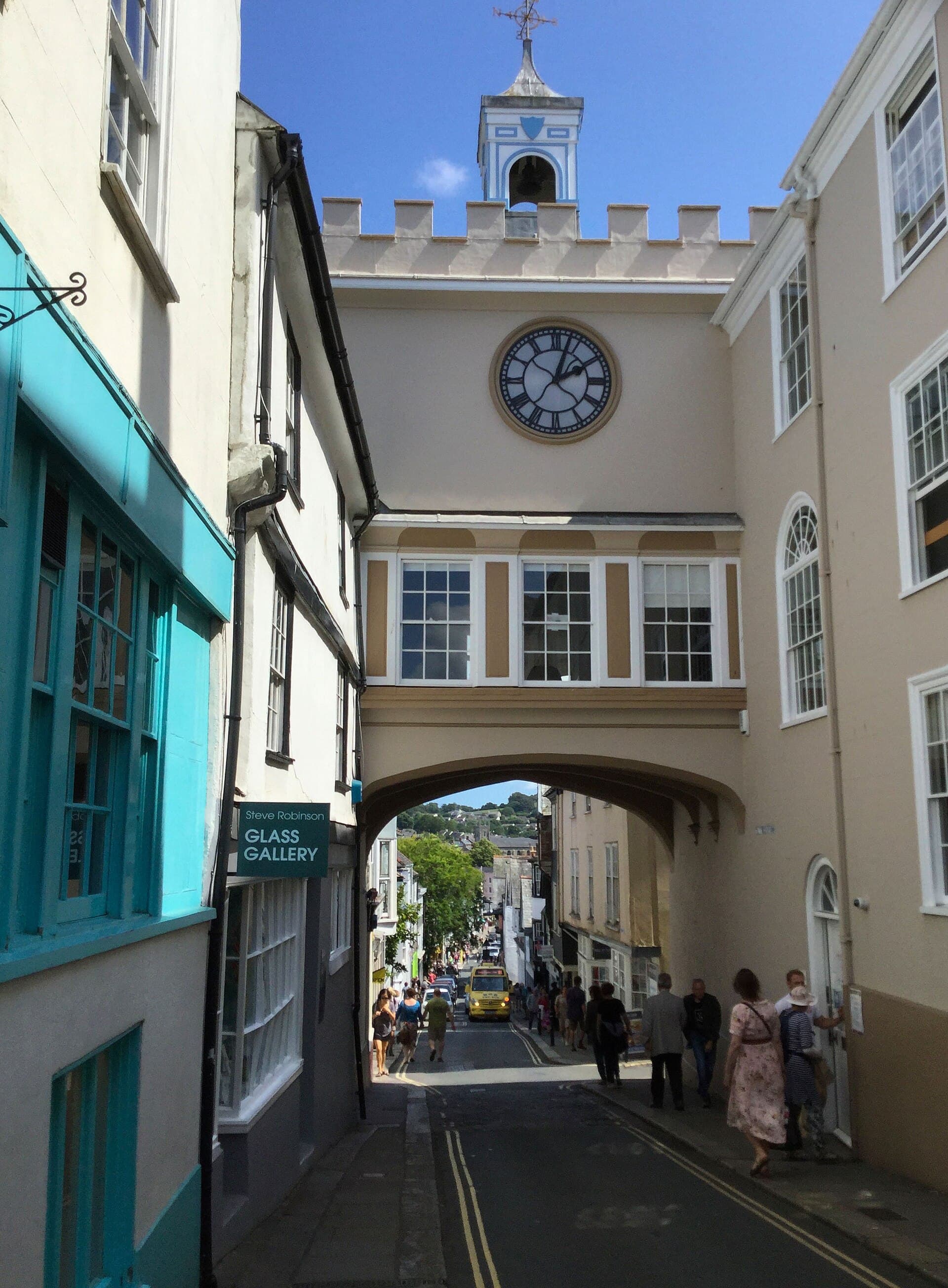
The 15th century saw Totnes ascend to become the second wealthiest town in Devon, a leader in the cloth trade, and an important exporter of tin. The prosperity of this era led to the rebuilding of St Mary's Church. The Tudor period brought further architectural developments, including the Butterwalk, a covered arcade constructed in the 16th century to shelter dairy stalls. The Elizabethan Eastgate, an arch spanning the main street, served as an entrance to the walled town.
## Modern Era and Independent Spirit By the 18th century, the cloth trade receded, and Totnes increasingly relied on its role as a market town for a fertile agricultural region and a river trading point. The town continued its expansion, with a new bridge built in 1828, leading to the development of Bridgetown. The arrival of the railway in 1847 further stimulated its growth and connectivity.
In recent times, Totnes has cultivated a reputation as a center for arts, alternative lifestyles, and sustainability. It is known for its independent shops, ethical trade, and a community actively engaged in environmental consciousness, exemplified by the Transition Town movement.
Begin your exploration at Totnes Castle, a well-preserved Norman motte-and-bailey fortress offering sweeping views of the town and the River Dart valley. Descend into the town to discover the Brutus Stone on Fore Street, a granite boulder full of the legend of Britain's mythical founder.
Walk along the High Street, observing the distinctive Elizabethan Eastgate Arch and the Butterwalk, a Tudor covered walkway that once sheltered market stalls. The Totnes Guildhall, a building with a history extending back to an 11th-century priory, also warrants a visit. Do not overlook St Mary's Church, a 15th-century structure built of striking red Devonian sandstone.
For shopping, Totnes' High Street is celebrated for its independent retailers, offering everything from artisan crafts to ethical goods. The town hosts regular markets, including weekly markets on Fridays and Saturdays, an Elizabethan market on Tuesday mornings (May-September) where traders dress in period costumes, and a Sunday Food Market on the third Sunday of each month. Consider a river trip on the Dart or explore the nearby Dartington Estate for its gardens and cultural offerings.
The most favorable time to visit Totnes for warm-weather activities is from late June to early September. During these months, the average daily high temperature exceeds 64°F (18°C), with July being the warmest month, averaging 67°F (19°C). Skies are also clearest in July, with less precipitation. While October is moderately cool and slightly breezy, with temperatures between 51-58°F (10-15°C), it can still be a pleasant time to visit for cultural events. Winters are long, wet, and cold.
Totnes is readily accessible by rail, with its station located about a 10-minute walk from the town center on the mainline from London Paddington to Penzance. National Express also provides direct coach services to Totnes, stopping on Coronation Road. If driving, Totnes is about a 15-minute drive from the A38 at Buckfastleigh, with public EV charging points available.
The town center is built on a steep incline, with the castle at the summit and the river quay at the base, so comfortable walking shoes are advisable. Many of the town's attractions are within walking distance of each other. For a unique shopping experience, be aware that Totnes once had its own local currency, the Totnes Pound, designed to support local businesses. While it is equivalent to Pounds Sterling, the initiative underscores the town's independent ethos.