The Leaning Tower of Toruń
This medieval tower isn't just crooked; it's a test of your moral compass.
Full story unlocks in the tour
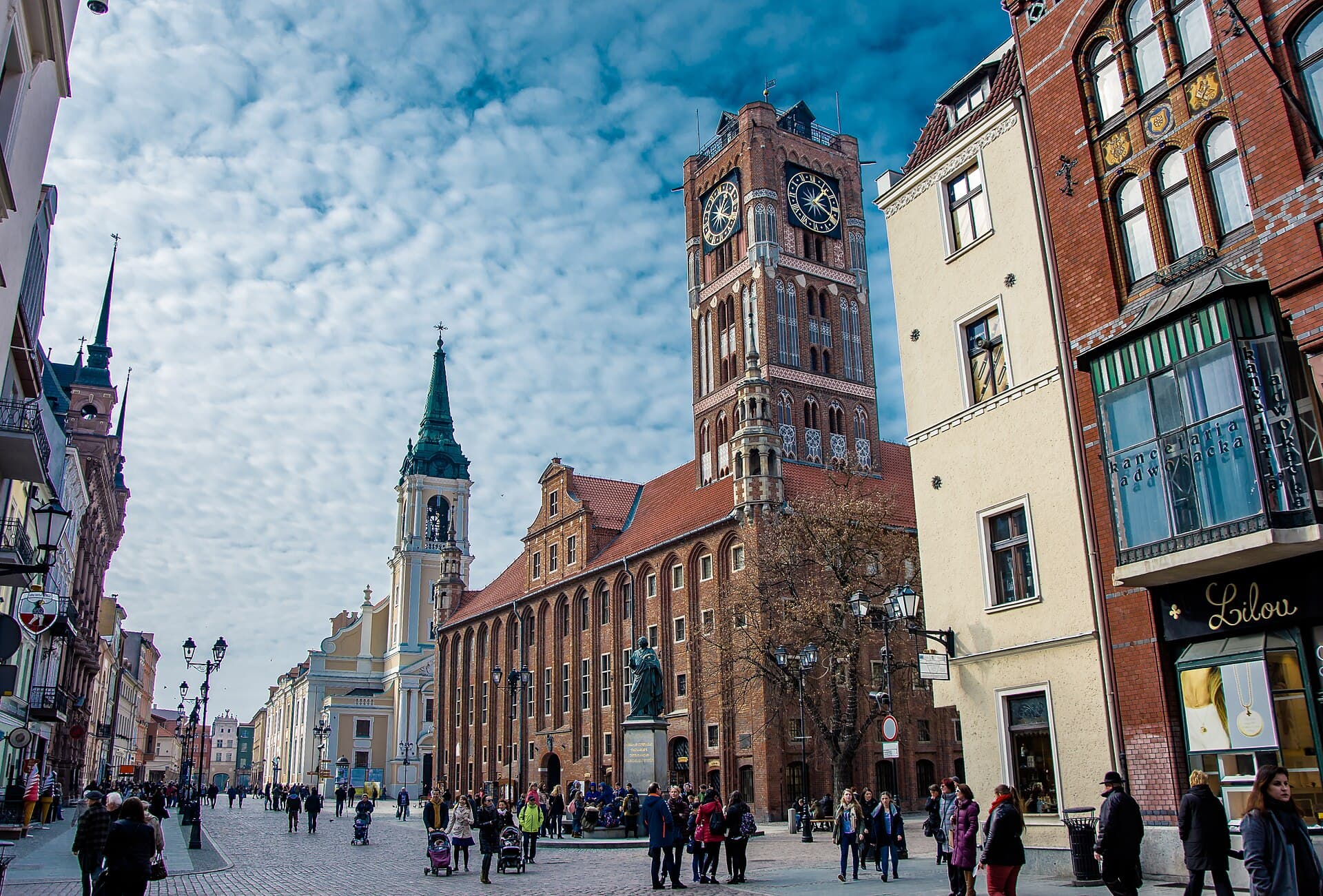 Domun / CC BY 3.0, via Wikimedia Commons
“Where Gothic spires meet celestial wonders and gingerbread dreams.”
Not the postcards. The stories even locals don't know — whispered in your ear, right where they happened.
This medieval tower isn't just crooked; it's a test of your moral compass.
Toruń's celebrated gingerbread wasn't always just a sweet confection.
The birthplace of a groundbreaking astronomer conceals a secret about his broader contributions.
Discover every secret of Toruń
Every address, every reveal in full — in your ear, right where it happened.
You pick your stops. You walk. The voice reveals what the others miss.
No tours available yet. Check back soon — we're preparing them.
Toruń, a city in north-central Poland along the Vistula River, offers a voyage into the past. Its medieval Old Town, recognized as a UNESCO World Heritage Site since 1997, remains remarkably intact, having largely evaded destruction during World War II. The city's original street configuration and exceptional early buildings present a complete portrayal of medieval life. Toruń is also known as the birthplace of the astronomer Nicolaus Copernicus, born in 1473, whose heliocentric theory reshaped our comprehension of the cosmos.
Beyond its historical importance, Toruń functions as a lively cultural center and a significant academic hub, housing Nicolaus Copernicus University. The city's allure extends to its culinary heritage, particularly its renowned gingerbread, which has been crafted here since the Middle Ages. Whether you are exploring Gothic architecture, delving into scientific history, or savoring local delicacies, Toruń provides a captivating encounter.
The city's medieval legacy, interwoven with its spirited contemporary atmosphere, renders it an engaging destination for travelers seeking a fusion of history, culture, and distinctive local tastes.
The earliest archaeological evidence of habitation in the Toruń area dates back to 1100 BCE, attributed to the Lusatian culture. From the 7th to the 13th centuries, an Old Slavic settlement flourished at a ford in the Vistula River, becoming part of the emerging Polish state in the 10th century. The city we recognize today began its formation in 1231 when the Teutonic Knights established a fortress. They officially granted town charters for Toruń and Chełmno in 1233. The current city plan was laid out in 1236.
Throughout the 14th century, Toruń's strategic placement on the Vistula River helped it become a prominent trading point. The city joined the Hanseatic League in 1264 and maintained its own merchant fleet, engaging extensively in trade with the Netherlands. This era of prosperity significantly influenced Toruń's architecture, which displays styles from Brick Gothic to Mannerist and Baroque. In 1440, the gentry of Toruń co-founded the anti-Teutonic Prussian Confederation, eventually leading to the overthrow of Teutonic rule in 1454. By 1466, Toruń was declared a free city under Polish administration, benefiting from economic advantages granted by Polish kings.
In the early modern period, Toruń was a royal city of Poland and among the country's four largest urban centers. The royal mint began operating in Toruń in 1528, and a gymnasium established in 1568 became one of northern Poland's leading schools. The city embraced Protestantism in 1557 during the Reformation. However, its autonomy faced challenges over centuries, with periods under Prussian rule, commencing in 1793. Napoleon's conquests briefly made Toruń part of the Polish Duchy of Warsaw in 1807, even serving as its temporary capital in 1809. Prussia re-annexed the city after Napoleon's defeat in 1814.
Poland regained its independence in 1918, and the Treaty of Versailles in 1919 officially returned Toruń to Poland, where it became the capital of the Pomeranian Voivodeship. The interwar period witnessed considerable urban development. Crucially, unlike many other Polish cities, Toruń's Old Town remained largely undamaged during World War II, allowing its historical buildings to endure intact. This remarkable preservation led to its inscription as a UNESCO World Heritage Site in 1997, acknowledging its "exceptionally complete picture of the medieval way of life."
Begin your exploration in the Old Town Market Square, a central point where you'll find the impressive Old Town Hall. This Gothic structure, among the most imposing in Northern Europe, now houses the District Museum and offers sweeping views of the city from its tower.
No visit to Toruń is complete without experiencing its connection to Nicolaus Copernicus. Visit the House of Nicolaus Copernicus, now a museum, to learn about the life of the celebrated astronomer. Nearby, the Toruń Planetarium offers an opportunity to explore the cosmos that captivated Copernicus.
Discover the city's defensive past at the Teutonic Castle Ruins, a testament to the city's origins. Walk along sections of the medieval city walls, including the Sailor's Gate, and seek out the intriguing Leaning Tower of Toruń, a medieval defensive tower with a noticeable tilt.
Immerse yourself in the city's sweet tradition at the Living Gingerbread Museum or the Museum of Toruń Gingerbread, where you can learn about the history and even participate in gingerbread-making workshops.
Admire the intricate Gothic architecture of Toruń's churches, such as the Cathedral of SS John the Baptist and John the Evangelist, where Copernicus was baptized, and the Church of St. James.
Toruń experiences a temperate continental climate with four distinct seasons. The warmest and most agreeable months are generally June, July, and August, with average daytime temperatures ranging from 23°C to 24.3°C. This period is ideal for walking and exploring. Spring and autumn offer milder temperatures, with spring seeing a gradual rise from 4°C to 18°C and autumn a decrease from 19°C to 5°C. Winters are cool, with average temperatures around freezing. Precipitation is relatively evenly distributed throughout the year, with July typically being the wettest month and February or April the driest. For warm-weather activities, mid-June to late August is considered the best time to visit.
Poland's currency is the Polish Złoty (PLN). While Toruń does not possess its own passenger airport, the nearest is Bydgoszcz (BZG) Airport, approximately 50 km distant. Other accessible airports include Gdańsk (GDN), Poznań (POZ), Warsaw Modlin (WMI), and Warsaw Chopin (WAW). From these airports, you can reach Toruń by train or bus.
Within Toruń, public transport is provided by numerous bus connections and several tram lines operated by Miejski Zakład Komunikacji (MZK Toruń). Daily lines typically operate from around 5:00 a.m. to 11:00 p.m., with a few night bus lines running afterward. Single-journey tickets are available for purchase at ticket machines in some vehicles, at specific stops, or via mobile applications like MoBILET, SkyCash, and mPay. Taxis and ride-sharing services like Uber and Bolt are also available.