Palazzo Madama
This imposing palace in Piazza Castello has stood for two millennia, evolving from a Roman gate to a royal residence. But it holds a secret about its most influential inhabitants.
Full story unlocks in the tour
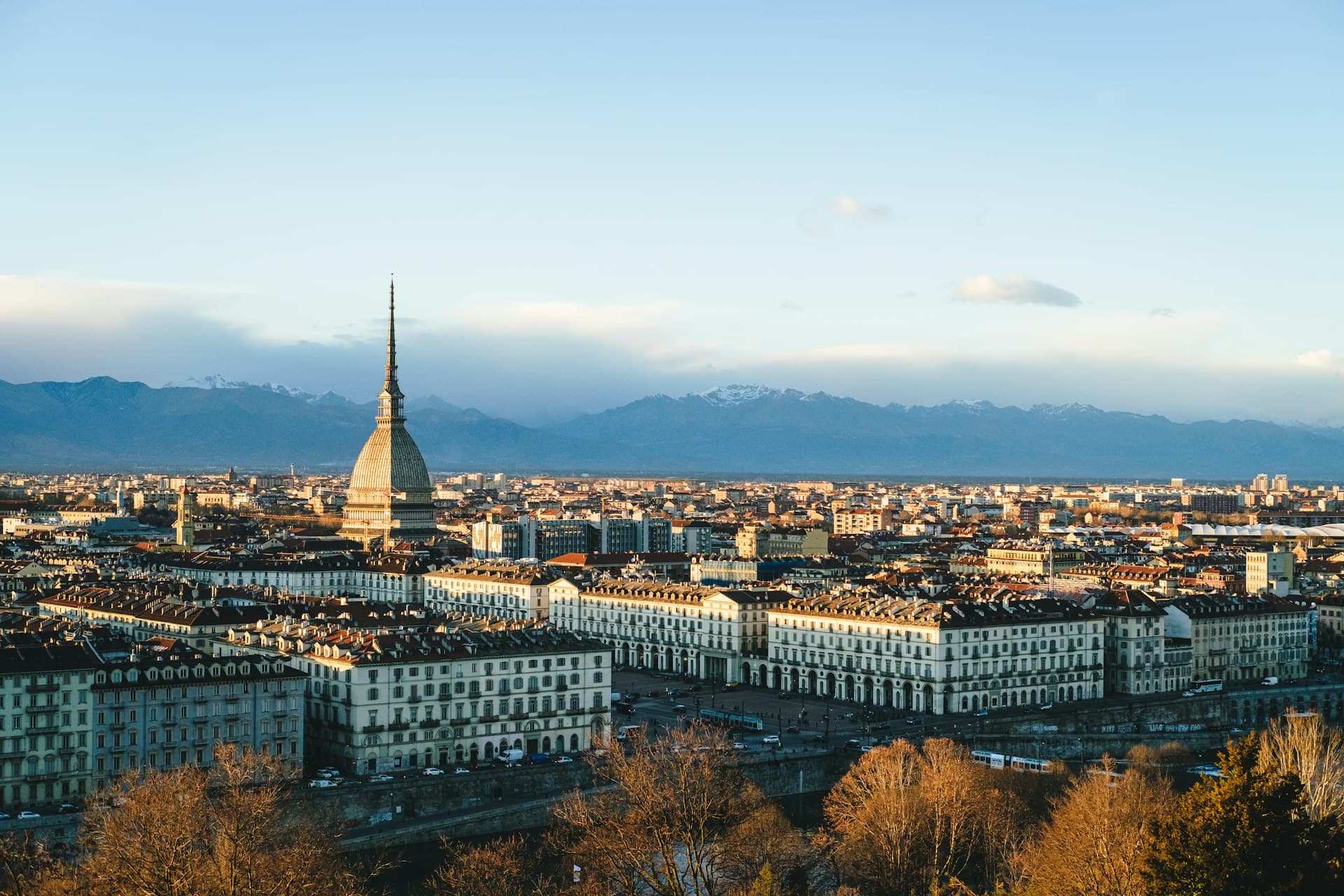 Photo: Fabio Fistarol / Unsplash
“Turin: where grand history meets everyday elegance.”
Not the postcards. The stories even locals don't know — whispered in your ear, right where they happened.
This imposing palace in Piazza Castello has stood for two millennia, evolving from a Roman gate to a royal residence. But it holds a secret about its most influential inhabitants.
The iconic spire dominating Turin's skyline wasn't always destined to be the National Cinema Museum. Its original purpose, and the architect's vision, took a surprising turn.
Turin is a city synonymous with chocolate, particularly the smooth, hazelnut-infused gianduiotto. But the creation of this beloved confection was born out of an unexpected historical event.
Discover every secret of Torino
Every address, every reveal in full — in your ear, right where it happened.
You pick your stops. You walk. The voice reveals what the others miss.
No tours available yet. Check back soon — we're preparing them.
At the foot of the Alps in Italy's Piedmont region, Turin (Torino to Italians) unfolds as a city of refined elegance and unexpected depth. Often overlooked in favor of more famous Italian destinations, Turin offers a rich collection of history, art, and culinary delights, all framed by grand Baroque architecture and wide, arcaded boulevards. It's a city that invites leisurely exploration, where every piazza tells a story and every cafe holds a piece of tradition.
Turin served as Italy's first capital from 1861 to 1865, playing a pivotal role in the country's unification, known as the Risorgimento. This legacy is evident in its stately palaces and museums, which showcase the grandeur of the House of Savoy, Italy's former royal family. Beyond its royal connections, Turin is a city of innovation, the birthplace of iconic Italian brands like Fiat, Lavazza coffee, and Juventus football club.
From its world-class Egyptian Museum, holding the largest collection of ancient Egyptian artifacts outside of Cairo, to the soaring Mole Antonelliana, home to the National Cinema Museum, Turin presents a compelling blend of the ancient and the modern. The city's sophisticated atmosphere is complemented by its renowned food and wine scene, particularly its chocolates and the tradition of aperitivo.
Turin's story begins over 2,000 years ago as a Celtic settlement. In 58 BC, Julius Caesar established it as a Roman military colony, later known as Augusta Taurinorum. After the fall of the Roman Empire, it was fortified by the Ostrogoths and subsequently fell under Lombard and Frankish rule.
The city's destiny was largely shaped by the powerful House of Savoy, which gained dominance in the region by the 13th century. In 1563, Duke Emanuele Filiberto of Savoy made Turin the capital of the Duchy of Savoy, initiating a period of significant architectural and cultural development. The Savoy family's influence is still visible in the numerous royal residences, many of which are now UNESCO World Heritage Sites.
During the 19th century, Turin became the political and intellectual heart of the Risorgimento, the movement for Italian unification. From 1861 to 1865, it proudly served as the first capital of a united Italy before the capital moved to Florence and then Rome. This era saw the construction of many of the city's iconic landmarks, including the Mole Antonelliana and Piazza Vittorio Veneto.
The late 19th and early 20th centuries marked Turin's rapid industrialization, particularly in the automotive sector. Fiat was established in 1899, followed by Lancia in 1906, solidifying Turin's reputation as a major industrial center. The city also became an important hub for cinema with the founding of Ambrosio Film, Italy's first film company. Turin hosted the 2006 Winter Olympics, further cementing its place on the international stage.
Begin your exploration in Piazza Castello, a grand central square surrounded by significant landmarks. Here you'll find the Palazzo Reale, the opulent former residence of the House of Savoy, which includes the Royal Armoury with one of Europe's finest collections of arms and armor. Adjacent is Palazzo Madama, a building that has evolved from a Roman gate to a medieval castle and now houses the Museum of Ancient Arts.
A short walk leads to the Duomo di San Giovanni Battista, Turin's cathedral, which houses the revered Shroud of Turin (rarely on public display). Nearby, the ancient Roman Porta Palatina stands as one of the best-preserved Roman gates in the world.
The Mole Antonelliana, Turin's architectural symbol, is a place to discover. Take the panoramic lift for expansive 360-degree views of the city and the Alps. Inside, the National Museum of Cinema offers an engaging journey through film history. Do not miss the Museo Egizio, which holds the largest collection of Egyptian artifacts outside of Cairo.
For a taste of Turin's automotive heritage, visit the Museo Nazionale dell'Automobile. Stroll along the elegant Via Roma for high-end shopping and admire the city's characteristic arcaded sidewalks. Experience the local tradition of aperitivo in one of the city's historic cafes, such as Caffè Torino in Piazza San Carlo.
The best times to visit Turin are during spring (mid-April to mid-June) and autumn (September to October). During these months, the weather is mild and pleasant, with temperatures ranging from 12°C to 28°C in spring and 15°C to 23°C in early autumn. This period avoids the summer crowds and higher prices of July and August, when temperatures can exceed 30°C. Autumn also brings the truffle season and vivid fall colors to the nearby Piedmont vineyards. Winter (November to March) is cold and can be foggy, with occasional snow, but offers a charming atmosphere with Christmas markets and opportunities for aperitivo.
Turin Airport (TRN) is approximately 9 miles north of the city center, with transfer options including taxis, trains, and buses. The GTT train to Dora Railway Station is the most economical option. Within the city, Turin's center is compact and easily explored on foot. For longer distances, an efficient public transportation system of buses and trams is available; purchase tickets before boarding at newsstands, bars, vending machines, or via the ToMove app, and remember to validate them. Driving in the city center is not recommended due to congestion and a confusing road system. Taxis are readily available at stands near major attractions and hotels.
Consider purchasing a Torino+Piemonte Card for free entry to many museums and attractions, as well as discounts on tours. While English is spoken in tourist areas, learning some basic Italian phrases like buongiorno (good morning) and grazie (thank you) will be appreciated. Be aware that many restaurants close between lunch and dinner, typically from around 3 PM to 7:30 PM.