Cosmovitral Botanical Garden
This botanical garden, a marvel of glass and greenery, occupies a structure that once hummed with a very different kind of commerce.
Full story unlocks in the tour
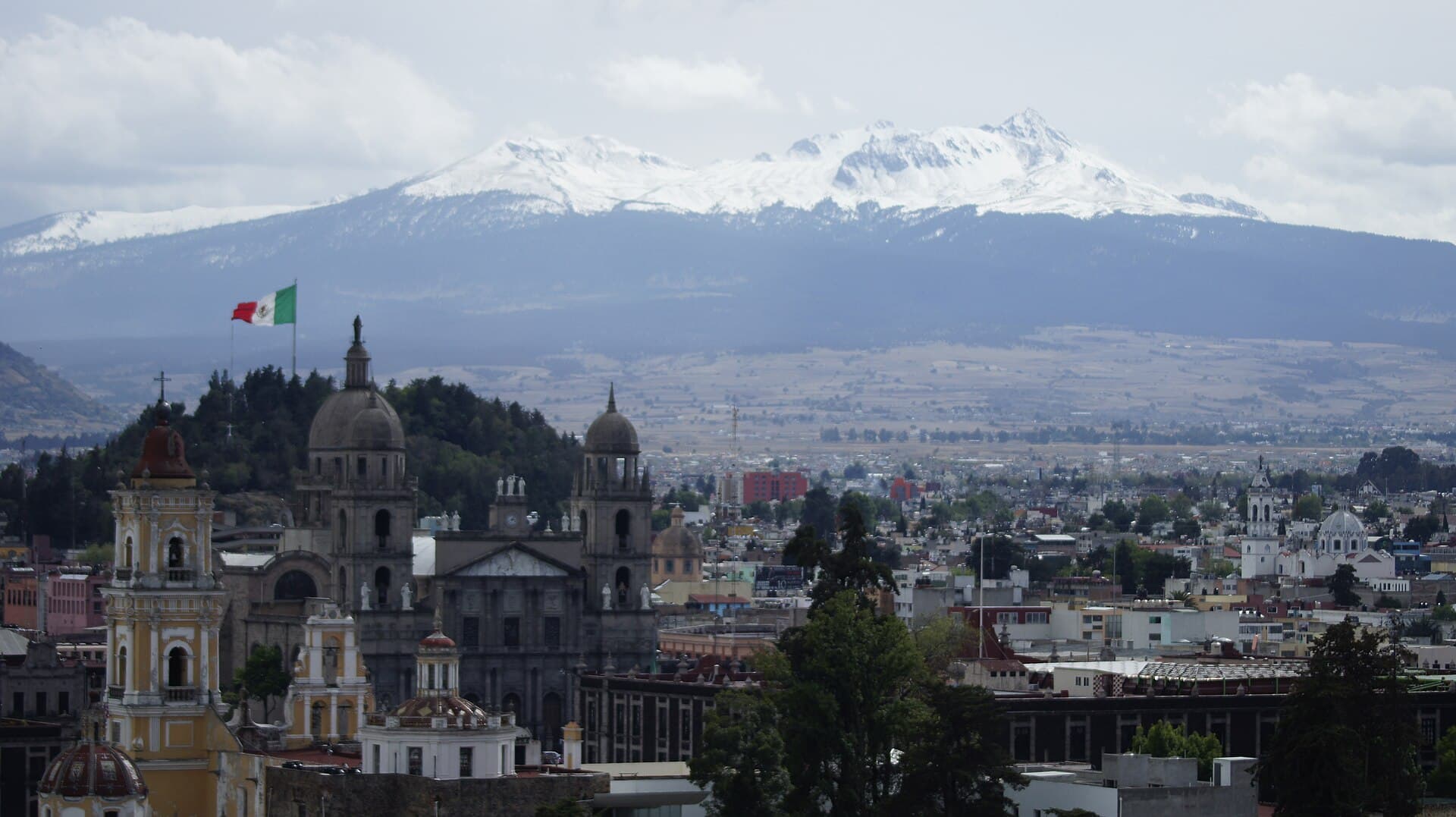 HernanLuna / CC BY-SA 3.0, via Wikimedia Commons
“Where high altitude meets high art and enduring traditions.”
Not the postcards. The stories even locals don't know — whispered in your ear, right where they happened.
This botanical garden, a marvel of glass and greenery, occupies a structure that once hummed with a very different kind of commerce.
One of Mexico's loftiest peaks, this volcano cradles a secret within its caldera.
The city's grand cathedral, dedicated to Saint Joseph, saw its construction unfold across more than a century.
Discover every secret of Toluca
Every address, every reveal in full — in your ear, right where it happened.
You pick your stops. You walk. The voice reveals what the others miss.
No tours available yet. Check back soon — we're preparing them.
Toluca de Lerdo, often simply called Toluca, serves as the capital of the State of Mexico and presents a city of compelling contrasts. Situated at an elevation of approximately 2,600 meters (8,500 feet) above sea level, it holds the distinction of being the highest capital city in Mexico and North America. This lofty position contributes to its temperate, often cool climate, offering a refreshing departure from Mexico's warmer regions.
Just 63 kilometers (39 miles) southwest of Mexico City, Toluca has experienced swift growth, evolving into a significant industrial and commercial center. Yet, amidst its contemporary pulse, the city carefully safeguards its historical and cultural legacy, visible in its colonial architecture, lively traditions, and a surprising number of museums—surpassed only by Mexico City in Mexico. Toluca offers a unique convergence of urban energy and natural splendor, with the grand Nevado de Toluca volcano rising prominently nearby.
## From Matlatzinca Roots to Colonial City Toluca's story reaches back over 9,000 years, with the Matlatzinca people among its earliest inhabitants in the 7th century. The Aztecs claimed the valley in 1473, renaming the area Tollocan, meaning "place of Tolo," after their deity. The nearby volcano was known as Tolutépetl, or "hill of the god Tolo."
Spanish conquistadors, led by Gonzalo de Sandoval, arrived in 1521, and the city was officially established on March 19, 1522, as Toluca de San José. The evangelization of the indigenous population commenced around 1524 with Franciscan missionaries. While recognized as a city as early as 1662, Toluca was officially granted city status by King Carlos IV of Spain on September 12, 1799.
## Capital of the State of Mexico The 19th century brought considerable advancements. The first city council was installed in 1812, and local authorities declared independence in 1821. After several changes, Toluca was designated the constitutional capital of the State of Mexico in 1830. In 1861, the city was renamed Toluca de Lerdo in honor of President Sebastián Lerdo de Tejada. The construction of the iconic Los Portales began in 1832, and a road connecting Toluca to Mexico City was initiated in 1793, fueling its economic development.
## Modern Growth and Cultural Preservation Throughout the 20th century, Toluca continued to expand, becoming a major industrial center due to its proximity to Mexico City. Despite its industrial expansion, the city has made deliberate efforts to preserve its cultural and artistic heritage. The Autonomous University of the State of Mexico, originally founded in 1828 as the Scientific and Literary Institute, stands as a testament to its long-standing commitment to education and culture. Today, Toluca remains a lively city that balances its historical foundations with contemporary aspirations.
Begin your exploration at the Cosmovitral Botanical Garden, a former 1910 market building transformed into a remarkable space of art and nature. Its walls and ceiling are adorned with 71 stained-glass murals, a monumental creation by local artist Leopoldo Flores, depicting the universe and humanity. Within, over 500 species of plants from across the globe thrive.
Next, visit the Toluca Cathedral (Catedral de San José de Nazaret), a neoclassical edifice whose construction spanned over a century, reaching completion in 1978. Observe its intricate facade, featuring images of saints and a relief of the Ascension of Jesus, then explore its expansive, ornate interior. Nearby, the Museo de Bellas Artes de Toluca (Fine Arts Museum) occupies a former Carmelite convent dating back to 1697. It displays over 2,000 pieces of art from the 16th to 19th centuries, including Baroque paintings and religious sculptures.
For an escape into nature, journey to Nevado de Toluca National Park, home to Mexico's fourth-highest peak, the Nevado de Toluca volcano (also known as Xinantécatl). The volcano's crater embraces two scenic lakes, Laguna del Sol and Laguna de la Luna, offering opportunities for hiking and expansive vistas.
Toluca experiences a temperate, subtropical highland climate throughout the year due to its considerable altitude. The dry season, from November to April, offers generally clear skies and minimal precipitation, making it an excellent time for sightseeing. Temperatures during these months are mild, with daytime highs averaging between 19°C and 23°C (66°F and 73°F). Evenings and nights can be cool, particularly in winter (December and January), with temperatures dipping to 4-5°C (39-41°F). The rainy season occurs from June to September, characterized by frequent but typically brief afternoon showers. For activities favoring warmer weather, late March to early June is considered the most favorable period.
Toluca is readily connected by road and rail, with a train service linking it to Mexico City. The city also maintains a public transportation system of buses and taxis. Toluca International Airport (TLC), officially Licenciado Adolfo López Mateos International Airport, serves the metropolitan area and functions as a secondary airport for Greater Mexico City. While it handles national and international air traffic, many travelers to Toluca often utilize Mexico City International Airport due to its extensive connectivity.
Regarding currency, the Mexican Peso (MXN) is used. While credit cards are widely accepted in larger establishments, it is advisable to carry some cash for smaller vendors and local markets. The official language is Spanish. Toluca is generally secure, but like any urban area, it is prudent to be aware of your surroundings, especially after dark, and to observe standard precautions against petty crime.