Monastery of San Juan de los Reyes
Observe the exterior walls of this grand monastery; you will notice something quite unusual.
Full story unlocks in the tour
 Dmitry Dzhus from London / CC BY 2.0, via Wikimedia Commons
“Where three cultures converge, stories unfold in stone and shadow.”
Not the postcards. The stories even locals don't know — whispered in your ear, right where they happened.
Observe the exterior walls of this grand monastery; you will notice something quite unusual.
This lively square, once the focal point of Toledo's public life, witnessed more than just commerce and celebrations.
The construction of this medieval bridge is bound to a dramatic account of an architect's despair and a wife's swift thinking.
Discover every secret of Toledo
Every address, every reveal in full — in your ear, right where it happened.
You pick your stops. You walk. The voice reveals what the others miss.
No tours available yet. Check back soon — we're preparing them.
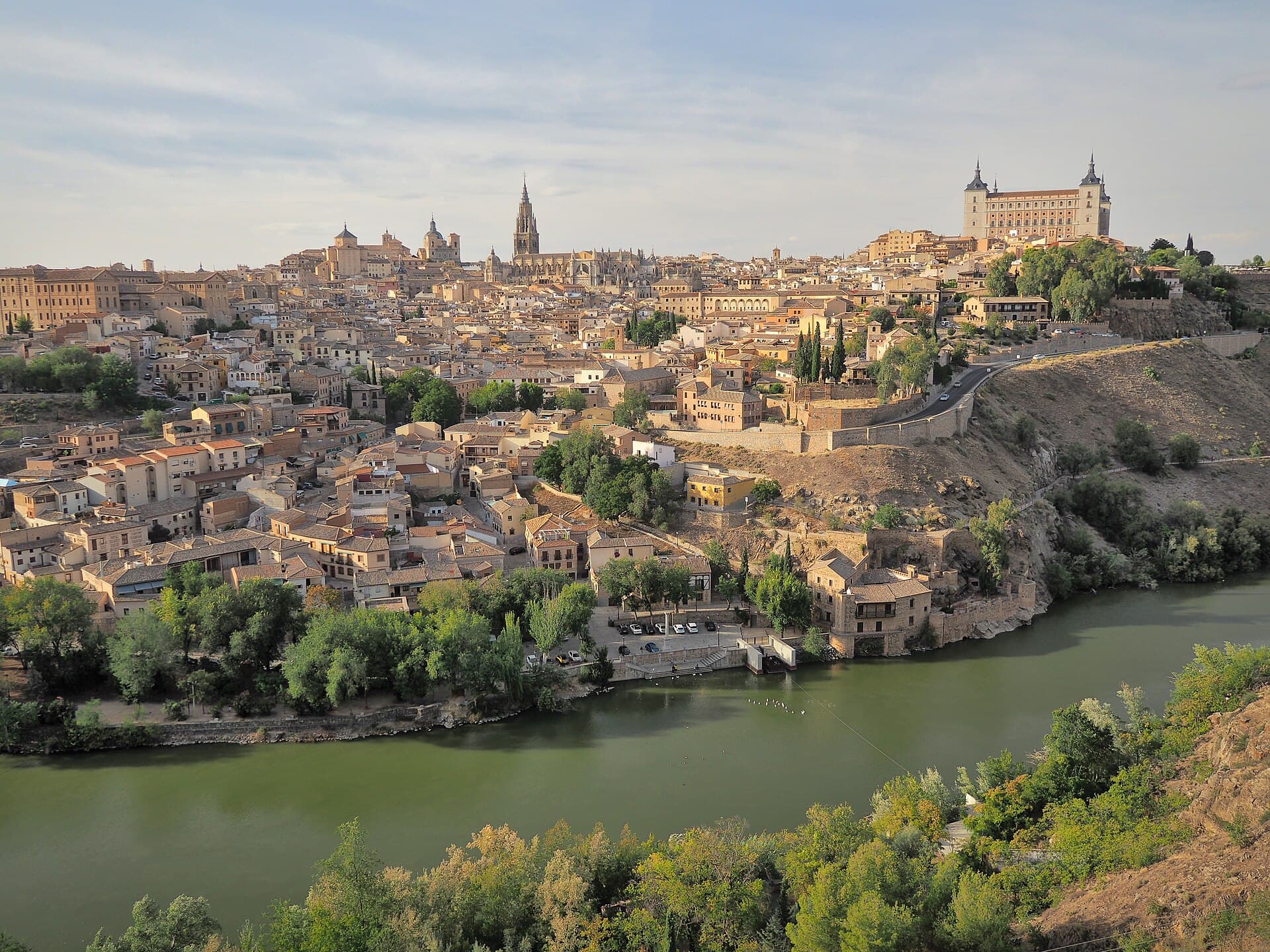
Toledo, a city in central Spain, stands as a living testament to centuries of intertwined Christian, Muslim, and Jewish cultures. Often called the 'City of Three Cultures,' its strategic location atop a hill, embraced on three sides by the Tagus River, made it a formidable stronghold throughout history. Designated a UNESCO World Heritage Site in 1986, Toledo's historic center preserves a medieval layout, inviting visitors to wander its narrow, winding streets and discover a remarkable collection of architectural styles.
Stepping into Toledo feels like entering a bygone era, where every stone and alleyway recounts its diverse past. The city's singular appeal lies in this layered history, evident in its mosques, synagogues, and churches that stand in close proximity. From ancient Roman foundations to the influence of Visigothic kings, Moorish rulers, and Christian monarchs, Toledo has continually evolved while retaining its distinct identity. It is a place where the past is not just remembered; it is palpable in the very fabric of the city.
Toledo's origins trace back to pre-Roman times, inhabited by the Vettones and Carpetani. The Romans, led by general Marcus Fulvius Nobilior, conquered the city in 193 BCE, establishing it as an important colony called Toletum. During this period, the Romans constructed city walls, a large circus capable of holding up to 15,000 people, public baths, and an extensive water system. Toledo's importance grew in late antiquity, with large private houses being built within its walls.
In the 6th century, Toledo ascended to a new prominence when the Visigoths made it the capital of their kingdom. It became a significant political and religious center, hosting important church councils that shaped the future of the Iberian Peninsula. The 8th century brought the Moorish conquest, and Toledo, then known as Tulaytula, became part of the Al-Andalus Caliphate. Under Moorish rule, the city flourished as a cultural and intellectual hub, known for its architecture, poetry, and philosophy.
In 1085, King Alfonso VI of Castile recaptured Toledo, marking a pivotal moment in its history. Following the Christian conquest, Toledo continued to be a lively cultural center, where Mozarabs (Arabic-speaking Christians), Muslims, and Jews coexisted. This unique fusion of cultures led to the city being known as the 'City of Three Cultures,' with their lasting architectural marks visible in its synagogues, mosques, and cathedrals. The 13th century saw the establishment of the School of Translators by Alfonso X (the Wise), where scholars from different backgrounds collaborated to preserve and disseminate classical knowledge.
Toledo served intermittently as the capital of Castile for five centuries, flourishing in medieval times and becoming known for its steel swords. However, its role as the political capital diminished in 1561 when King Philip II moved his court to Madrid. Despite this, Toledo's cultural and spiritual influence remained strong, and it continued to be an important artistic and religious center. The city also became home to the renowned Greek painter El Greco, who moved there in 1577 and created some of his most famous works within its walls.
Toledo's compact layout makes it ideal for exploring on foot, with many significant sites within easy walking distance. The Toledo Cathedral, a Gothic masterpiece, is a highlight, housing an impressive collection of religious art, including works by El Greco, Goya, and Titian. Allow yourself ample time to admire its intricate details, from stained-glass windows to the opulent High Altar.
The Alcázar of Toledo, a stone fortification at the city's highest point, offers sweeping views and houses the Army Museum, providing insights into Spain's military history. Wander through the Jewish Quarter to discover the Synagogue of Santa María la Blanca and the Synagogue del Tránsito (housing the Sephardic Museum), both fine examples of Mudéjar architecture. The Mosque of Cristo de la Luz, a preserved 10th-century mosque, illuminates the city's Moorish past. Do not overlook the Monastery of San Juan de los Reyes, an elaborate Isabelline Gothic church.
For expansive city views, make your way to the Mirador del Valle across the Tagus River. The Puente de Alcántara and Puente de San Martín are ancient bridges offering picturesque perspectives of Toledo's skyline. Consider the Toledo Tourist Wristband for access to multiple sites.
The most comfortable weather and appealing landscapes in Toledo are typically found in the spring (March–May) and fall (September–November). During these 'shoulder seasons,' you can anticipate warm days, crisp mornings, and cool evenings, with average temperatures around 15–25°C (59–77°F). This period also generally experiences fewer crowds and potentially more affordable accommodation.
Summer (June–August) in Toledo brings intense heat, with temperatures often exceeding 35°C (95°F), and larger crowds, making exploration less comfortable. Winters (December–February) are cooler, with average temperatures around 5–10°C (41–50°F), and while it rarely snows, it is a quieter time to visit, with the added appeal of a Christmas Market.
Toledo is easily accessible from Madrid. The high-speed AVE train from Madrid's Atocha Station reaches Toledo in about 35 minutes, with tickets typically costing €7–10. Buses are a more economical option, departing from Madrid's Plaza Elíptica and taking approximately one hour for around €6–10.
Once in Toledo, the city is best explored on foot due to its compact layout and narrow, winding streets. Be prepared for steep inclines, as the city is built on a hill. Public escalators, such as the Safont Escalator from the train station area, can help navigate the elevation. Driving into the old town is generally not advised due to narrow streets and limited parking; it is better to park outside the walls and use escalators or city buses. Consider purchasing the Toledo Tourist Wristband for convenient access to multiple attractions.