Tobolsk Kremlin
Siberia's sole stone Kremlin conceals a curious fact within its formidable walls, a testament to an unexpected labor force.
Full story unlocks in the tour
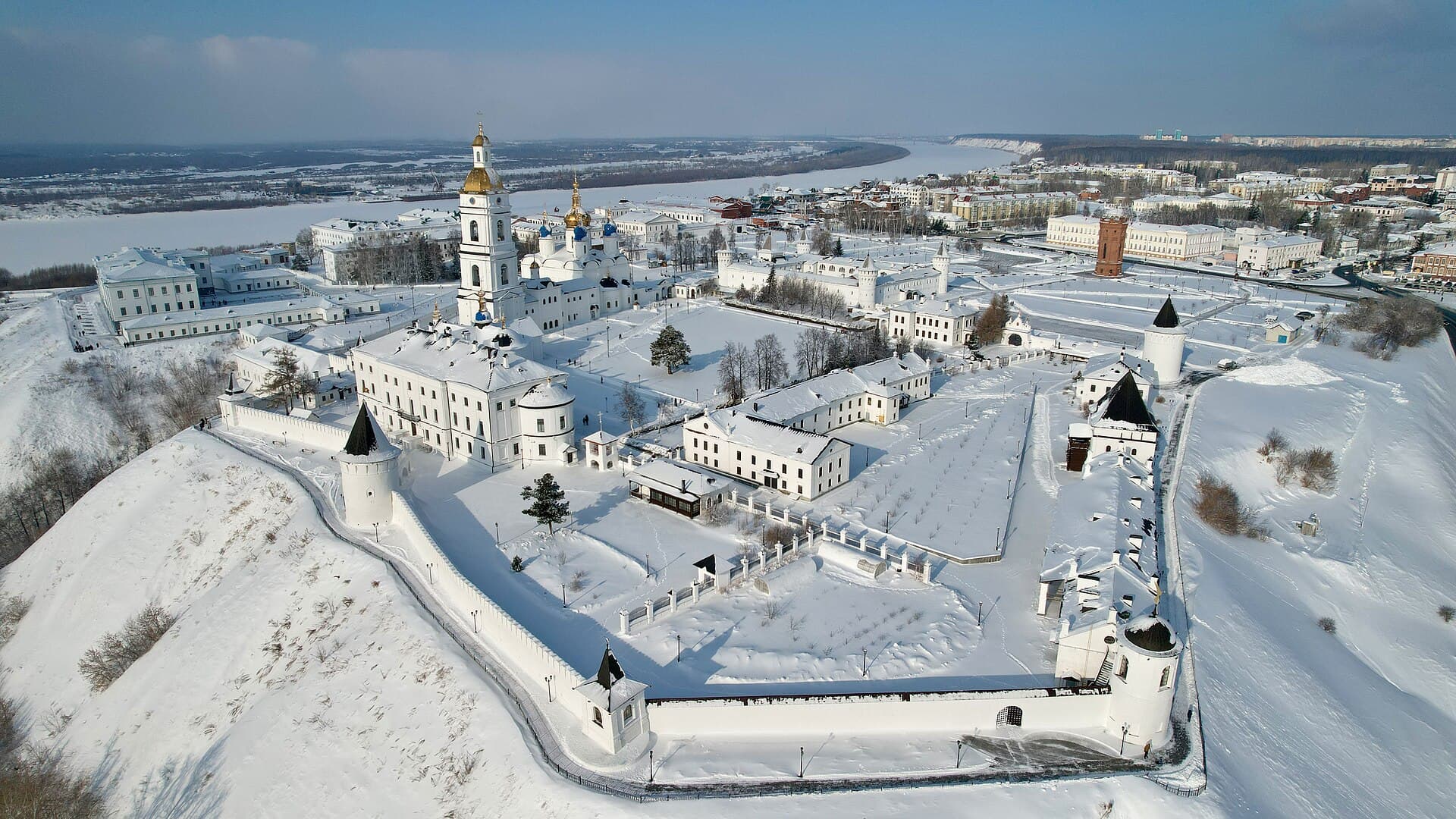 Vyacheslav Bukharov / CC BY-SA 4.0, via Wikimedia Commons
“Where Siberian history stands in stone.”
Not the postcards. The stories even locals don't know — whispered in your ear, right where they happened.
Siberia's sole stone Kremlin conceals a curious fact within its formidable walls, a testament to an unexpected labor force.
Among Tobolsk's most unusual exiles was not a person, but an object, formally punished for its perceived role in a royal tragedy.
The last Russian Imperial family, the Romanovs, found a temporary dwelling in Tobolsk, their stay marked by a small, yet profoundly poignant, architectural detail.
Discover every secret of Tobolsk
Every address, every reveal in full — in your ear, right where it happened.
You pick your stops. You walk. The voice reveals what the others miss.
No tours available yet. Check back soon — we're preparing them.
Tobolsk, where the Tobol and Irtysh rivers converge, is a city carrying the weight of Siberian history within its stone walls and wooden streets. Established in 1587, it stands as the second-oldest Russian settlement east of the Ural Mountains and served for centuries as the historic capital of Siberia. Its strategic position made it a vital junction for trade routes stretching towards China and Central Asia, fostering a rich exchange of cultures and economies.
Today, Tobolsk is a living monument, inviting exploration of its unique blend of Russian and Siberian heritage. While it may have ceded some of its former political and economic sway after the Trans-Siberian Railway bypassed it in the late 19th century, its historical importance and architectural preservation continue to draw travelers. The city divides into the Upper City (Gora) and the Lower City (Podgora), each offering distinct experiences, from the commanding presence of the Kremlin to the charming, older residential quarters.
## From Cossack Outpost to Siberian Capital Tobolsk's story begins in 1587, when a detachment of Cossacks, led by Daniil Chulkov, established a fortified outpost near the remnants of Qashliq, a Tatar settlement. This strategic location at the junction of the Tobol and Irtysh rivers proved crucial for Russia's expansion into Siberia. By 1590, it received city status, quickly becoming the administrative center for the vast Siberian territories.
Throughout the 17th and 18th centuries, Tobolsk thrived as the capital of the Siberian Governorate, a colossal province extending from the Urals to the Pacific Ocean. During this era, the city became a significant cultural, educational, and spiritual hub. Siberia's first school, theater, and newspaper were established here, alongside the Siberian archbishopric in 1620. The city's prominence is perhaps best embodied by the construction of the Tobolsk Kremlin, the only stone Kremlin in all of Siberia, which began in the late 17th century.
## Exiles and Decline Tobolsk's history is also interwoven with a long tradition of exile. From the 17th century onward, it became a destination for political and religious figures, including Archpriest Avvakum, various Decembrists after their 1825 revolt, and even the last Russian Emperor Nicholas II and his family in 1917. The arrival of the Decembrists, in particular, significantly shaped the city's cultural and educational environment.
The city's importance began to diminish in the late 19th century with the construction of the Trans-Siberian Railway, which veered south of Tobolsk. This shift in merchant routes lessened its regional influence, and the administrative seat of the Governor-General of Western Siberia relocated to Omsk. Despite this decline in political and economic significance, Tobolsk has safeguarded its historical and architectural heritage, evolving into a notable tourist destination in Siberia today.
The Tobolsk Kremlin is the city's foremost landmark and the only stone Kremlin in Siberia. Its white walls and towers, alongside the Sophia-Assumption Cathedral (Siberia's oldest stone building, dating to 1686), offer a striking silhouette against the sky. Ascend the Bell Tower for expansive views of the Lower Posad and the Irtysh River.
Connecting the Upper and Lower Cities is the Pryamskoy Vzvoz, a unique 198-step wooden staircase laid between massive retaining walls. Above it stands the Rentereya (Swedish Chamber), a monumental building that once safeguarded furs and the state treasury.
For a somber perspective on history, visit the Prison Castle, which operated until 1989 and now houses the Museum of Siberian Katorga and Exile. Explore its corridors and cells, which once held figures like Fyodor Dostoevsky and Nikolai Chernyshevsky. The Governor's House is another significant site, containing an exposition dedicated to the exile of Emperor Nicholas II and his family.
Beyond the Kremlin, consider a journey to the Abalak Tourist Complex, approximately 20 kilometers from Tobolsk. This complex features a recreated wooden fortress reflecting early Siberian settlements and the Abalak Znamensky Monastery, recognized for its Siberian Baroque architecture.
Tobolsk experiences a continental climate with distinct seasonal variations. The ideal time for warm-weather activities and outdoor exploration is from late June to early August, with July typically being the warmest month, averaging around 18°C to 24°C (64°F to 75°F). Summers are comfortable and partly cloudy, with moderate rainfall. For those who appreciate snow-covered landscapes and crisp air, December offers a magical, though frigid, experience, with average temperatures ranging from -15°C to -22°C (3°F to -7°F).
Tobolsk is accessible by air, train, and bus. Remezov Airport (RMZ) offers flights from major Russian cities, with a 30-minute taxi or bus ride to the city center. The Tobolsk railway station receives long-distance trains, and commuter trains connect it to Tyumen. Buses are a popular and economical option, especially from neighboring regions like Tyumen.
Within the city, public transport relies on buses and minibuses (marshrutkas). Taxis are also readily available and convenient for navigating between the Upper and Lower Towns, particularly in the evenings when buses cease running earlier. The local currency is the Russian Ruble (RUB), and while cards are accepted in many establishments, it is wise to carry cash for smaller purchases and markets. In summer (June-July), insect repellent is advisable due to midges.