Villa d'Este
The elaborate fountains of Villa d'Este, a marvel of Renaissance engineering, operate without a single modern pump or motor.
Full story unlocks in the tour
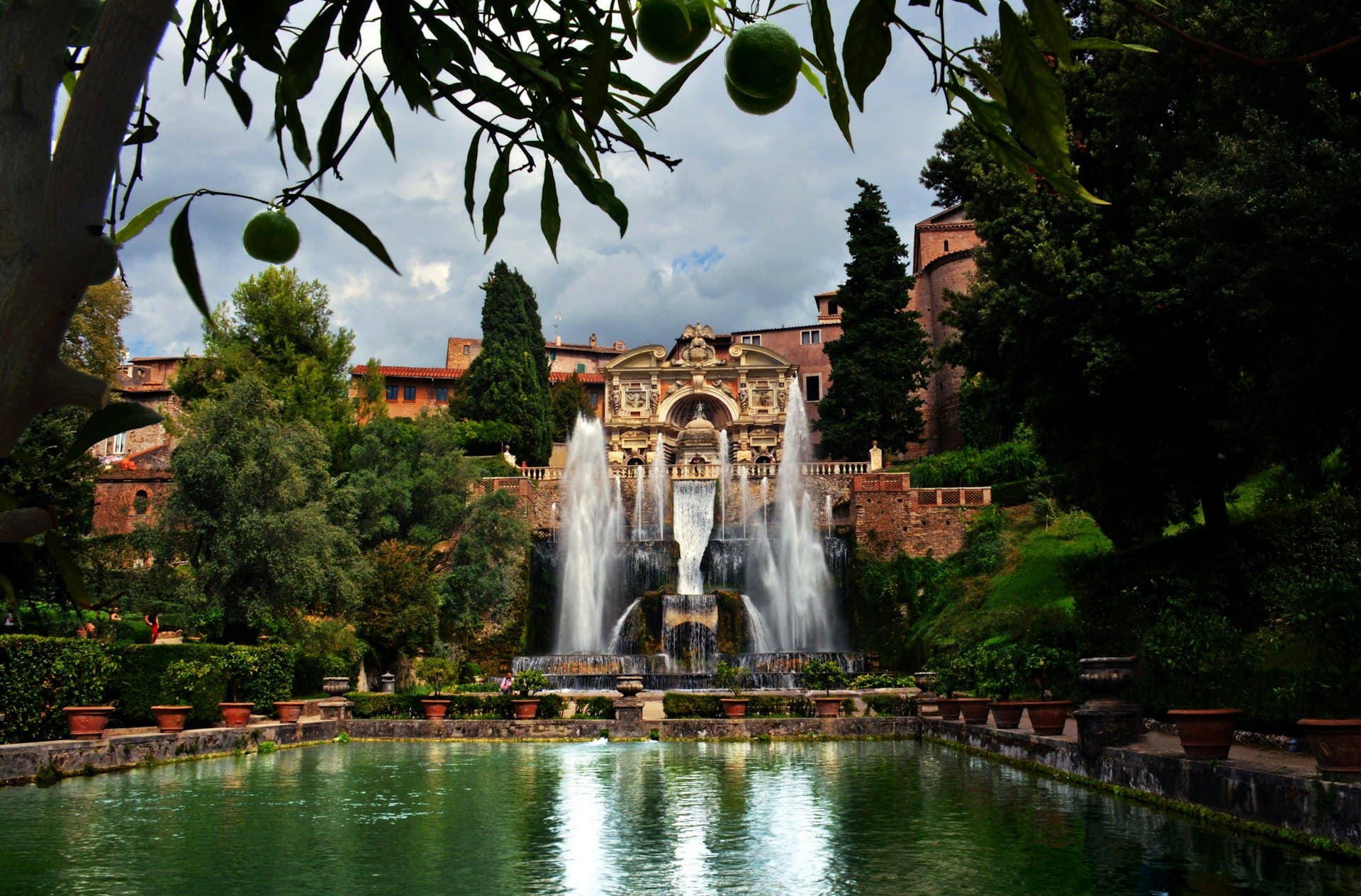 Photo: Diana Horonceanu / Unsplash
“Where ancient emperors and Renaissance cardinals found their escape, and you can too.”
Not the postcards. The stories even locals don't know — whispered in your ear, right where they happened.
The elaborate fountains of Villa d'Este, a marvel of Renaissance engineering, operate without a single modern pump or motor.
Emperor Hadrian's sprawling retreat wasn't just a country estate; it was a miniature world reflecting his vast empire.
Tivoli proudly claims to be older than Rome itself.
Discover every secret of Tivoli
Every address, every reveal in full — in your ear, right where it happened.
You pick your stops. You walk. The voice reveals what the others miss.
No tours available yet. Check back soon — we're preparing them.
Situated in the Sabine Hills, a mere 30 kilometers east of Rome, Tivoli offers a captivating escape from the Eternal City's commotion. This ancient hill town, known as Tibur in antiquity, has long been a cherished refuge, first for Roman emperors and later for Renaissance cardinals seeking cooler temperatures and scenic beauty. Today, Tivoli is celebrated for its two UNESCO World Heritage sites: the sprawling ruins of Hadrian's Villa and the exquisite gardens of Villa d'Este.
Beyond its renowned villas, Tivoli itself presents a charming labyrinth of medieval streets, historic churches, and ancient ruins, inviting exploration. The town's strategic position along the Aniene River, with its dramatic waterfalls and verdant landscapes, has made it a focal point for visitors drawn to its blend of history, art, and natural splendor.
The origins of Tivoli, ancient Tibur, are shrouded in legend, with its founding traditionally placed in 1215 BC, making it significantly older than Rome. Initially an independent member of the Latin League and a rival to Rome, Tibur eventually fell under Roman control in the 4th century BC, gaining Roman citizenship in 90 BC. Its natural beauty, plentiful water, and cooler climate quickly established it as a popular summer resort for the Roman elite. Notable figures like Emperor Augustus and poets Horace, Catullus, and Statius all maintained villas here.
The most significant Roman legacy is Hadrian's Villa (Villa Adriana), constructed between 117 and 138 AD. Emperor Hadrian, an architect and traveler, designed this immense complex as his primary residence, recreating architectural styles from across his expansive empire. Spanning over 300 acres, it included palaces, temples, baths, theaters, and extensive gardens, functioning as a self-contained city.
After the fall of the Roman Empire, Tivoli's importance diminished but saw a resurgence in the Middle Ages as an independent commune. It maintained a degree of autonomy until the 15th century, marked by structures like the Palace of Arengo and the Rocca Pia fortress, built by Pope Pius II in 1461 to assert papal control. The Renaissance brought another wave of architectural splendor, most notably with the construction of Villa d'Este. Commissioned in 1550 by Cardinal Ippolito II d'Este, this villa stands as a masterpiece of Italian Renaissance architecture and garden design, celebrated for its elaborate terraced gardens and hundreds of fountains, which are still gravity-fed. The 18th century saw Tivoli become a compulsory stop on the Grand Tour, drawing aristocratic intellectuals to its antiquities and scenic beauty.
Tivoli's allure resides in its remarkable villas and the character of its historic center. The two UNESCO World Heritage sites are essential visits. Hadrian's Villa (Villa Adriana) is a vast archaeological park, once Emperor Hadrian's opulent retreat. Explore the remains of palaces, thermal baths, temples, and the evocative Canopus, a long pool surrounded by classical statues. Allow ample time to wander its extensive grounds. Villa d'Este displays a different kind of magnificence, a 16th-century Renaissance villa famous for its elaborate terraced gardens and hundreds of fountains, including the iconic Organ Fountain and the Avenue of the Hundred Fountains. Its hydraulic system, operating without modern pumps, stands as a testament to Renaissance ingenuity.
Beyond the villas, explore the town itself. The Rocca Pia, a 15th-century fortress, offers expansive views. Wander through the medieval streets, discovering ancient churches like the Cathedral of San Lorenzo and the Church of Santa Maria Maggiore. Do not overlook the Santuario di Ercole Vincitore, a large Roman temple and theater complex dedicated to Hercules. For a natural escape, Villa Gregoriana is a park created around a dramatic gorge and waterfall, offering wooded paths and grottoes.
The most favorable times to visit Tivoli are during the shoulder seasons of spring (April to June) and fall (September to October). During these months, the weather is pleasantly warm, ideal for exploring the extensive gardens and ruins, and the crowds are generally smaller than in peak summer. Summer (July and August) can be intensely hot, with temperatures often exceeding 30°C (86°F), though evenings bring a pleasant coolness. Winter is mild but wetter, offering a tranquil experience with fewer tourists, though some attractions may have reduced hours.
Tivoli is readily accessible from Rome, located about 30 km northeast of the city. Trains from Rome's Tiburtina station (and less frequently from Termini) reach Tivoli in 35 to 90 minutes. Buses from Rome's Ponte Mammolo metro station also serve Tivoli. Once in Tivoli, Villa d'Este is within walking distance of the train station. Hadrian's Villa is about 5 km outside the town center and requires a local bus or taxi. Consider booking skip-the-line tickets for the villas online, especially during busy periods. The town's medieval center has uneven surfaces and stairs, so comfortable footwear is essential. Google Maps may not be entirely reliable for walking paths within the town.