Sri Venkateswara Temple, Tirumala
The idol of Lord Venkateswara appears to stand in the center of the sanctum, yet its true position is a subtle deviation.
Full story unlocks in the tour
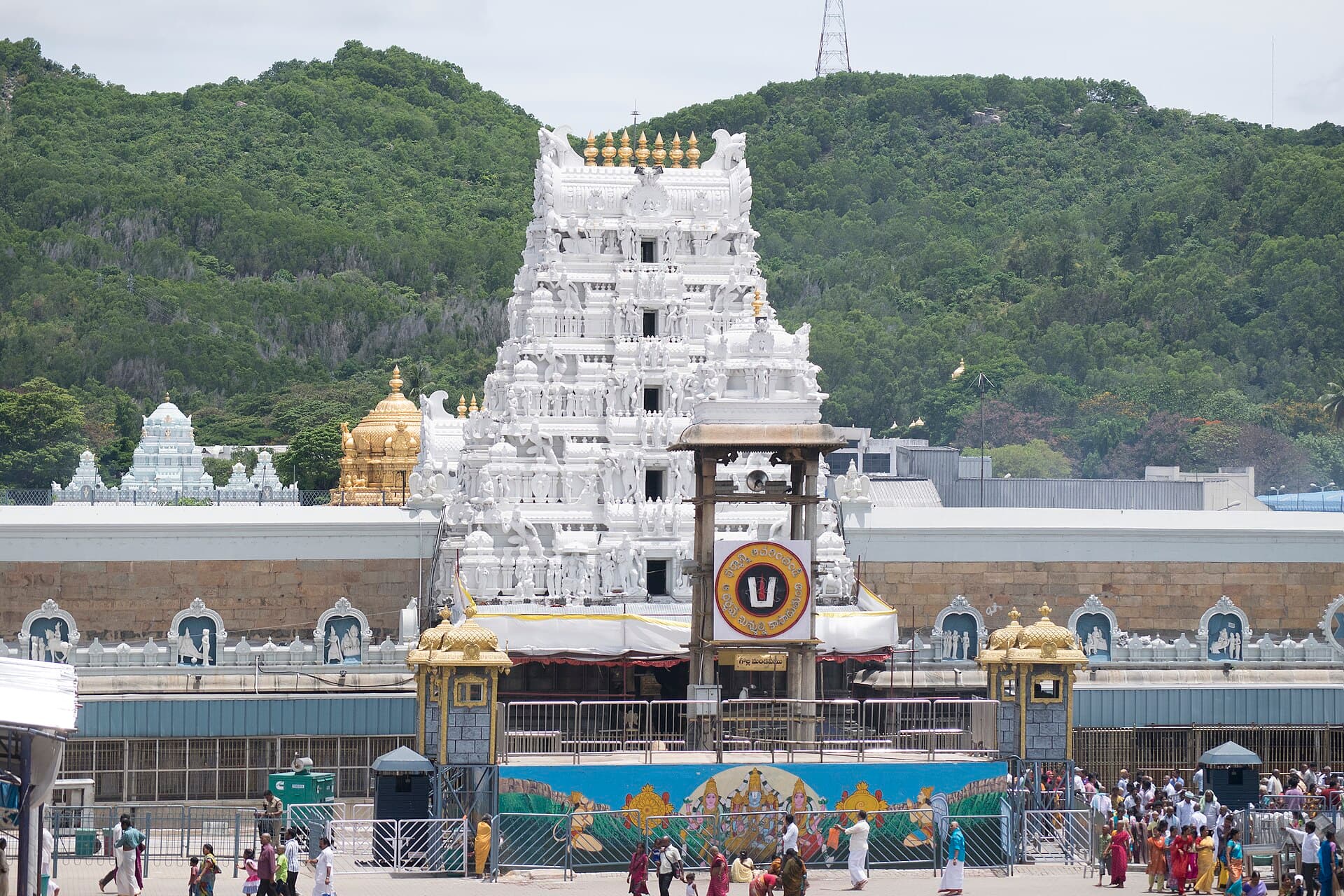 Nikhilb239 / CC BY-SA 4.0, via Wikimedia Commons
“Where ancient hills echo with devotion and divine mysteries linger.”
Not the postcards. The stories even locals don't know — whispered in your ear, right where they happened.
The idol of Lord Venkateswara appears to stand in the center of the sanctum, yet its true position is a subtle deviation.
Visitors and priests have reported an unusual auditory phenomenon within the temple's sanctum, despite its inland location.
The flowers offered daily to the deity are not simply discarded within the temple complex.
Discover every secret of Tirupati
Every address, every reveal in full — in your ear, right where it happened.
You pick your stops. You walk. The voice reveals what the others miss.
No tours available yet. Check back soon — we're preparing them.
Tirupati, a city in the Indian state of Andhra Pradesh, stands as a profound spiritual and cultural center. It functions as the administrative heart of the Tirupati district and is celebrated for its religious heritage, particularly the Tirumala Venkateswara Temple. This major Hindu pilgrimage site draws millions of devotees each year, establishing it as one of the most frequented religious destinations globally. The city rests amidst the Eastern Ghats, offering a convergence of devotion, history, and the gentle beauty of the land.
The spiritual core of Tirupati resides in the Tirumala Venkateswara Temple, often referred to as the "Temple of Seven Hills." Dedicated to Lord Venkateswara, an incarnation of Lord Vishnu, the temple is considered among the world's most affluent, receiving substantial offerings in cash, gold, and other precious items. Beyond its spiritual draw, Tirupati also presents natural wonders like cascading waterfalls, expansive national parks, and historical sites, providing a varied experience for all who journey here.
The story of Tirupati is deeply interwoven with the Sri Venkateswara Temple, a place believed to have developed over a period commencing from 300 CE. According to Hindu scriptures, Lord Venkateswara made Tirumala his dwelling five thousand years ago, preceded by Lord Varahaswami. The temple's venerable age is supported by extensive literary and epigraphic records, with various influential dynasties of the southern peninsula paying homage to Lord Sri Venkateswara.
Among these patrons were the Pallavas of Kancheepuram in the 9th century AD, followed by the Cholas of Thanjavur a century later, and the Pandyas of Madurai. The city gained considerable Vaishnava significance in the 11th century during the era of Saint Ramanujacharya, who refined the temple's rituals according to the Vaikhanasa Agama tradition. He also consecrated the Sri Govindarajaswamy Temple in 1130 CE, around which the lower Tirupati city gradually expanded.
The temple's growth and prosperity saw a considerable surge during the Vijayanagara Empire (14th-17th century). Rulers such as Krishna Deva Raya, Achyuta Deva Raya, Sadasiva Raya, and Tirumala Deva Raya contributed substantial resources and wealth, with some even having their likenesses installed at the temple portals. Following the decline of the Vijayanagara dynasty, nobles and chieftains from across the country continued to offer gifts and pay respects at the temple. In the mid-18th century, Maratha General Raghoji I Bhonsale envisioned a permanent body to oversee the temple's operations, leading to the eventual formation of the Tirumala Tirupati Devasthanams (TTD) in 1933. The TTD now manages and maintains numerous temples and their associated shrines throughout the region.
Tirupati offers a spectrum of attractions beyond its primary spiritual magnet. The Sri Venkateswara Temple on Tirumala Hills serves as the focal point, an architectural marvel dedicated to Lord Venkateswara. Before entering the main temple, it is customary to first visit the Sri Bhu Varaha Swamy Temple, situated on the northwestern bank of the Swami Pushkarini lake. In Tirupati town, the Sri Govindarajaswamy Temple, consecrated in 1130 CE, stands as one of the oldest and largest temple complexes, dedicated to Lord Govindaraja in a reclining posture.
For those drawn to natural wonders, Silathoranam is a naturally occurring rock formation approximately 3 km from the Sri Venkateswara Temple, considered a geological marvel and a singular spot for photography. The Talakona Waterfall, about 60 km from Tirupati, is Andhra Pradesh's tallest cascade, descending 270 feet amidst the dense forests of Sri Venkateswara National Park, a perfect destination for those who cherish nature and trekking. The Sri Venkateswara Zoological Park, one of Asia's largest zoos, provides an engaging family experience with its diverse wildlife. Those with an interest in history can explore Chandragiri Fort, located about 15 km from Tirupati, which offers glimpses into the Vijayanagara Empire and expansive views. Other notable temples include Sri Padmavathi Ammavari Temple in Tiruchanur, dedicated to Lord Venkateswara's consort, and Sri Kapileswara Swamy Temple at the base of Tirumala hill, dedicated to Lord Shiva, where pilgrims often partake in a holy dip in the Kapila Teertham.
The most agreeable time to journey to Tirupati is during the winter months, from November to February. In this period, temperatures generally range from 13-27 degrees Celsius, providing cool and comfortable weather ideal for temple visits and exploring the surroundings. This time is considered the busiest season, drawing a substantial number of pilgrims. The monsoon season, from July to October, brings moderate to heavy rainfall, resulting in verdant landscapes and cooler temperatures, though humidity levels can be elevated. While potentially less crowded than winter, significant festivals like Brahmotsavam in September can attract considerable numbers. Summers, from March to June, are exceedingly hot and humid, with temperatures reaching up to 46 degrees Celsius, generally making it a less inviting time for visitors, though it might be a quieter option for travelers on a budget.
Tirupati is readily accessible by air, rail, and road. Tirupati Airport (TIR) is 15 km from the city center, with flights connecting to major Indian cities. The Tirupati railway station offers solid connections across the country. The city is also reachable by bus and car, approximately 140 km from Chennai and 250 km from Bengaluru. When visiting temples, a precise dress code applies: men should wear dhoti, kurta-pajama, or formal pants with a shirt, while women should wear a saree, salwar kameez, or half-saree. Western attire like shorts and sleeveless tops are not permitted.
Mobile phones, cameras, smartwatches, and other electronic devices are strictly forbidden inside the Tirumala temple premises. Complimentary locker facilities are available to store these items before darshan. It is wise to reserve darshan tickets in advance, especially for special entry options like the ₹300 Special Entry Darshan or Srivani VIP Break Darshan. Always carry a valid ID, such as an Aadhaar card. Public transport is available, but taxis or ride-sharing applications can offer greater ease for navigating various sites. Staying hydrated and applying sunscreen is advised, particularly during warmer months.