Union Square (Piața Unirii)
This grand Baroque expanse holds a secret about its designation, long after its colorful structures first rose.
Full story unlocks in the tour
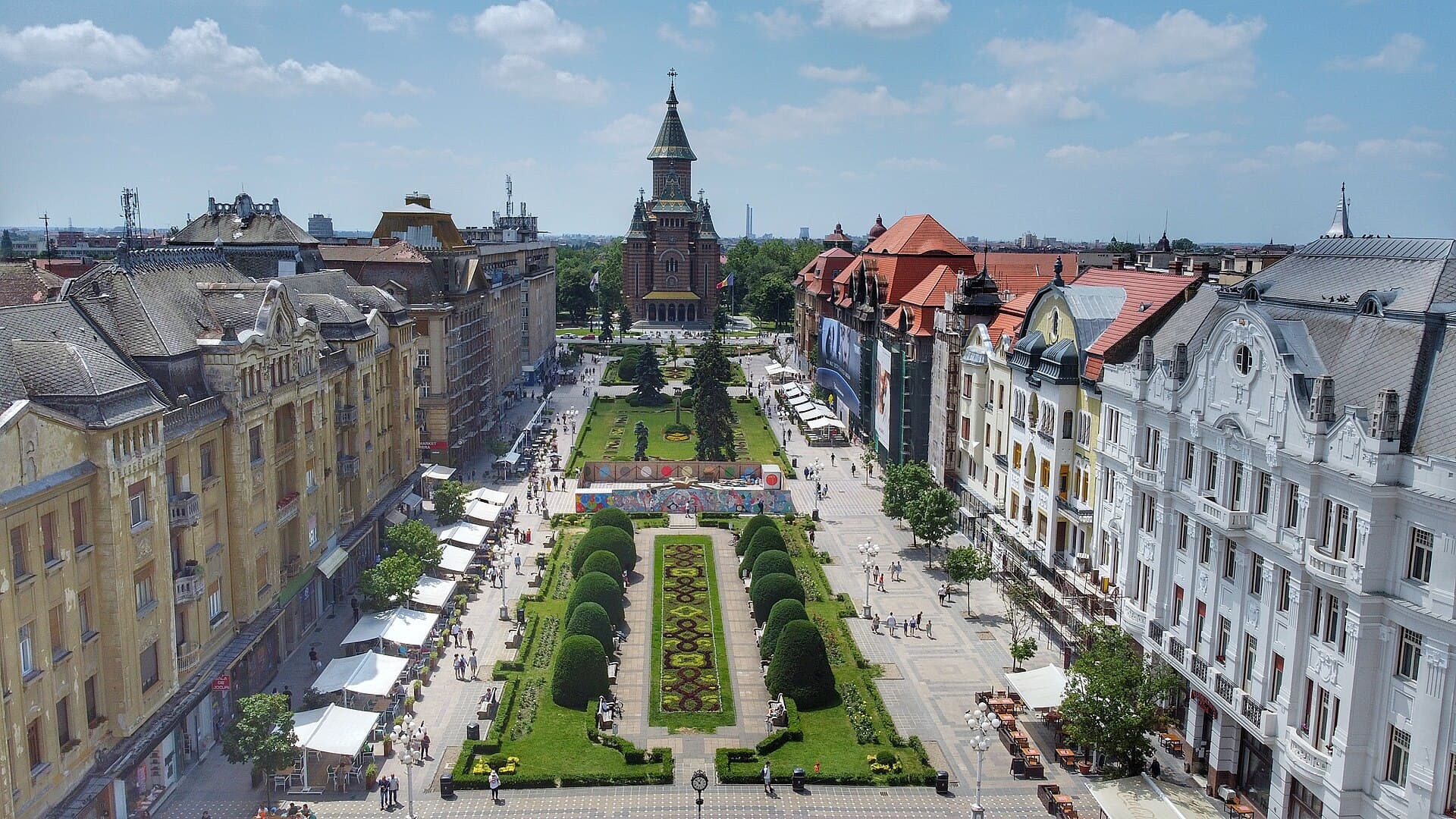 Marius Catalin Boldeanu / CC BY-SA 4.0, via Wikimedia Commons
“Timișoara: Where Europe's initial electric glow ignited the spark of revolution.”
Not the postcards. The stories even locals don't know — whispered in your ear, right where they happened.
This grand Baroque expanse holds a secret about its designation, long after its colorful structures first rose.
The calm Bega Canal, now a pleasant waterway, conceals a past that was far less predictable and much more turbulent.
The open promenade of Victory Square, where people now gather and wander, was once bisected by an unspoken social custom.
Discover every secret of Timișoara
Every address, every reveal in full — in your ear, right where it happened.
You pick your stops. You walk. The voice reveals what the others miss.
No tours available yet. Check back soon — we're preparing them.
Timișoara, often called "Little Vienna" for its graceful architecture, is a city that has consistently cast its gaze toward the future. Situated along the Bega River in western Romania, it is a place where grand Baroque and Art Nouveau buildings frame expansive public squares, and green spaces are intricately woven into the urban fabric. This multicultural nexus, home to 21 ethnic groups and 18 religious denominations, has long served as a crossroads of cultures, with Romanian, German, Hungarian, and Serbian communities coexisting for centuries.
Beyond its architectural splendor, Timișoara occupies a significant position in history as a city of groundbreaking achievements. It was the initial city in the Habsburg monarchy to feature street lighting in 1760 and the first in Europe to be illuminated by electric street lamps in 1884. This forward-thinking spirit reached its zenith in December 1989, when Timișoara became the genesis and the first city liberated from communism during the Romanian Revolution. Today, it remains a lively center of culture, education, and commerce, inviting visitors to explore its profound legacy and animated atmosphere.
Timișoara's origins extend back to ancient eras, with archaeological evidence suggesting Neolithic and Roman settlements. It was first officially documented in 1212 as Castrum Regium Temesiensis, a Roman fortification. The city, constructed amidst marshy terrain, was sacked by the Tatars in the 13th century but was subsequently rebuilt and reinforced. In the 14th century, it served as a royal dwelling for Hungarian King Charles I.
The city's strategic location at the convergence of trade routes made it a coveted prize for various empires. It fell under Ottoman dominion in 1552, remaining an administrative center for 160 years. In 1716, Habsburg forces, commanded by Eugene of Savoy, recaptured Timișoara, initiating a new period of growth and reconstruction. During this time, the city acquired its distinctive Baroque architectural style, earning it the moniker "Little Vienna."
The 19th century witnessed Timișoara emerge as a city of innovation. It was the first city in the Habsburg monarchy with street lighting in 1760. In 1869, it introduced the first horse-drawn tram in modern Romania. Most notably, in 1884, Timișoara became the first city in continental Europe to possess electric street lighting, a pioneering accomplishment that influenced cities across the continent.
During World War I, Timișoara changed hands multiple times before officially becoming part of the Kingdom of Romania in 1919, following the Treaty of Trianon. The city experienced considerable industrialization and urbanization during the communist era. However, it was in December 1989 that Timișoara inscribed its name into modern history, becoming the catalyst of the Romanian Revolution. Extensive protests against the communist regime commenced here, spreading swiftly and ultimately leading to the overthrow of Nicolae Ceaușescu. On December 20, 1989, Timișoara was declared the first city in Romania free from communism. In 2023, Timișoara was recognized as the European Capital of Culture, a testament to its profound cultural inheritance and lively contemporary scene.
Begin your journey in the city's three primary squares, each possessing its own character. Victory Square (Piața Victoriei), also known as Opera Square, stands as the core of Timișoara and the place where the city was proclaimed free from communism in 1989. It is bordered by the Romanian National Opera House at one end and the imposing Timișoara Orthodox Metropolitan Cathedral at the other, with its eleven spires ascending 90 meters skyward.
A brief walk leads to Liberty Square (Piața Libertății), notable for the Old Town Hall and the Plague Column, a Baroque monument from 1756. Continue to Union Square (Piața Unirii), the oldest and arguably most beautiful square, celebrated for its animated, pastel-colored Baroque and Secessionist buildings. Here, you will find the Serbian Orthodox Cathedral and St. George's Catholic Cathedral facing each other, alongside the Baroque Palace, which houses the National Museum of Art.
Beyond the squares, wander along the Bega Canal, where you can board a vaporetto (water bus) or rent a bicycle. Explore the city's many green spaces, such as Roses Park with its expansive rose gardens, or the Botanical Park. For a deeper understanding of the city's recent past, visit the Timișoara Revolution Memorial. Do not overlook the remnants of the Timișoara Fortress, including the Maria Theresia Bastion, a preserved section of the old defensive walls.
Timișoara experiences all four seasons, each presenting a distinct allure. For ideal strolling weather and to observe the city in full bloom, late spring (April-May) or early autumn (September) are excellent choices. Temperatures in May are mild, and the parks are verdant. September offers warm days, cool evenings, and fewer crowds. Summer (June-August) brings animated outdoor life and festivals, though temperatures can be high. Winters are cold, with the possibility of snow, and provide a quieter, more reflective experience with Christmas markets and inviting cafes.
Timișoara Traian Vuia International Airport (TSR) is situated approximately 12 kilometers northeast of the city center. You can reach the city center via Express Bus E4, a journey of about 20-30 minutes, with tickets payable on board. Taxis and rideshare services like Bolt and Uber are also accessible from the airport, with a ride to the center costing around 25-35 RON.
The city center is easily navigable on foot, making exploration simple. Timișoara also possesses a comprehensive public transportation network, including trams, buses, trolleybuses, and vaporettos (water buses) on the Bega Canal. Tickets can be purchased on the bus with a bank card, via SMS, or through mobile applications, or from STPT kiosks. A 1-hour ticket permits multiple transfers, except on vaporettos. For extended stays, 1-day subscriptions are available. While generally secure, be mindful of petty theft in crowded areas.