Pucará de Tilcara
The most prominent structure at the Pucará de Tilcara, a pyramid-like monument, appears to stand as a proud symbol of ancient ingenuity.
Full story unlocks in the tour
 Stéphane Batigne / CC BY 3.0, via Wikimedia Commons
“Where ancient stones speak and the mountains wear a thousand colors.”
Not the postcards. The stories even locals don't know — whispered in your ear, right where they happened.
The most prominent structure at the Pucará de Tilcara, a pyramid-like monument, appears to stand as a proud symbol of ancient ingenuity.
You might discover a dessert in Tilcara that offers a subtle, almost rose-like aroma, yet its main ingredient is a protected wild fruit.
The main church in Tilcara, with its white adobe walls, features a surprising architectural element derived from a protected local plant.
Discover every secret of Tilcara
Every address, every reveal in full — in your ear, right where it happened.
You pick your stops. You walk. The voice reveals what the others miss.
No tours available yet. Check back soon — we're preparing them.
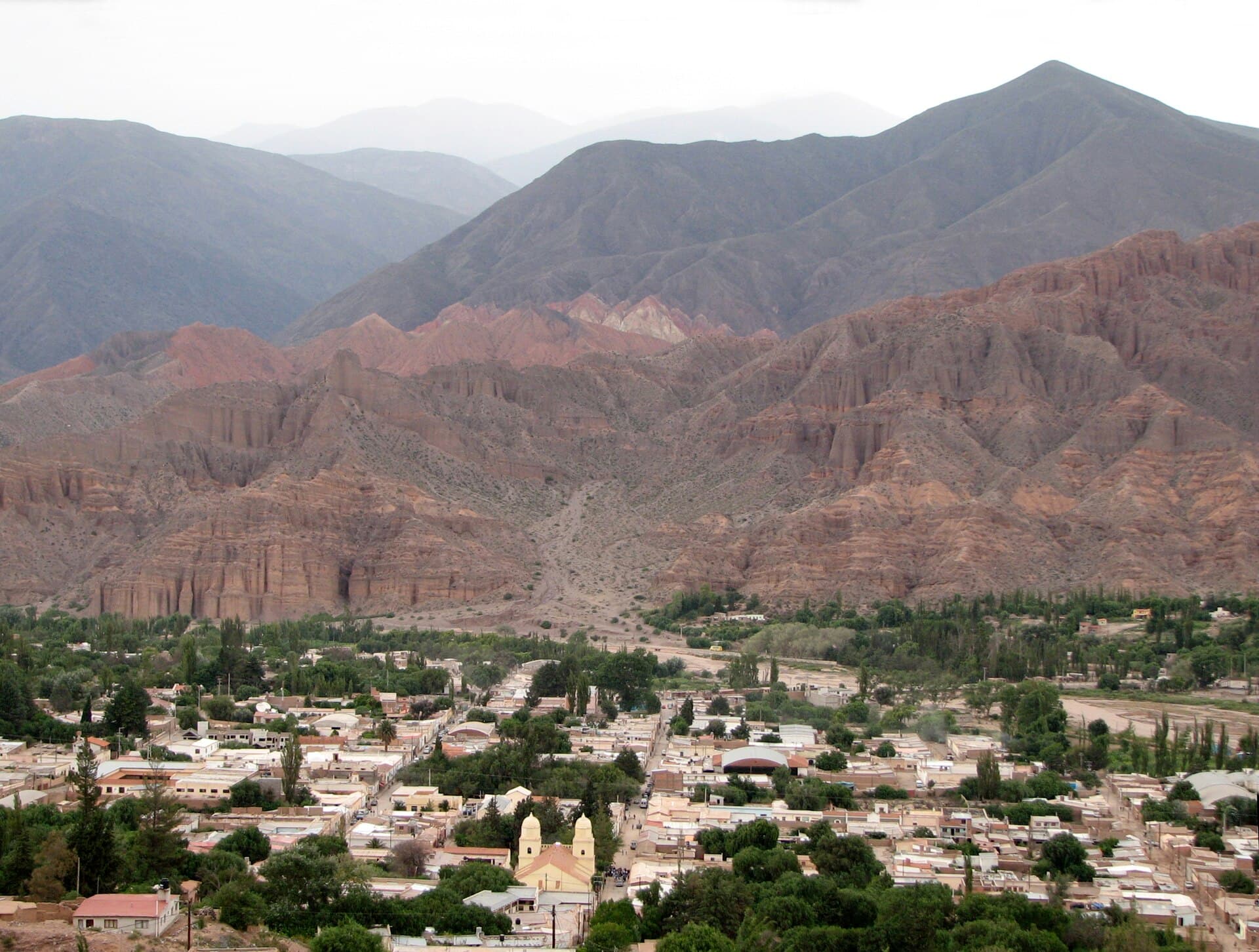
Tilcara, a town in Argentina's Jujuy province, is a place where the vivid hues of the Andes meet a deep current of pre-Columbian history. Situated along National Route 9 in the Quebrada de Humahuaca, a UNESCO World Heritage cultural landscape, Tilcara sits at an elevation of approximately 2,500 meters (8,200 feet) above sea level. The town functions as a lively center within this dramatic mountainous region, characterized by its low adobe houses, stone-paved paths, and a palpable sense of enduring traditions. Traces of human habitation in the area date back over 10,000 years, making it one of Argentina's oldest continuously inhabited settlements.
Tilcara is a popular destination for those seeking to immerse themselves in Andean culture, offering a blend of archaeological wonders, local artistry, and natural splendor. The town's atmosphere is often described as bohemian, drawing artists, poets, musicians, and painters. Visitors can explore its small center on foot, where indigenous Andean-style handicrafts are readily available in numerous shops and markets. Beyond the town, the surrounding landscapes invite exploration, from ancient fortifications to scenic hiking trails leading to waterfalls and panoramic viewpoints.
The story of Tilcara is deeply intertwined with the Quebrada de Humahuaca, a valley that has served as a vital pathway through the Andes for over ten millennia. The area has been continuously inhabited for more than 10,000 years, making Tilcara one of Argentina's oldest settlements. Around the 12th century, the ancestors of the Omaguaca tribe established a fortified settlement known as the Pucará de Tilcara on a strategically chosen hill overlooking the Río Grande de Jujuy. This location provided excellent defensive capabilities and commanding views over a significant stretch of the Quebrada.
The Pucará de Tilcara was a substantial pre-Hispanic settlement, covering approximately 15 acres and housing over 2,000 people at its peak around the 14th century A.D. It functioned as an important administrative and military center, featuring living quarters, corrals, sites for religious ceremonies, and burial grounds. The Omaguaca were skilled warriors, farmers, weavers, and potters, and the region was a significant trading hub, with archaeologists finding evidence of metal and stone workshops.
In the 15th century, the expanding Inca Empire incorporated the Pucará de Tilcara into its vast network. Unlike other pukarás (Quechua for "fortification"), Tilcara's site showed fewer defensive constructions, suggesting it was more of an administrative center than a purely military one for the Inca. The Tilcara people paid tribute to the Inca with their metal and stone objects, as well as through physical labor on projects like maintaining the Qhapaq Ñan, the extensive Inca road system.
The arrival of the Spanish conquistadores in the late 1500s brought new dynamics to the region. The Quebrada de Humahuaca became a direct route for silver from the Bolivian altiplano mines to Spanish colonial cities. While the Spanish subdued and enslaved the indigenous people, forcing many to work in mines or on plantations, everyday cultural traditions of the Quechua people largely persisted, adapting rather than disappearing.
The Pucará de Tilcara lay dormant for centuries until its rediscovery in 1908 by ethnographer Juan Bautista Ambrosetti and his student Salvador Debenedetti of the University of Buenos Aires. Their initial excavations cataloged over 3,000 artifacts. Subsequent work, particularly in the 1950s, involved clearing and partially reconstructing some of the structures to prepare the site for visitors. This reconstruction, while common practice at the time, reflects evolving archaeological standards.
In 2000, the Pucará de Tilcara was declared an Argentine National Monument, and in 2003, the entire Quebrada de Humahuaca was inscribed as a UNESCO World Heritage cultural landscape, recognizing the region's continuous human movement and habitation over millennia. Today, the site receives over 100,000 visitors annually, standing as a testament to the enduring legacy of pre-Inca and Inca cultures in Argentina.
Begin your exploration at the Pucará de Tilcara, a pre-Inca fortification that offers expansive views of the Humahuaca Ravine. This archaeological site, built by the Omaguaca tribe, displays reconstructed living quarters, ceremonial areas, and burial sites. Adjacent to the Pucará is the Jardín Botánico de Altura (High Altitude Botanical Garden), which preserves the biodiversity of the region, featuring a diverse collection of cacti and other high-altitude vegetation.
In town, the Dr. Eduardo Casanova Archaeological Museum, located near the main square, houses artifacts from the Pucará and provides deeper insights into the Tilcara culture. For art enthusiasts, the José Antonio Terry Regional Museum of Paintings exhibits works by local artists and the renowned Argentine painter José Antonio Terry, who made Tilcara his home. The Museo Irureta is another local art museum focusing on the vivid landscapes and indigenous people of the region.
Beyond the museums, wander through Tilcara's artisan markets, where you can find indigenous Andean-style crafts and textiles. For a natural escape, hike to the Garganta del Diablo (Devil's Throat) waterfall, a scenic two-hour trek from town, or a shorter walk if you drive part of the way. Consider a trip to the nearby Salinas Grandes, vast salt flats that offer a striking contrast to the colorful mountains.
Tilcara experiences a cool, dry climate, with a distinct dry season from May to August and a wet season from December to March. The most pleasant times to visit are during spring (September to November) and autumn (March to May), when temperatures are moderate and ideal for outdoor exploration. Daytime temperatures average around 18-20°C (64-68°F) during these periods. While summer (December to March) can be warm and wet, it's also when Tilcara hosts its lively Carnival celebrations. Winter (June to September) offers cooler, drier weather, which is good for hiking, but be prepared for chilly nights, as temperatures can drop to around -1°C (30°F) in July.
Tilcara sits at approximately 2,500 meters (8,200 feet) above sea level, so it's advisable to take precautions against altitude sickness. Acclimatize by taking it easy upon arrival, staying hydrated, and avoiding alcohol. Coca tea, offered at many establishments, can help alleviate mild symptoms. For severe symptoms, immediate descent and medical attention are necessary.
The local currency is the Argentine Peso (ARS). While credit cards are accepted in some places, it's wise to carry cash. Exchange rates can vary, and unofficial exchange offices around the plaza may offer better rates for foreign currency. Western Union is another option for obtaining cash.
Tilcara's town center and main attractions are walkable. Taxis are available for shorter trips, and buses connect Tilcara to neighboring towns like Salta and San Salvador de Jujuy. The nearest airport is Jujuy International Airport (JUJ), about 71 miles away, with bus or shared taxi services to Tilcara. For those driving, Route 9 is the main access road.
Tilcara is generally safe for solo travelers, but minor theft can occur, so keep personal belongings secure.