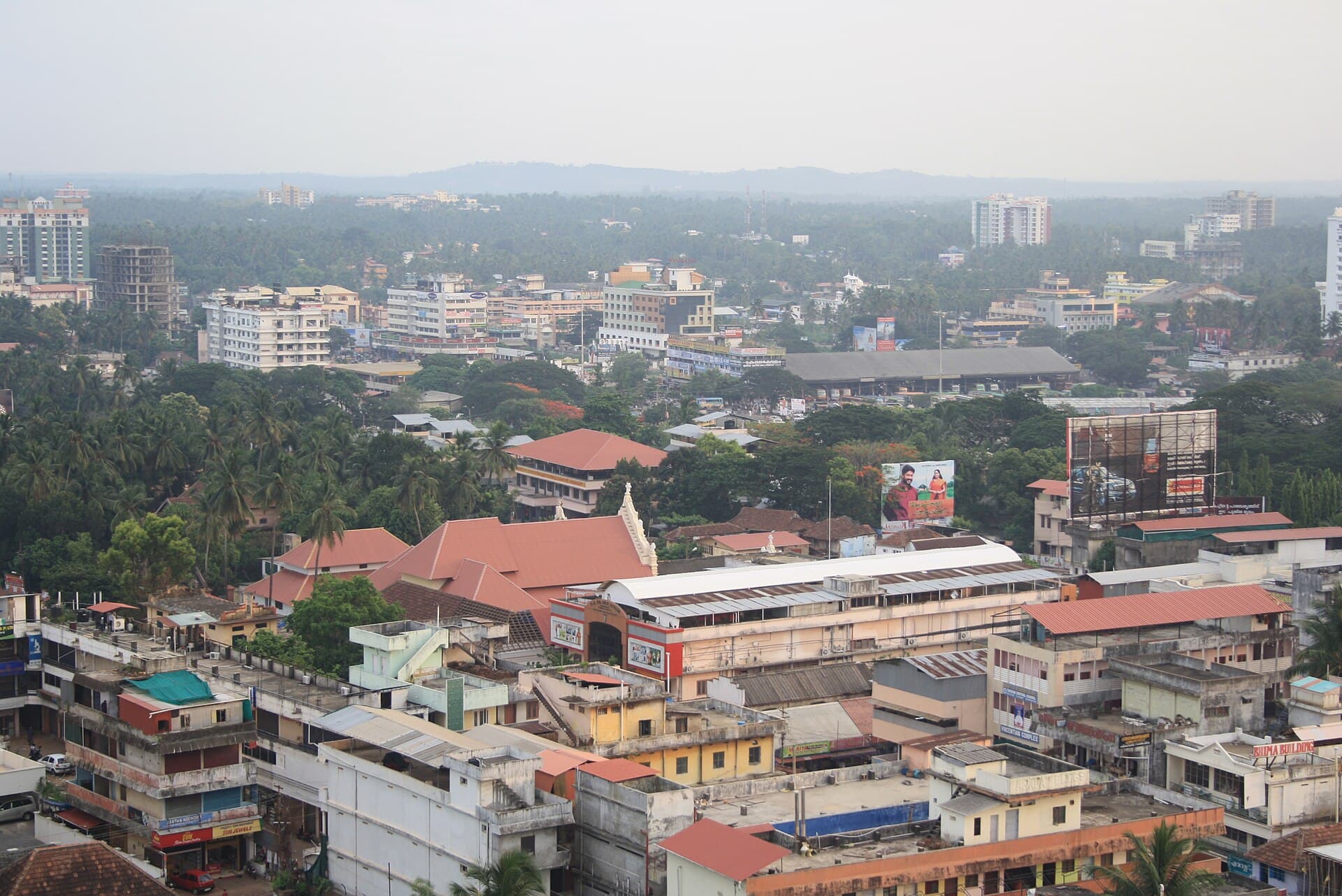
Vadakkunnathan Temple grounds (Thekkinkadu Maidan)
The expansive green core of Thrissur, embracing a revered Shiva temple, conceals a secret about its very layout.
Full story unlocks in the tour
 Jpullokaran / CC BY-SA 3.0, via Wikimedia Commons
“Where ancient traditions dance with contemporary rhythms.”
Not the postcards. The stories even locals don't know — whispered in your ear, right where they happened.
The expansive green core of Thrissur, embracing a revered Shiva temple, conceals a secret about its very layout.
One of India's earliest mosques, situated near Thrissur, shares an unexpected link to an ancient Chera monarch.
A short journey from Thrissur reveals a site that redefined the understanding of ancient trade between India and the Roman Empire.
Discover every secret of Thrissur
Every address, every reveal in full — in your ear, right where it happened.
You pick your stops. You walk. The voice reveals what the others miss.
No tours available yet. Check back soon — we're preparing them.
Thrissur, often recognized as the 'Cultural Capital of Kerala,' is a city where enduring traditions and a lively contemporary spirit intertwine. Its very designation, a shortened form of 'Thiru-Shiva-Perur,' signifies 'the city of the sacred Shiva,' a nod to its central and most venerated landmark, the Vadakkunnathan Temple. Built around a 65-acre hillock known as Thekkinkadu Maidan, which encompasses the temple, Thrissur's urban fabric extends outward from this spiritual core. The city stands as a living testament to Kerala's profound cultural heritage, spiritual depth, and timeless allure, presenting a distinctive fusion of historical monuments, natural scenery, and a flourishing arts community.
Beyond its spiritual resonance, Thrissur functions as a significant commercial and educational nexus in Kerala. It has historically served as a crossroads for diverse cultures, including Assyrians, Greeks, Persians, Arabs, Romans, Portuguese, Dutch, and English, each leaving their imprint on the city's character. Today, Thrissur draws a substantial number of domestic travelers, attracted by its cultural richness, numerous festivals, and the tranquil atmosphere that offers a peaceful respite.
The narrative of Thrissur extends back over two millennia, with indications of human habitation from as early as 1000 BCE to 500 CE, evidenced by prehistoric megaliths and dolmens discovered in areas like Ramavarmapuram. During the Sangam period, these lands formed part of the ancient Chera Empire. Tradition maintains that Thrissur is where Christianity, Islam, and Judaism first arrived on the Indian subcontinent, with local Christian accounts attributing the arrival of Thomas the Apostle in 52 CE and Muslim tradition pointing to Methala as the location of India's first mosque.
From the 9th to the 12th centuries, Thrissur's story was interwoven with the Kulasekharas of Mahodayapuram. The city gained considerable prominence after Maharaja Sakthan Thampuran ascended the throne of the Kingdom of Cochin (1769–1805) and established Thrissur as his capital. He is largely credited with shaping modern Thrissur, transforming it into a major financial and commercial center. Sakthan Thampuran also played a pivotal role in curtailing the influence of feudal chieftains and reinforcing royal authority. His reign saw the growth of industries, including gold ornament manufacturing and financial companies, for which the city remains recognized.
Over the centuries, Thrissur experienced the governance of various dynasties, including the Chera, Pandya, and Perumals, each adding to its architectural and cultural legacy. The city also felt the naval presence of the Portuguese in the 16th century, followed by the Dutch in the early 17th century. The rivalry between the Zamorins of Calicut and the Kingdom of Cochin led to continuous skirmishes in the area. Despite these shifts, Thrissur maintained its standing as a center of Hindu scholarship and a gathering point for diverse religious communities. The city was formally known as Trichur until 1990, when it returned to its original Malayalam name, Thrissur.
Thrissur presents a diverse collection of sights, merging spiritual landmarks with natural allure. The Vadakkunnathan Temple, a UNESCO World Heritage Site, stands at the city's core, an architectural marvel dedicated to Lord Shiva. Its traditional Kerala style, intricate wood carvings, and ancient murals are particularly noteworthy. Nearby, the Paramekkavu Bhagavathy Temple is another ancient and significant temple, recognized for its dignified architecture and its role in the Thrissur Pooram festival.
For a glimpse into royal history, explore the Sakthan Thampuran Palace, a grand 18th-century structure displaying a distinctive blend of traditional Kerala and Dutch architectural influences. It now houses a museum with artifacts, paintings, and royal mementos. The Our Lady of Dolours Basilica is a prominent Roman Catholic church, acknowledged as the third-tallest church in Asia, and an impressive example of Gothic construction.
Beyond the city center, the Athirappilly Waterfalls, often referred to as the 'Niagara of India,' are a significant natural draw, located about 60 kilometers away at the entrance to the Sholayar forest ranges. The adjacent Vazhachal Falls also offer scenic splendor and are known for the unique species found in the surrounding dense forests. For those interested in wildlife, the Peechi-Vazhani Wildlife Sanctuary is a sanctuary of biological diversity, home to various flora and fauna, including orchids, leopards, tigers, and elephants. Do not miss the Guruvayur Anakotta, an elephant sanctuary where you can observe mahouts tending to and training elephants.
Thrissur experiences a tropical climate with warm temperatures throughout the year. The most agreeable time to visit is during the winter months, from October to March, when the weather is pleasant and comfortable, with temperatures ranging from approximately 22°C to 30°C. This period is ideal for exploring cultural heritage and enjoying outdoor activities without the discomfort of extreme heat or heavy rainfall. The renowned Thrissur Pooram festival, a spectacular cultural event, typically occurs in April or May, making it a lively time to visit despite warmer temperatures.
Thrissur is well-connected and easily reached. Cochin International Airport (COK) is approximately an hour's drive away, and Thrissur Railway Station is a major junction with excellent connectivity to other Indian cities. The city is also well-linked by national highways to nearby cities like Coimbatore and Thiruvananthapuram. Within Thrissur, auto-rickshaws and taxis are readily available for local transit. For excursions to waterfalls or beaches, it is advisable to arrange a car with a driver through your accommodation or a local agency.
When visiting temples, modest attire is required; shoulders and knees should be covered, and footwear must be removed before entering. The climate is tropical, so light, breathable clothing made from natural fabrics like cotton or linen is recommended year-round. If traveling during the monsoon season (June to September), an umbrella or raincoat will be beneficial. Generally, Thrissur is considered a safe city for travelers, but it is always prudent to be aware of your surroundings, especially in crowded areas like bus stands and railway stations.