Te Anau Glowworm Caves
Deep within the Murchison Mountains, a world of flowing water and soft light unfolds.
Full story unlocks in the tour
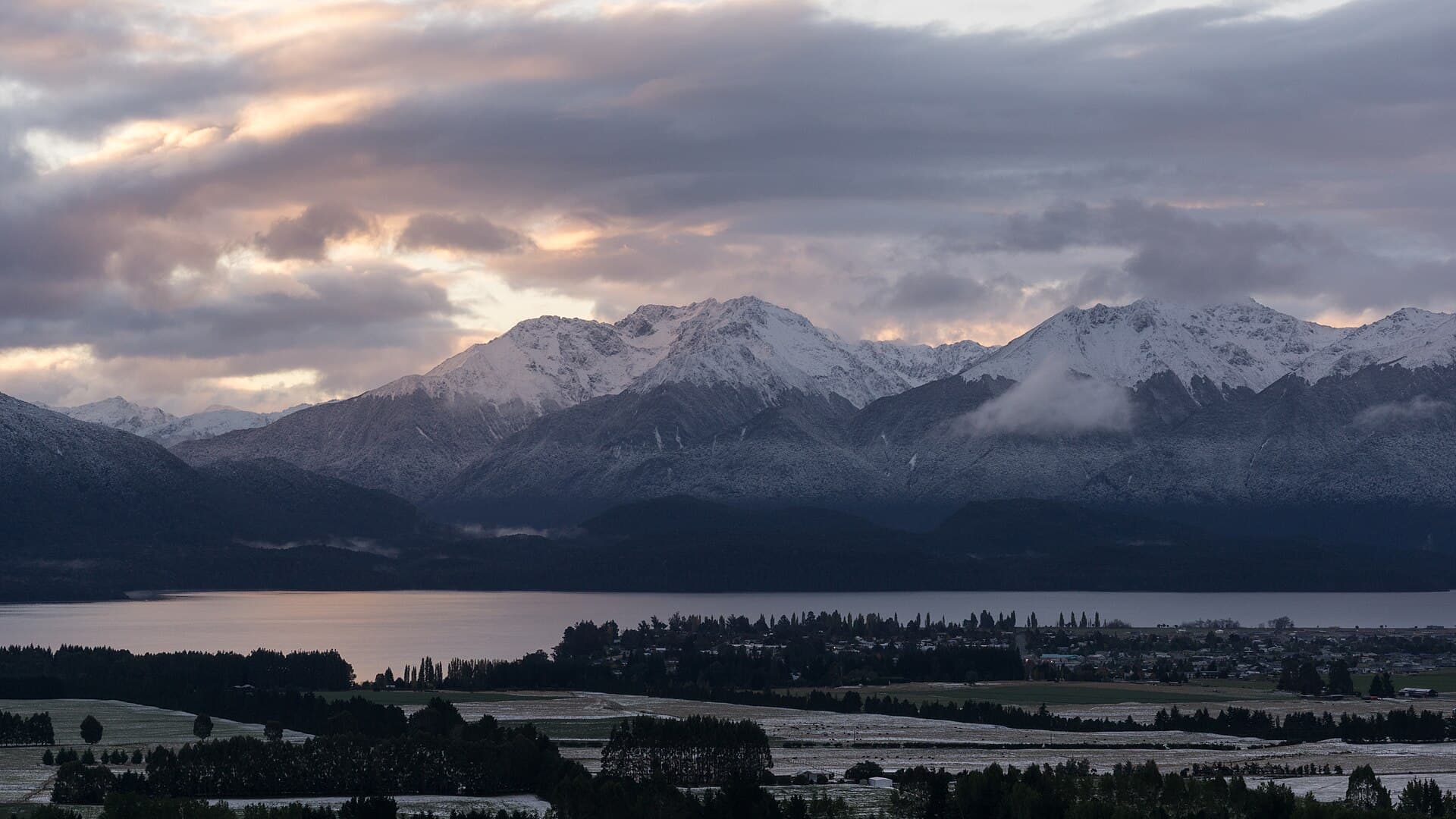 Tim Burgess / CC BY-SA 4.0, via Wikimedia Commons
“Where glacial valleys meet a vast, reflective lake.”
Not the postcards. The stories even locals don't know — whispered in your ear, right where they happened.
Deep within the Murchison Mountains, a world of flowing water and soft light unfolds.
A flightless bird, once believed lost to time, finds sanctuary along the lake's edge.
Seek shelter from the weather and delve into Fiordland's wild past from a comfortable seat.
Discover every secret of Te Anau
Every address, every reveal in full — in your ear, right where it happened.
You pick your stops. You walk. The voice reveals what the others miss.
No tours available yet. Check back soon — we're preparing them.
Te Anau, on New Zealand's South Island, serves as a primary entry point to the expansive wilderness of Fiordland National Park, a UNESCO World Heritage site. Positioned on the eastern shore of Lake Te Anau, the South Island's grandest lake, the town offers a serene base for exploring dramatic glacial formations, dense woodlands, and exceptionally clear waters. The name "Te Anau" originates from the Māori phrase "Te Ana-au," which translates to "the place of the swirling waters," referencing the glowworm caves situated on the lake's western shore.
With an estimated resident population of approximately 2,910 people as of June 2024, Te Anau maintains a small-town character while providing essential services and conveniences for visitors. It acts as a focal point for those who love the outdoors, offering entry to some of New Zealand's most celebrated multi-day hikes, alongside a variety of lake activities, scenic flights, and encounters with local wildlife. The town's calm atmosphere and impressive natural surroundings make it an inviting destination for those seeking both adventure and tranquility in the very heart of Fiordland.
Te Anau's past is deeply connected to Māori heritage, particularly that of the Ngāi Tahu iwi. The area surrounding Lake Te Anau was a significant seasonal location for Māori, who gathered pounamu (greenstone) and food resources during their journeys between the South Island's east and west coasts. While evidence of permanent Māori settlements is scarce, the spiritual and mythological significance of the region holds profound importance for the tangata whenua (people of the land). The name Te Anau itself, meaning "the place of the swirling waters," is a Māori term referring to the limestone cave formations found on the lake's western shores.
European explorers first arrived at Lake Te Anau’s shores in 1852, guided by Māori, with C.J. Nairn and W.J. Stephen among them. The lake was formally surveyed in 1863, and the township of Te Anau was surveyed in 1893. Early European interest in the region was limited, though the discovery of gold in Preservation Inlet in the 1890s brought a brief period of intense activity. However, Fiordland's harsh climate and rugged terrain presented considerable challenges for sustained settlement and resource extraction.
The true development of Te Anau as a town began with the opening of the Milford Track in 1899, establishing it as a starting point for adventurers. Significant growth, however, followed the completion of the Homer Tunnel and the Milford Road in 1953, which provided road access to Milford Sound. This infrastructure transformed Te Anau into the final major service center before the fiord, solidifying its role as the entry point to Fiordland National Park. In 1952, Fiordland National Park was officially established, and in 1986, it was designated a UNESCO World Heritage Area, further enhancing tourism to the region.
Today, Te Anau's economy is primarily driven by tourism, alongside farming and a venison industry. The town's population has seen steady growth, with an increase of 26.8% between the 2013 and 2018 censuses. The community actively participates in conservation efforts, particularly for endangered native bird species like the takahē, which was rediscovered in the nearby Murchison Mountains.
Te Anau offers a variety of activities, many centered around its expansive lake and its role as an entry point to Fiordland National Park. A journey to the Te Anau Glowworm Caves is a popular undertaking, beginning with a serene cruise across Lake Te Anau and continuing into an underground realm of flowing water and bioluminescent glowworms. For those interested in wildlife, the Te Anau Bird Sanctuary (Punanga Manu o Te Anau) provides an opportunity to observe rare native birds, including the takahē. The lakefront itself invites leisurely walks, offering broad views of the surrounding mountains.
Te Anau is widely known as New Zealand's "walking capital," with three of the ten Great Walks either commencing or traversing the area: the Milford Track, Kepler Track, and Routeburn Track. Day hikes are also plentiful, such as the Key Summit Track or the Lake Marian Track, both accessible from Milford Road. For those seeking a different perspective, scenic flights by float plane or helicopter provide unparalleled views of Fiordland. Jet boating on the local rivers offers an exhilarating adventure, while lake cruises provide a more relaxed way to experience the scenery. The Fiordland Cinema also offers a distinct cultural experience, screening local films about the region's past and natural grandeur.
The most agreeable time to visit Te Anau for warm-weather activities is from mid-January to mid-February, when average daily high temperatures exceed 16°C (61°F). January is typically the warmest month, with an average high of 17°C (63°F). For a blend of dry and warm conditions, February is a favored choice. The drier season generally extends from January to April. Spring and autumn (November and March) offer mild climates and fewer visitors. While rain is common throughout the year, it often enhances the scenery by creating numerous temporary waterfalls, especially in Milford Sound.
Te Anau is approximately a 2.5-hour drive (170 km) from Queenstown and about a 2-hour drive (155 km) from Invercargill. Renting a car is often the most convenient way to reach and explore the area, as bus connections can be infrequent. Once in Te Anau, the town is compact enough for easy navigation on foot. Staying at least two nights in Te Anau is recommended to fully experience the area and reduce travel time to Milford and Doubtful Sounds.
Accommodation options in Te Anau range from backpacker hostels to luxury lodges and holiday parks. It is advisable to book well in advance, particularly during the peak summer season, due to high demand. The town offers a variety of restaurants and cafes, many featuring local South Island produce and lake views. For those planning hikes, sturdy hiking boots, rain gear, and ample water are essential, as the weather can change quickly. Always check road conditions before traveling, especially in winter, as snow can impact the Milford Road.