Santa Prisca Church
The grand Santa Prisca Church, a Baroque marvel, was brought to life by the vision of a single silver magnate.
Full story unlocks in the tour
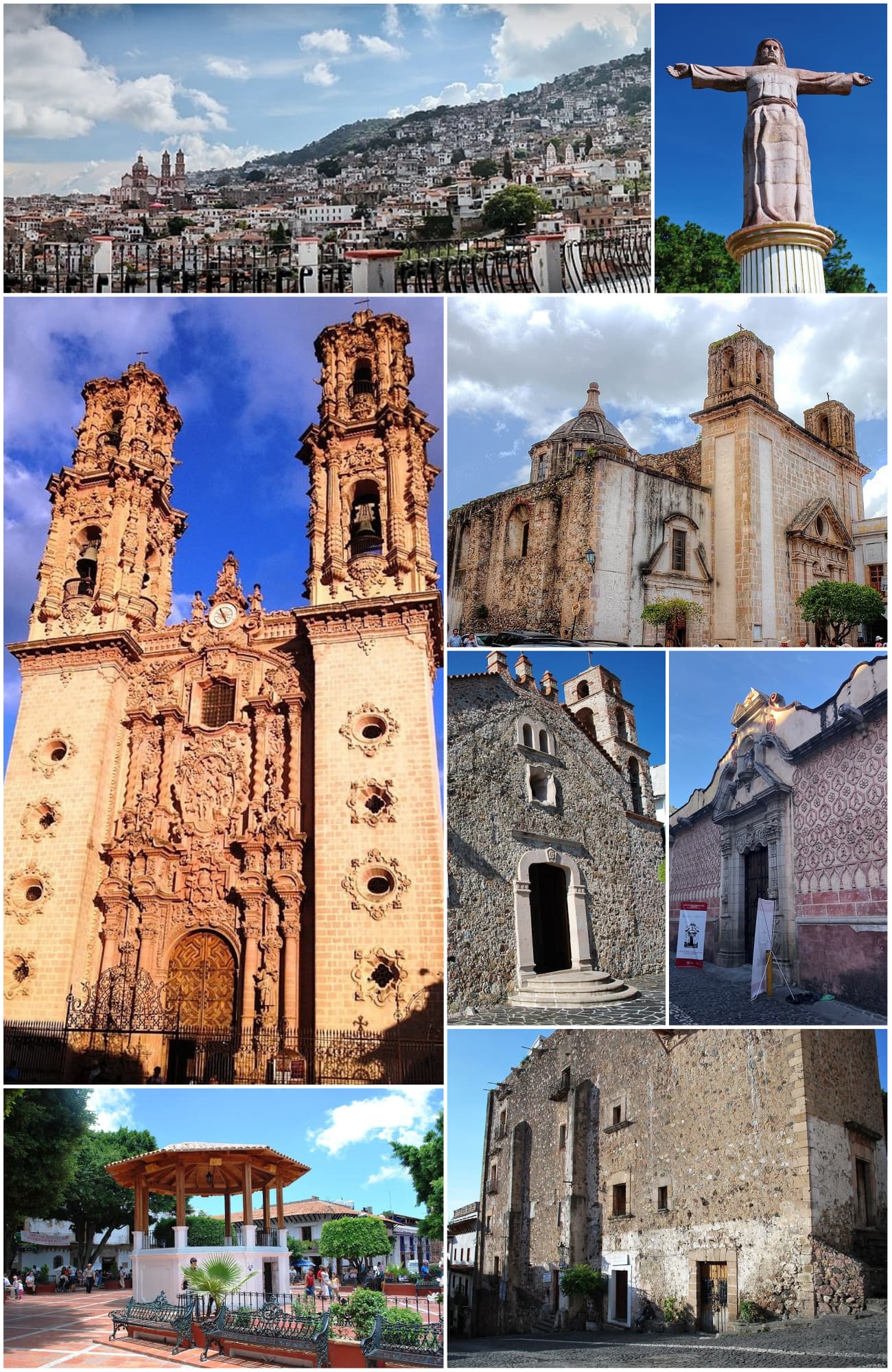 Microstar / CC BY-SA 4.0, via Wikimedia Commons
“Taxco: Where silver's gleam illuminates ancient streets.”
Not the postcards. The stories even locals don't know — whispered in your ear, right where they happened.
The grand Santa Prisca Church, a Baroque marvel, was brought to life by the vision of a single silver magnate.
Beneath the foundations of a contemporary hotel lies a profound secret, reaching back centuries before the arrival of the Spanish.
Observe the dark stone paving on some of Taxco's precipitous thoroughfares, and you might discern unusual white stone patterns.
Discover every secret of Taxco
Every address, every reveal in full — in your ear, right where it happened.
You pick your stops. You walk. The voice reveals what the others miss.
No tours available yet. Check back soon — we're preparing them.
Situated on the rugged slopes of Atache Hill in Guerrero, Mexico, Taxco de Alarcón is a colonial city celebrated for its silver artistry and meticulously preserved 18th-century architecture. Its steep, narrow roadways meander through a maze of white stucco buildings crowned with red-tile roofs, crafting a scenic tableau that feels suspended in time. Designated a national monument, Taxco is a captivating destination, offering a window into Mexico's mining legacy and artisanal traditions.
Often called the 'Silver Capital of the World,' Taxco's very essence is intertwined with this precious metal. While large-scale mining operations have largely ceased, the city continues to flourish as a hub for silver design and jewelry creation, drawing visitors eager to explore its many silversmith workshops and bustling markets. Beyond its gleaming treasures, Taxco offers a tranquil atmosphere, expansive mountain vistas, and a singular cultural encounter, making it a favored short-stay destination for both Mexican and international travelers.
The history of Taxco stretches back to pre-Hispanic times, when indigenous communities extracted various stones for decorative and ceremonial purposes. The name 'Taxco' likely originates from the Nahuatl word Tlachco, meaning 'place of the ballgame,' or tatzco, meaning 'where the father of the water is,' referencing a waterfall on Atatzin Mountain. Before the Spanish arrival, the original indigenous settlement of Taxco, now known as Taxco El Viejo, was a significant center, serving as the seat of an Aztec governor who oversaw tribute collection in surrounding districts.
Hernán Cortés established the modern Spanish town of Taxco around 1529 in an area then called Tetelcingo, drawn by the plentiful silver. Spanish commercial silver mining commenced around 1532, positioning Taxco as one of the oldest European mining centers in the Americas. Early colonial mining was conducted by haciendas founded by Cortés and his knights. By the close of the 16th century, Taxco had become Spain's primary source of silver and precious metals in the New World.
The 18th century marked Taxco's true mining zenith, largely due to José de la Borda, a French-Spanish miner who arrived around 1716. De la Borda amassed a vast fortune from mines such as Pedregal, El Coyote, San Ignacio, and Cerro Perdido, and in gratitude, he funded much of the city's early infrastructure, including roads, schools, houses, and most notably, the magnificent Santa Prisca Church. Other successful miners followed his example, constructing their own elaborate residences and churches.
However, the 19th century brought a decline in Taxco's silver industry. During Mexico's War of Independence, Spanish barons destroyed their mines to prevent them from falling into revolutionary hands, leaving the industry in disarray. The silver industry remained largely dormant until the 1920s, when American artist and architect William Spratling arrived. Spratling was instrumental in revitalizing silversmithing in Taxco, establishing design workshops and exporting pieces, primarily to the United States. His endeavors transformed Taxco from primarily a mining town into a celebrated center for silver design, leading to a surge in tourism that endures to this day.
Taxco's colonial character, with its distinctive Baroque architecture and steep, narrow streets, led to its declaration as a national monument. In 2019, the city received international recognition as a 'City of Light' for its architectural lighting plan, further enhancing its charming atmosphere. The city's official full name, Taxco de Alarcón, honors the 18th-century writer Juan Ruiz de Alarcón, a native of the town.
Taxco's focal points gather around its central Plaza Borda, a lively square shaded by Indian laurel trees. The most prominent edifice is the Santa Prisca Church, an 18th-century Baroque masterpiece with a rose-colored facade and an opulent, gold-adorned interior. Visitors can admire its intricate carvings and soaring bell towers.
Beyond the church, the true allure of Taxco lies in strolling its steep, stone-paved streets, often shared by pedestrians and the distinctive white Volkswagen Beetle taxis. These charming streets are lined with hundreds of silver shops, presenting a wide array of jewelry, silverware, and other handcrafted items. The Tianguis de la Plata, or silver market, is a popular destination for those seeking unique pieces.
For sweeping views of the city, ascend to the Cristo Monumental (Monumental Christ of Taxco) statue, which offers arguably the finest vantage point. Another excellent option for elevated perspectives is the Teleférico (cable car).
Delve into Taxco's mining past at the Pre-Hispanic Mine of Taxco, located beneath the Posada de la Misión hotel. This ancient mine provides a unique glimpse into early mining techniques. For those interested in the art of silversmithing and pre-Hispanic artifacts, the Guillermo Spratling Archaeological Museum and the Museo de la Platería (Silver Museum) are worthwhile visits.
Excursions from Taxco often include the Grutas de Cacahuamilpa Caverns, an expansive network of caves known for their impressive formations, situated about 40 minutes away. Other natural attractions include Mil Cascadas and Pozas Azules de Atzala.
The most favorable time to visit Taxco for pleasant weather and outdoor pursuits generally spans from January through April, and again in October, November, and December. The tourism assessment favors clear, dry days with temperatures between 65°F and 80°F, peaking in late April. The dry season extends from late autumn to early summer.
Taxco experiences a wet season during the summer months, from June to late September, with September being the month with the most rainfall. While precipitation may occur on approximately 50% of days during this period, it seldom rains continuously throughout an entire day. Temperatures remain generally comfortable year-round, ranging from 68°F to 93°F, rarely falling below 63°F or exceeding 98°F. Visiting during January through April can offer fewer crowds.
Taxco is located approximately 170 kilometers (106 miles) southwest of Mexico City and is readily accessible by bus. Direct bus services from Mexico City's Terminal Sur (Taxqueña) take about three hours. It is advisable to secure return tickets in advance, particularly during busy periods.
Upon arrival in Taxco, navigating the city involves traversing its steep and narrow stone-paved streets. The iconic white Volkswagen Beetle taxis are a common mode of transportation, and the city also features 'Kombis' (converted VW vans) that operate as minibuses. Walking is an integral part of the Taxco experience, so comfortable footwear is essential.
While Taxco's historic center is generally considered safe for visitors during the day and early evening, it is important to be aware of broader safety advisories for the state of Guerrero. The US State Department has issued a 'Do Not Travel' advisory for Guerrero, though the situation in Taxco's tourist areas is often described as more nuanced. It is recommended to travel during daylight hours and avoid onward travel south of Taxco towards Iguala, Chilpancingo, or Acapulco by road due to elevated risk.
The local currency is the Mexican Peso (MXN). Banks with ATMs and Casas de Cambio (currency exchange houses) are available in the central area. Spanish is the primary language.