Mabel Dodge Luhan House
This adobe home once hosted a who's who of 20th-century intellectuals and artists, but its original owner had a rather unconventional way of attracting them.
Full story unlocks in the tour
 Zeality / CC BY 2.5, via Wikimedia Commons
“Where ancient traditions meet artistic rebellion under the New Mexico sky.”
Not the postcards. The stories even locals don't know — whispered in your ear, right where they happened.
This adobe home once hosted a who's who of 20th-century intellectuals and artists, but its original owner had a rather unconventional way of attracting them.
The back of this historic church is more famous than its front, especially among certain artistic circles.
The legendary frontiersman Kit Carson bought this house as a wedding gift, but his Masonic lodge later played a crucial role in preserving it.
Discover every secret of Taos
Every address, every reveal in full — in your ear, right where it happened.
You pick your stops. You walk. The voice reveals what the others miss.
No tours available yet. Check back soon — we're preparing them.
Taos, New Mexico, is a place where the high desert meets the Sangre de Cristo Mountains, creating a landscape that has drawn people for millennia. It is a town deeply rooted in its Indigenous and Spanish heritage, evident in the multi-storied adobe architecture and the enduring cultural traditions. This unique blend has, for over a century, also attracted artists and writers seeking inspiration in its distinct light and spiritual essence.
The town offers a palpable sense of history, from the ancient Taos Pueblo, a UNESCO World Heritage Site, to the Spanish Colonial plaza. Beyond the historical sites, Taos is a hub for outdoor adventure, with opportunities for skiing, hiking, and exploring the dramatic Rio Grande Gorge. It is a destination that encourages a slower pace, inviting visitors to observe the interplay of cultures and landscapes that define this corner of the American Southwest.
The history of Taos begins with the Taos Pueblo, an Indigenous community that has continuously inhabited the Taos Valley for thousands of years. The multi-storied adobe homes that stand today are estimated to have been constructed between 1000 and 1450 A.D.. Before European arrival, Taos Pueblo was a significant trade center for Native populations along the Rio Grande and Plains Tribes to the northeast.
The first Spanish explorers, led by Captain Hernando Alvarado, arrived in the Taos Valley in 1540 as part of the Francisco Vasquez de Coronado expedition, searching for the fabled 'Seven Cities of Gold.' Initially, the Spanish believed the micaceous clay used in the Pueblo's adobe construction, which glitters in the light, indicated these golden cities. Don Juan de Oñate, the first Governor of New Mexico, later established Spanish colonies in the region. By 1615, Taos was formally established as a Spanish village, with an appointed Alcalde (Mayor).
The relationship between the Indigenous people and the Spanish was not always peaceful. Conflicts arose over religious beliefs and the treatment of Native peoples, leading to revolts. Taos Pueblo participated in the widespread Pueblo Revolt of 1680, which temporarily expelled the Spanish from New Mexico. After the Spanish Reconquest in 1692, resistance continued until 1696.
In the late 1700s, the town of Don Fernando de Taos, now simply Taos, began to grow with the construction of a fortified plaza, which is today's Taos Plaza. This period also saw the establishment of Spanish and Native American agricultural communities like Ranchos de Taos, where the San Francisco de Asís Mission Church was constructed between 1772 and 1816.
Following the Mexican-American War, the region was occupied by the United States, leading to the Taos Revolt of 1847, a rebellion among Hispanic and Native American communities. New Mexico became a U.S. territory in 1850 and a state in 1912.
Around the turn of the 20th century, artists began to discover Taos, drawn by its unique light, colors, and the Indigenous cultural traditions. In 1898, artists Bert Geer Phillips and Ernest L. Blumenschein arrived in Taos, a pivotal moment in the creation of the Taos art colony. They, along with other painters like Joseph Henry Sharp and E. Irving Couse, formed the Taos Society of Artists in 1915, establishing Taos as a renowned art destination. This artistic legacy was further enhanced by figures like arts patron Mabel Dodge Luhan, who hosted influential artists and writers at her home. Today, Taos continues to be a spirited center for art and culture, while also preserving its deep historical roots.
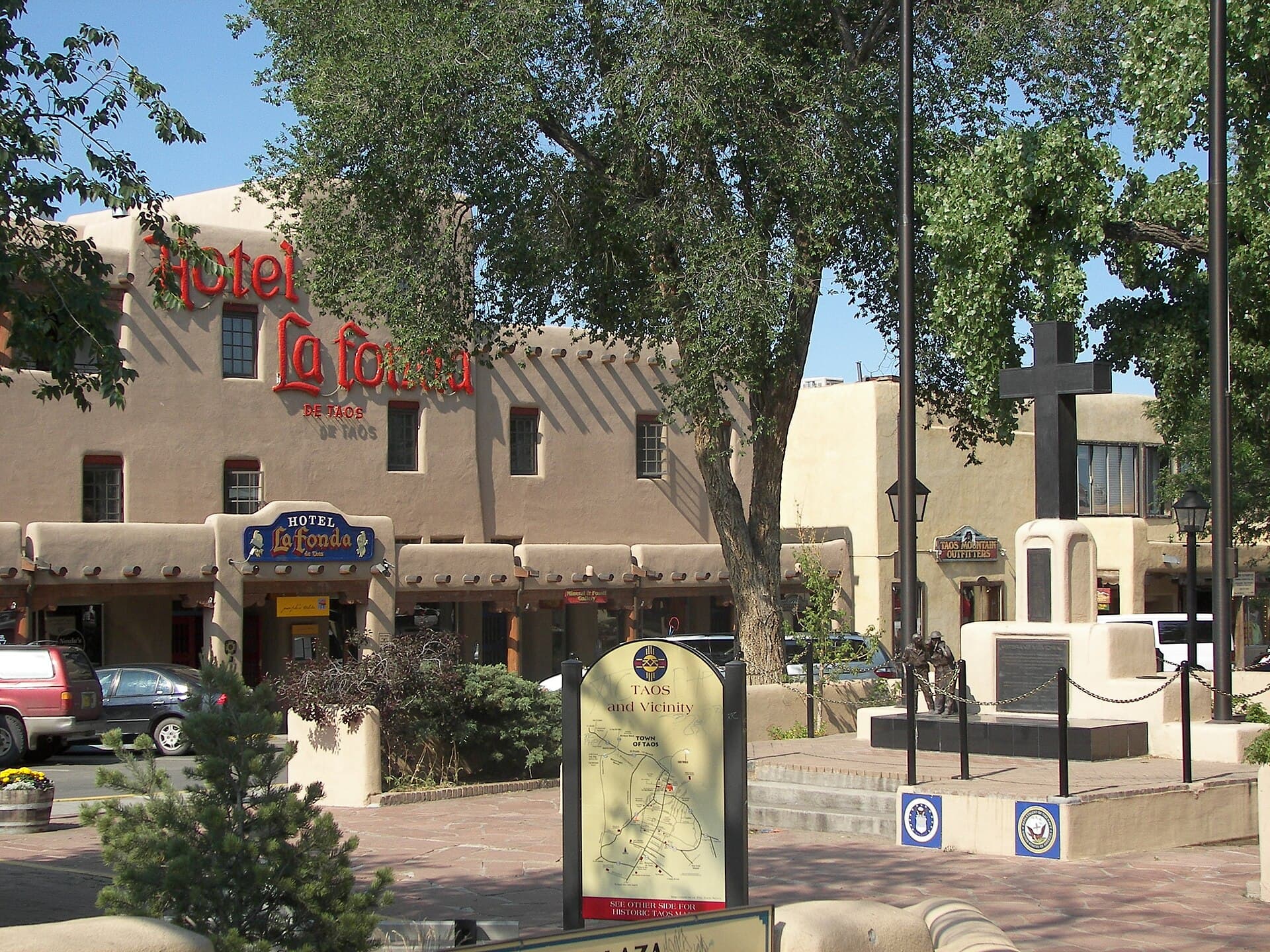
Begin your exploration at Taos Pueblo, a UNESCO World Heritage Site and National Historic Landmark, where multi-storied adobe buildings have been continuously inhabited for centuries. Observe the traditional architecture and learn about the Taos-speaking (Tiwa) Native American tribe. Next, visit the Taos Plaza, the historic heart of the town, surrounded by shops and galleries. A short distance away is the Kit Carson Home and Museum, the preserved 19th-century adobe residence of the famous frontiersman, offering a glimpse into his life and the era.
Drive to Ranchos de Taos to experience the iconic San Francisco de Asís Mission Church, a National Historic Landmark renowned for its Spanish Colonial architecture and distinctive 'beehive' buttresses that have inspired countless artists. For art enthusiasts, the Mabel Dodge Luhan House is a place of historical note, a historic adobe where the influential arts patron hosted a salon for prominent figures like D.H. Lawrence and Georgia O'Keeffe. The town also features numerous art galleries showcasing the enduring legacy of the Taos art colony.
Taos offers distinct experiences throughout the year. For warm-weather activities like hiking, mountain biking, and rafting, the best time to visit is from mid-June to late August, when average daily high temperatures are above 75°F. Fall, from September to October, is considered a 'sweet spot' by many locals, with cooler air, changing aspen leaves, and cultural events like the Taos Wool Festival. Winter, from December to March, is ideal for skiing and snowboarding at Taos Ski Valley, with average highs in the low to mid-40s°F and lows in the teens°F. Spring (March to May) offers milder temperatures and blooming wildflowers, making it a good time for a quieter visit before the summer crowds.
Taos Regional Airport (TSM/SKX) is located eight nautical miles northwest of the town center, primarily serving general aviation, though JSX offers seasonal commercial flights to destinations like Dallas Love Field and Denver-Rocky Mountain. For those flying into larger airports, the Albuquerque International Sunport offers nonstop flights to 24 major cities, and Santa Fe Airport has daily flights to Dallas/Fort Worth, Denver, and Phoenix. Ground transportation from these airports to Taos is available via private shuttle services or the North Central Regional Transit District (NCRTD) 'Blue Bus,' which also provides fare-free routes around Taos and the Enchanted Circle. While Uber drivers are limited, a local ridesharing service called MyBlue operates within a 2-mile radius of the 340 Chile Line Route. Taos sits at an elevation of 6,967 feet, so be mindful of potential altitude sickness and stay hydrated. Temperatures can drop significantly after sunset, so carrying a jacket is advisable even in warmer months.