Town Hall Square
The central square in Tallinn's Old Town holds a secret connecting it to festive seasons across Europe.
Full story unlocks in the tour
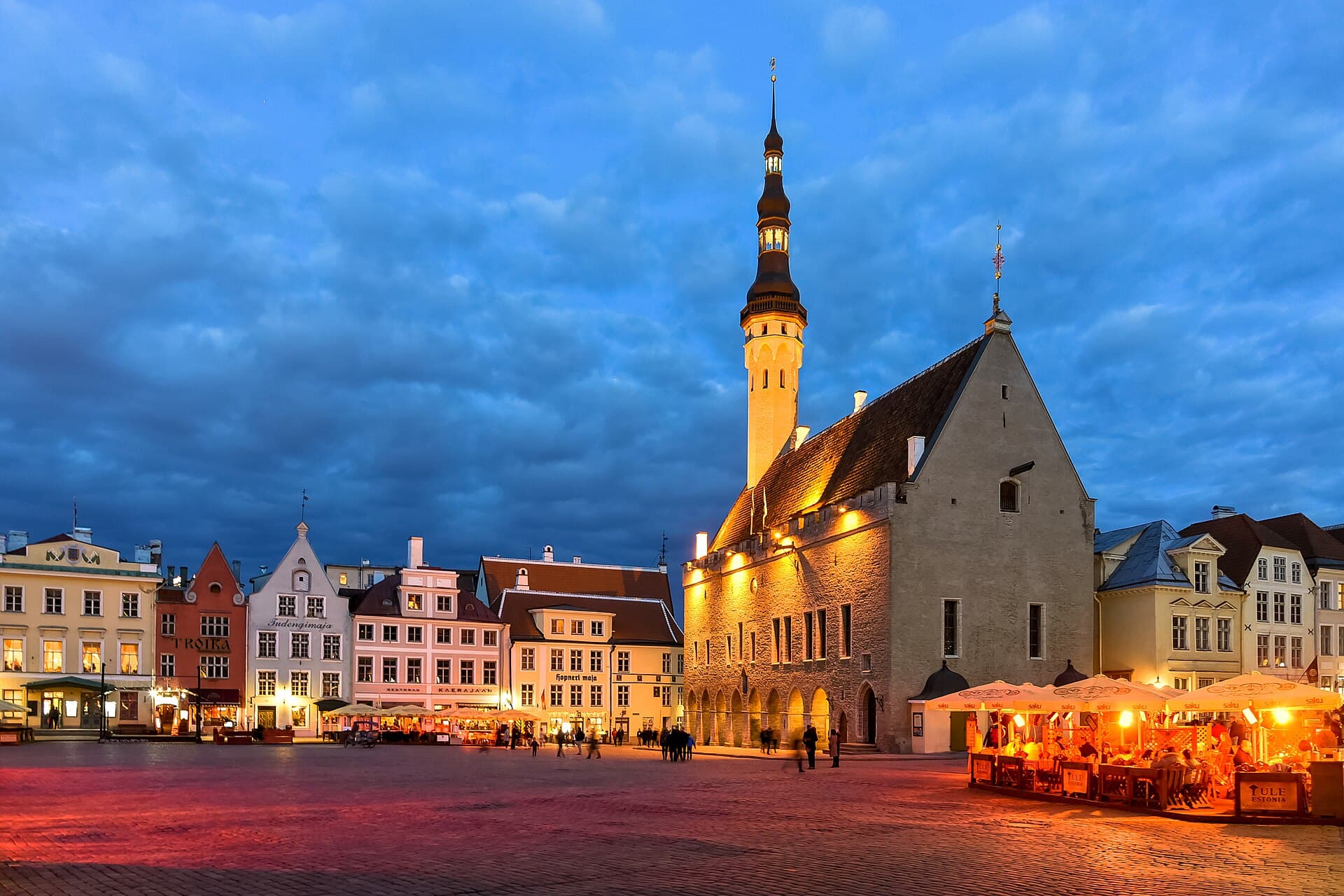 Jorge Franganillo / CC BY 2.0, via Wikimedia Commons
“Where medieval stones meet digital currents.”
Not the postcards. The stories even locals don't know — whispered in your ear, right where they happened.
The central square in Tallinn's Old Town holds a secret connecting it to festive seasons across Europe.
This towering spire, once a record-breaker, also observed Cold War secrets.
The seat of Estonia's parliament conceals a colorful architectural evolution, narrating a story of shifting powers.
Discover every secret of Tallinn
Every address, every reveal in full — in your ear, right where it happened.
You pick your stops. You walk. The voice reveals what the others miss.
No tours available yet. Check back soon — we're preparing them.
Tallinn, the capital of Estonia, is a city where centuries of human endeavor are remarkably preserved alongside a modern spirit. Its Old Town, a UNESCO World Heritage site, is a labyrinth of winding passageways, ancient towers, and merchant houses that transport visitors back to the Hanseatic era. This well-preserved medieval core offers a tangible connection to a past where trade and fortifications shaped daily life.
Beyond the ancient walls, Tallinn reveals itself as a dynamic and youthful metropolis. It is a center of innovation, with one of the highest numbers of startups per capita in Europe and being the birthplace of international tech companies like Skype and Bolt. This blend of deep historical roots and cutting-edge digital advancement creates a compelling contrast, making Tallinn a unique destination in Northern Europe.
## From Ancient Settlement to Hanseatic Powerhouse Tallinn's history stretches back to the late 1st millennium BCE with a fortified settlement, evolving into a town by the 12th century. In 1219, Danish crusaders captured the area, building a new fortress on Toompea hill. This marked the beginning of a period of alternating Scandinavian and Teutonic rule. Trade flourished, especially after Tallinn, then known as Reval, joined the Hanseatic League in 1285. As the northernmost member of this powerful mercantile alliance, Tallinn's strategic port became a significant trade hub between Western Europe and the East from the 14th to 16th centuries. The city was heavily fortified with walls and numerous defense towers during this period.
## Shifting Powers and Modern Independence In 1346, the Danish king sold Reval to the Teutonic Knights. The city converted to Lutheranism during the Protestant Reformation. In 1561, it became a dominion of Sweden. Peter I (the Great) captured Tallinn in 1710 during the Great Northern War, bringing it into the Russian Empire. During the late 19th century, Tallinn industrialized, and its character began to shift with an influx of ethnic Estonian workers.
Estonia declared independence in Tallinn on February 24, 1918, a period followed by German occupation until the end of World War I. During World War II, Tallinn endured Soviet occupation and annexation in 1940, followed by German occupation from 1941 to 1944, suffering severe damage from Soviet aerial bombing. After Soviet rule was re-established, the city expanded significantly, with a large influx of people from other Soviet republics. In 1991, Estonia regained its independence, and Tallinn became the capital of the refounded republic, embarking on a period of rapid development as a modern European capital. The Old Town was designated a UNESCO World Heritage site in 1997.
Tallinn's Old Town is a pedestrian-friendly area, ideal for exploration on foot. Start at Town Hall Square (Raekoja plats), the city's historic heart, surrounded by merchant houses dating from the 15th to 17th centuries. From the circular stone compass rose in the center, you can see the spires of five historic churches. The Gothic Town Hall, the only surviving one in Northern Europe, commands the square, its spire topped by the weather vane "Old Thomas," the city's guardian. Just off the square is the Town Hall Pharmacy (Raeapteek), one of Europe's oldest continuously operating pharmacies, dating back to 1422.
Ascend to Toompea Hill, the Upper Town, which was historically the seat of power. Here you'll find Toompea Castle, now home to the Estonian Parliament, with its distinctive Pikk Hermann tower. Nearby is the striking Alexander Nevsky Cathedral, a Russian Orthodox cathedral with onion domes. For expansive views of the Old Town's red-tiled roofs and the Baltic Sea, visit the Patkuli and Kohtuotsa viewing platforms on Toompea Hill. Descend into St. Catherine's Passage (Katariina käik), a medieval alleyway where artisan workshops continue traditional crafts. You can also walk along sections of the medieval city walls and towers, such as between Nunna, Sauna, and Kuldjala towers, or explore the Bastion Tunnels underneath the Kiek in de Kök fortification museum.
Tallinn offers distinct experiences throughout the year. The summer months (June to August) are the most popular, with warm temperatures (15-22°C) and nearly 19 hours of daylight. This is when the Old Town stirs with outdoor dining, street performances, and festivals. However, July and August are also the rainiest months. For a quieter visit with comfortable walking weather and fewer crowds, consider spring (April to May) or autumn (September). September, in particular, offers a golden autumn atmosphere with temperatures of 10-16°C and rich foliage. Winter (December to February) transforms the city into a snow-covered destination, home to one of Europe's most celebrated Christmas markets in Town Hall Square.
Estonia uses the euro (€), and card payments are widely accepted, even at small stalls. While Estonian is the official language, English is commonly spoken in the city center, especially within hospitality, retail, and tourism sectors. Tallinn is a safe city, but it's always wise to be aware of your surroundings in crowded areas and keep an eye on your belongings. The Old Town's stone streets are charming but uneven, so comfortable, flat-soled shoes are highly recommended for extensive walking. Free Wi-Fi is readily available in most hotels, cafés, public spaces, and even some newer trams. Tallinn's Old Town is compact and very walkable, making it easy to explore on foot, and public transport (buses, trams, trolleybuses) provides an extensive network for areas outside the Old Town.