Plaza de Armas
The main square in Talca possesses a distinctive European character, but the origin of some of its most elegant adornments is a less-told story.
Full story unlocks in the tour
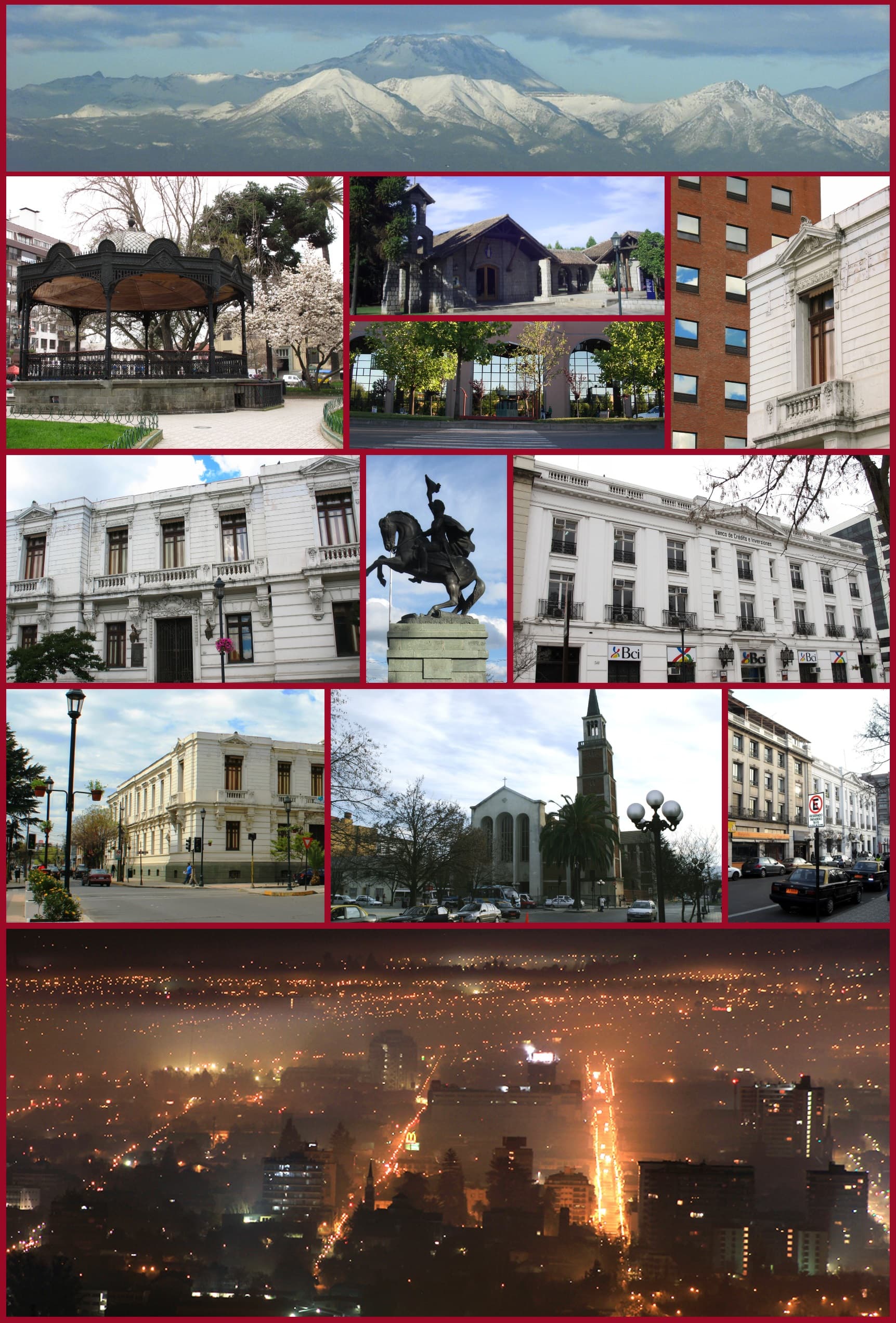 Montaje realizado por Wikiedro. / CC BY-SA 4.0, via Wikimedia Commons
“Where Chile's independence was declared, and fine wines are born.”
Not the postcards. The stories even locals don't know — whispered in your ear, right where they happened.
The main square in Talca possesses a distinctive European character, but the origin of some of its most elegant adornments is a less-told story.
Deep within a national park near Talca lies a puzzling volcanic plateau, rumored to connect with realms beyond our own.
Locals share a lighthearted saying about their city, drawing a connection to two iconic global capitals.
Discover every secret of Talca
Every address, every reveal in full — in your ear, right where it happened.
You pick your stops. You walk. The voice reveals what the others miss.
No tours available yet. Check back soon — we're preparing them.
Talca, the capital of the Maule Region, settles in Chile's fertile Central Valley, approximately 255 kilometers south of Santiago. It functions as a significant economic, cultural, and educational center, blending expansive green spaces with a dynamic urban pulse. The city serves as a gateway to the Maule Valley's sprawling vineyards, making it an ideal starting point for exploring Chile's celebrated wine country.
Often passed over by travelers journeying to more prominent destinations, Talca offers a singular appeal with its unhurried pace, welcoming residents, and a noticeable absence of tourist throngs. Its strategic position makes it a convenient base for day trips to natural wonders like the Radal Siete Tazas National Park and the Altos de Lircay National Reserve. Talca's Mediterranean climate, marked by dry, warm summers and wet, cool winters, makes it pleasant for exploration for much of the year.
Talca's origins trace back to 1692 with an initial attempt at settlement by Tomás Marín de Poveda. However, it was formally re-established on May 12, 1742, by Governor José Antonio Manso de Velasco, who named it Villa de San Agustín de Talca. The name 'Talca' itself originates from the Mapudungun language, meaning 'thunder' or 'thunderous voice,' likely referencing the nearby river.
From its inception, Talca's economy was deeply rooted in the land, with grain cultivation, livestock farming, and viticulture establishing the region's prosperity. The city's growth was further propelled by its advantageous geographical location in the Central Valley, providing ideal conditions for agriculture and commerce.
Talca occupies a central position in Chilean history as the 'Cradle of Independence.' On February 12, 1818, national hero Bernardo O'Higgins affixed his signature to Chile's Act of Independence here, formally establishing the nation's sovereignty. The historic structure where this momentous event occurred, also O'Higgins' childhood home, is now the O'Higgins and Fine Arts Museum.
Despite its significant historical role, Talca has confronted numerous challenges, particularly from destructive earthquakes. The city was largely undone in 1742 and again in 1928, and sustained extensive damage in the 2010 earthquake, which had its epicenter southwest of the city. Each time, the resilient city has been reconstructed, with its colonial and neoclassical architectural heritage often altered. Today, Talca continues to flourish as a commercial and service center, with a strong emphasis on processing the region's agricultural resources, including its prominent wine industry.
Begin your exploration at the Plaza de Armas, the city's central square, recognized for its shaded pathways, fountains, sculptures, and a distinctly European atmosphere. Surrounding the plaza are several historical structures, making it an excellent starting point for a walking tour. A short walk from the main square leads to the O'Higgins and Fine Arts Museum, situated in the former residence of Bernardo O'Higgins, where Chile's Declaration of Independence was signed. The museum offers insights into the independence struggle and displays works by Chilean artists.
For a deeper understanding of colonial life and regional culture, consider a visit to the Villa Cultural Huilquilemu, located just beyond the city limits. This 19th-century estate features a museum of religious art and ethnography, encircled by a picturesque park, and even provides wine tastings from local Maule Valley wineries.
Those who appreciate nature should consider a day trip to Parque Nacional Radal Siete Tazas, celebrated for its seven clear pools and impressive cascades, including the 50-meter-high 'Velo de la Novia' (Bridal Veil). Another option for hikers is the Altos de Lircay National Reserve, offering trails through forests and expansive views of the Andes, including the singular volcanic plateau of El Enladrillado.
Do not overlook the bustling Mercado Municipal (Mercado Central de Talca), where local farmers offer fresh produce, cheeses, and spices, providing a lively glimpse into daily life and a chance to sample local delicacies. For those who appreciate wine, the Maule Valley is Chile's largest wine-producing region, and many local wineries extend invitations for tours and tastings.
The ideal time to visit Talca for warm-weather activities extends from early December to early March, during the Southern Hemisphere's summer. In these months, temperatures average around 21.7°C, with daytime highs reaching 29.3°C, and rainfall is minimal, making it perfect for outdoor excursions and vineyard visits. Spring (September to November) and fall (March to May) are also excellent, offering mild weather, fewer crowds, and opportunities to observe wildflowers or the grape harvest. Winters (June to August) are cooler and wetter, with July being the coldest month, averaging 8.6°C.
Talca is well-connected and easily reached. While the city does not have its own commercial airport, you can fly into Arturo Merino Benítez Airport (SCL) in Santiago, approximately 253 kilometers north. From Santiago, Talca can be reached by rental car or direct bus in about 3 to 3.5 hours via Ruta 5, part of the Pan-American Highway. Alternatively, Carriel Sur Airport (CCP) in Concepción, about 196.5 kilometers south, offers another regional hub option. Express trains also travel to Talca from Santiago.
Within the city, most points of interest are walkable, especially around the central Plaza de Armas. For longer distances, local buses or colectivos (shared taxis) are readily available. Nightlife in Talca tends to begin later, with bars filling around 10:00 PM and clubs after midnight. Central districts and the casino area are generally considered secure, but it is advisable to use taxis or ride-sharing applications like Uber or DiDi for nighttime travel. Prices for cocktails and snacks in bars are typically more economical than in Santiago.