Reök Palace
This Art Nouveau creation, with its flowing lines and water lily motifs, wasn't just a flight of architectural fancy.
Full story unlocks in the tour
 Szilas / CC0, via Wikimedia Commons
“Where sunshine and Art Nouveau illuminate a city of resilience.”
Not the postcards. The stories even locals don't know — whispered in your ear, right where they happened.
This Art Nouveau creation, with its flowing lines and water lily motifs, wasn't just a flight of architectural fancy.
Standing since 1904, this isn't just a functional piece of infrastructure.
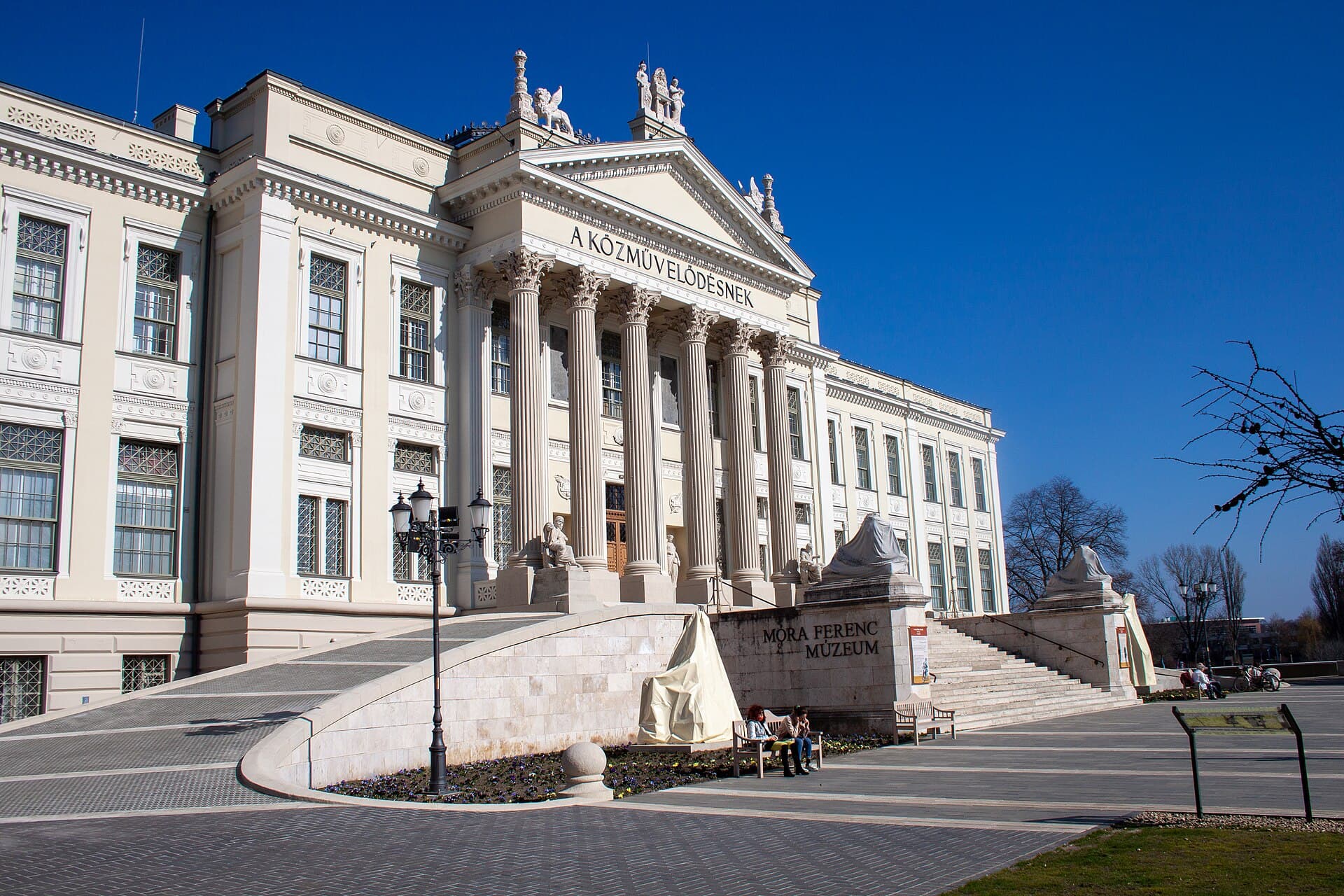
Beyond its neoclassical facade, this museum holds a secret that glitters.
Discover every secret of Szeged
Every address, every reveal in full — in your ear, right where it happened.
You pick your stops. You walk. The voice reveals what the others miss.
No tours available yet. Check back soon — we're preparing them.
Szeged, often called the "City of Sunshine" for its abundant sunny days, is Hungary's third-largest city, situated on the Tisza River near the Serbian and Romanian borders. This university town offers a relaxed pace, elegant architecture, and a youthful atmosphere. Its compact city center, with pedestrian-friendly streets and a scenic riverside promenade, makes it ideal for exploration on foot or by bike.
While Szeged possesses centuries of existence, its present-day appearance was largely shaped by a catastrophic flood in 1879, which destroyed most of the city. The subsequent reconstruction, supported by various European cities, resulted in a modern urban plan featuring wide boulevards and radial avenues, showcasing a striking blend of Eclecticism and Art Nouveau architecture. This blend of historical resilience and architectural beauty makes Szeged a singular destination in Central Europe.
## From Ancient Settlement to Ottoman Rule Szeged and its surrounding area have been continuously inhabited since ancient times, with Ptolemy mentioning the city's oldest known name, Partiscum. A Roman trading post was established on an island in the Tisza in the second century AD, and the foundations of Szeged Castle suggest an even earlier fort. The city's name, Szeged, was first documented in 1183 in a charter by King Béla III. By the 14th century, Szeged had become a significant town in Southern Hungary, its strategic location at the confluence of the Tisza and Maros rivers making it an important trade center, particularly for salt. King Sigismund of Luxembourg ordered the construction of a city wall, and in 1498, Szeged was granted the status of a free royal town.
The city faced numerous challenges, including destruction during the Mongol invasion in the 13th century, after which it was rebuilt. In 1543, Szeged was occupied by the Ottoman Army and became an administrative center of the Ottoman Empire, remaining under their rule until 1686. After being liberated, it regained its free royal town status in 1715, and in 1719, received its coat of arms, which is still in use today.
## The Great Flood and Rebirth The 19th century brought renewed prosperity, with the first printing press established in 1801 and the arrival of the railway in 1854. However, Szeged's history took a dramatic turn on March 12, 1879, when a catastrophic flood of the Tisza River destroyed nearly 95% of the city's buildings. Out of over five thousand houses, only a few hundred survived. This devastating event, however, led to a massive reconstruction effort, with financial aid and support from various European capitals. The city was rebuilt according to a modern urban plan, featuring concentric boulevards and radial avenues, which gave Szeged its current elegant and harmonious appearance. The Votive Church, a prominent landmark, was built between 1913 and 1930 as a vow made by the city's inhabitants after the flood.
## A Modern University City In the 20th century, Szeged continued to evolve. Following the Treaty of Trianon in 1921, the university from Kolozsvár (now Cluj-Napoca, Romania) relocated to Szeged, transforming it into a major educational hub. The University of Szeged, established in 1581, is now one of Hungary's most distinguished universities and the second largest by student numbers. Today, Szeged is a lively university town, a center for light industry and food production, particularly known for its paprika and salami.
Begin your exploration at Dóm Square, one of Hungary's largest squares, framed by university buildings and the impressive Votive Church. This Neo-Romanesque cathedral, with its twin 91-meter-high towers and elaborate interior, was built as a vow after the 1879 flood. You can climb a tower for expansive city views. In front of the Votive Church stands the St. Demetrius Tower, the oldest building in Szeged, with foundations dating to the 11th century.
Szeged is celebrated for its Art Nouveau architecture. Wander through the city center to discover buildings like the Reök Palace, designed by Ede Magyar, with its flowing facade adorned with water lily motifs, now a regional art center. Other Art Nouveau examples include Ungár-Mayer Palace and Raichl House. The Móra Ferenc Museum, housed in a neoclassical building on the Tisza River, offers collections spanning archaeology, ethnography, and fine arts.
For a different perspective, visit the Szent István Square Water Tower, an early reinforced concrete industrial monument with Art Nouveau elements. It functions as a water tower and occasionally offers lookout access. You can also enjoy a leisurely stroll along the Tisza River, offering green spaces and pleasant views.
The best time to visit Szeged for warm-weather activities is from late May to mid-September, with peak enjoyment in the third week of August. During this period, the average daily high temperatures are above 74°F (23°C). For those who prefer milder weather, late spring (May-June) and early autumn (September) offer pleasant days with temperatures between 18-24°C (64-75°F). Summers host the popular Szeged Open Air Festival, adding a cultural dimension to your visit.
Szeged is easily accessible from Budapest by train, with direct IC trains departing hourly and a journey time of approximately 2 hours and 30 minutes. Once in the city, Szeged is highly walkable, with a compact center and pedestrian-friendly streets. An extensive network of trams and buses, along with a growing cycling infrastructure, provides efficient internal transportation. The local currency is the Hungarian Forint (HUF), and while Hungarian is the official language, English is widely spoken in hospitality and tourist areas. The city center, particularly around the Votive Church and open-air markets, is lively and generally safe, though it's always wise to be aware of your surroundings in crowded areas.