Wat Si Chum
The colossal Buddha image within Wat Si Chum captivates, yet its design held a clever purpose beyond devotion.
Full story unlocks in the tour
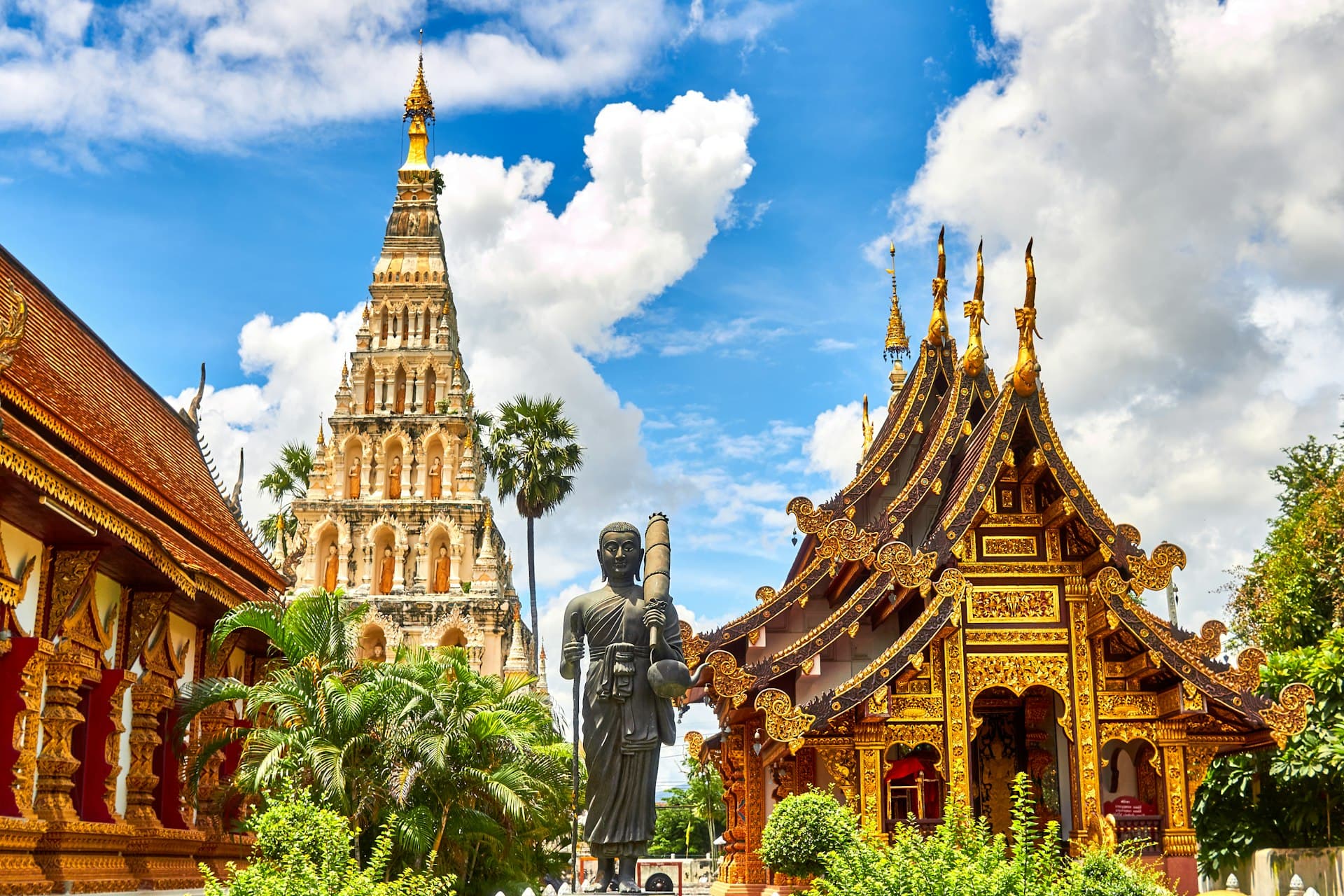 Photo: Mathew Schwartz / Unsplash
“Where the 'Dawn of Happiness' still echoes a golden age.”
Not the postcards. The stories even locals don't know — whispered in your ear, right where they happened.
The colossal Buddha image within Wat Si Chum captivates, yet its design held a clever purpose beyond devotion.
Before modern banknotes, the Sukhothai Kingdom circulated a distinct form of money, far removed from today's flat coins.
Even the contemporary gateway to Sukhothai provides an unexpected and charming diversion for travelers.
Discover every secret of Sukhothai
Every address, every reveal in full — in your ear, right where it happened.
You pick your stops. You walk. The voice reveals what the others miss.
No tours available yet. Check back soon — we're preparing them.
Sukhothai, a name meaning 'Dawn of Happiness,' served as the initial capital of Siam, a kingdom that laid much of the groundwork for modern Thai culture. Established in the 13th century after gaining sovereignty from the Khmer empire, Sukhothai thrived for approximately two centuries, becoming a vital center for governance, trade, and worship. Today, the enduring structures of this glorious era are preserved within the Sukhothai Historical Park, a UNESCO World Heritage site spanning over 70 square kilometers and encompassing nearly 200 ancient structures.
Exploring Sukhothai offers a journey into the past, providing a tranquil contrast to Thailand's busy cities. The park's level terrain, punctuated by ancient temples, Buddha statues, and lily ponds, invites exploration by bicycle, allowing for a relaxed pace to absorb the historical atmosphere. It is a place where the elegant architecture and artistry of the Sukhothai style, particularly its distinct Buddha images, narrate stories of a prosperous and culturally rich period.
The story of Sukhothai begins in the 13th century, evolving from a trading post and an outpost of the Khmer Empire into an independent city-state. In 1238, two Thai chieftains, Pho Khun Bang Klang Hao and Pho Khun Pha Mueang, led a rebellion against Khmer dominion, establishing the first significant independent Thai state. This crucial moment marked the genesis of the Sukhothai Kingdom and the Phra Ruang dynasty.
The kingdom's golden age is largely attributed to its third ruler, King Ramkhamhaeng the Great (reigned c. 1279–c. 1298). He is revered as a foundational figure of the Thai nation, extending Sukhothai's influence considerably across present-day Laos, westward to the Andaman Sea, and southward to the Malay Peninsula. Beyond territorial expansion, King Ramkhamhaeng's reign witnessed profound cultural and economic advancements. It was during this period that the Thai alphabet was likely created, with the earliest known example found in the Ramkhamhaeng Inscription from 1292. Theravada Buddhism, influenced by Sri Lankan styles, also became deeply rooted, profoundly shaping the kingdom's art and architecture.
Sukhothai's prosperity was further fueled by its strategic location in the fertile Yom River valley and an impressive system of hydraulic engineering, including dams, reservoirs, and canals for irrigation and flood control. The kingdom also fostered open trade, with markets accessible to all without transit taxes, and became recognized for its high-quality Sangkhalok ceramics, which were widely exported.
However, Sukhothai's autonomy was not eternal. After 1351, with the emergence of the powerful Ayutthaya kingdom, Sukhothai's influence began to diminish, eventually being conquered and absorbed by Ayutthaya in 1438. The city was largely abandoned in the late 15th or early 16th century, and its wooden structures faded over time. It was not until the 19th century, with the discovery of the Ramkhamhaeng stele by King Mongkut (Rama IV), that interest in Sukhothai's historical importance was renewed. Extensive restoration efforts in the 1970s led to the opening of the Sukhothai Historical Park in 1988, which was recognized as a UNESCO World Heritage site in 1991, ensuring the preservation of this 'Dawn of Happiness' for future generations.
The Sukhothai Historical Park is organized into five zones. The Central, Northern, and Western zones require an entrance fee, while the Southern and Eastern zones are free to explore.
Within the Central Zone, the expansive Wat Mahathat stands as the most significant royal temple, featuring numerous stupas, prangs, and Buddha figures. Nearby, Wat Sa Si is notable for its tranquil setting on a small island amidst the Traphang-Takuan pond, often graced with lotus flowers. Also in this zone, Wat Si Sawai displays strong Khmer architectural influences, with three distinct prangs.
The Northern Zone contains Wat Si Chum, celebrated for its immense 15-meter-high seated Buddha image, Phra Achana, housed within a mandapa. Close by is Wat Phra Phai Luang, considered one of the oldest monuments in the park, exhibiting Khmer prangs and intricate carvings.
While exploring the park, make time for the Ramkhamhaeng National Museum, situated opposite the main entrance. It holds artifacts from excavations, including the Ramkhamhaeng Stele, which presents the earliest known example of the Thai alphabet.
The ideal time to experience Sukhothai is during the cool season, from November to February. In these months, temperatures are pleasant, ranging from 24°C to 31°C (75°F to 87°F), with lower humidity and minimal rainfall, making outdoor exploration of the historical park comfortable. December and January are particularly favorable. The park often extends its opening hours until 9 PM on Saturdays, with floodlights illuminating the ruins, offering a different perspective.
Sukhothai is divided into 'Old Sukhothai,' where the Historical Park is situated, and 'New Sukhothai,' the modern town approximately 12 kilometers away, where most accommodations and services are found. Local buses run frequently between the two, costing around 30 Baht for a 30-minute journey. Tuk-tuks and songthaews (shared pickup trucks) are also available.
The Sukhothai Historical Park entrance fee for the Central Zone is 200 THB, with the Northern and Western zones costing 120 THB each. An additional 10 THB is charged for bringing a bicycle into each paid zone. Tickets are valid for one day, allowing re-entry.
Renting a bicycle (30-50 THB per day) is the most popular and recommended method to explore the expansive park. ATMs are available in New Sukhothai and near the park entrance, but carrying small Thai Baht (THB) denominations is advisable for local markets and smaller purchases.