The Stuttgart Fernsehturm
This pioneering structure wasn't just a television tower; it introduced a concept that would sweep the globe.
Full story unlocks in the tour
 Julian Herzog (Website) / CC BY 4.0, via Wikimedia Commons
“Where visionary engineering meets ancient vineyards, and the roar of engines shares the stage with historic palaces.”
Not the postcards. The stories even locals don't know — whispered in your ear, right where they happened.
This pioneering structure wasn't just a television tower; it introduced a concept that would sweep the globe.
Despite its industrial prowess, Stuttgart holds a surprising secret within its city limits, a testament to a much older tradition.
In a city celebrated for its high-tech automotive marvels, one museum offers a decidedly different, and rather extensive, collection.
Discover every secret of Stuttgart
Every address, every reveal in full — in your ear, right where it happened.
You pick your stops. You walk. The voice reveals what the others miss.
No tours available yet. Check back soon — we're preparing them.
Stuttgart, the capital of Baden-Württemberg, is a city that masterfully blends its industrial might with a surprising abundance of green spaces and a profound cultural heritage. Situated in a fertile valley, often called the Stuttgarter Kessel (Stuttgart Cauldron), the city is encircled by hills, forests, and vineyards, creating a distinctive landscape for a major German metropolis. Home to global automotive giants like Mercedes-Benz and Porsche, Stuttgart is frequently acknowledged as the "cradle of the automobile," a legacy proudly displayed in its world-class museums.
Beyond its automotive renown, Stuttgart presents a lively cultural scene, from acclaimed ballet and opera to a diverse culinary landscape influenced by its significant international population. With a history extending back over a thousand years to a ducal stud farm, the city has evolved into a dynamic center of innovation, finance, and tourism, consistently ranking high in quality of living.
## From Stud Farm to Swabian Capital Stuttgart's origins trace back to approximately 950 AD, when Duke Liudolf of Swabia established a stud farm, or "Stuotgarten," for his warhorses in the Nesenbach Valley. This foundational act is still reflected in the city's name and its coat of arms, which features a rearing black stallion. For centuries, the nascent town was overshadowed by the nearby Roman-era settlement of Bad Cannstatt, an important regional center.
Stuttgart's fortunes began to shift in the 13th century when it gained city status and, by 1321, became the official residence of the Counts of Württemberg. This elevation in status led to gradual growth and the construction of fortifications, including a fort on the site of the present-day Old Castle. By the 15th century, Stuttgart was declared the capital of Württemberg, a position it maintained through its evolution from a county to a duchy and eventually a kingdom, until 1918.
The 19th century ushered in an era of significant industrial and scientific development for Stuttgart. The city saw the establishment of factories, a university, and schools of engineering and art. Crucially, the late 19th century marked Stuttgart's pivotal role in automotive history with the invention of the first gasoline engine and carburetor, laying the groundwork for the modern automobile industry. This legacy continues today, with Mercedes-Benz and Porsche headquartered in the city.
Despite setbacks during the Thirty Years' War and extensive damage from Allied air raids during World War II, Stuttgart demonstrated remarkable resilience. By 1952, it had recovered to become a major cultural, economic, and industrial hub. Today, Stuttgart is recognized for its strong high-tech industry, particularly in the automotive sector, and holds one of the highest standards of prosperity among German cities. The city's post-war reconstruction also led to a more modern architectural landscape, as many historic buildings were not rebuilt.
## Modern Stuttgart: Innovation and Green Living In more recent times, Stuttgart has embraced its dual identity as a center of innovation and a city committed to green living. It was recognized in 2017 as the world's least stressful city in a study, a testament to its green spaces, family purchasing power, and citizens' mental health. The city's ongoing "Stuttgart 21" project aims to further improve its transport links and international infrastructure, reflecting its ambition to be "The new Heart of Europe." Stuttgart's commitment to culture is also evident in its numerous museums, galleries, and its world-renowned ballet company.
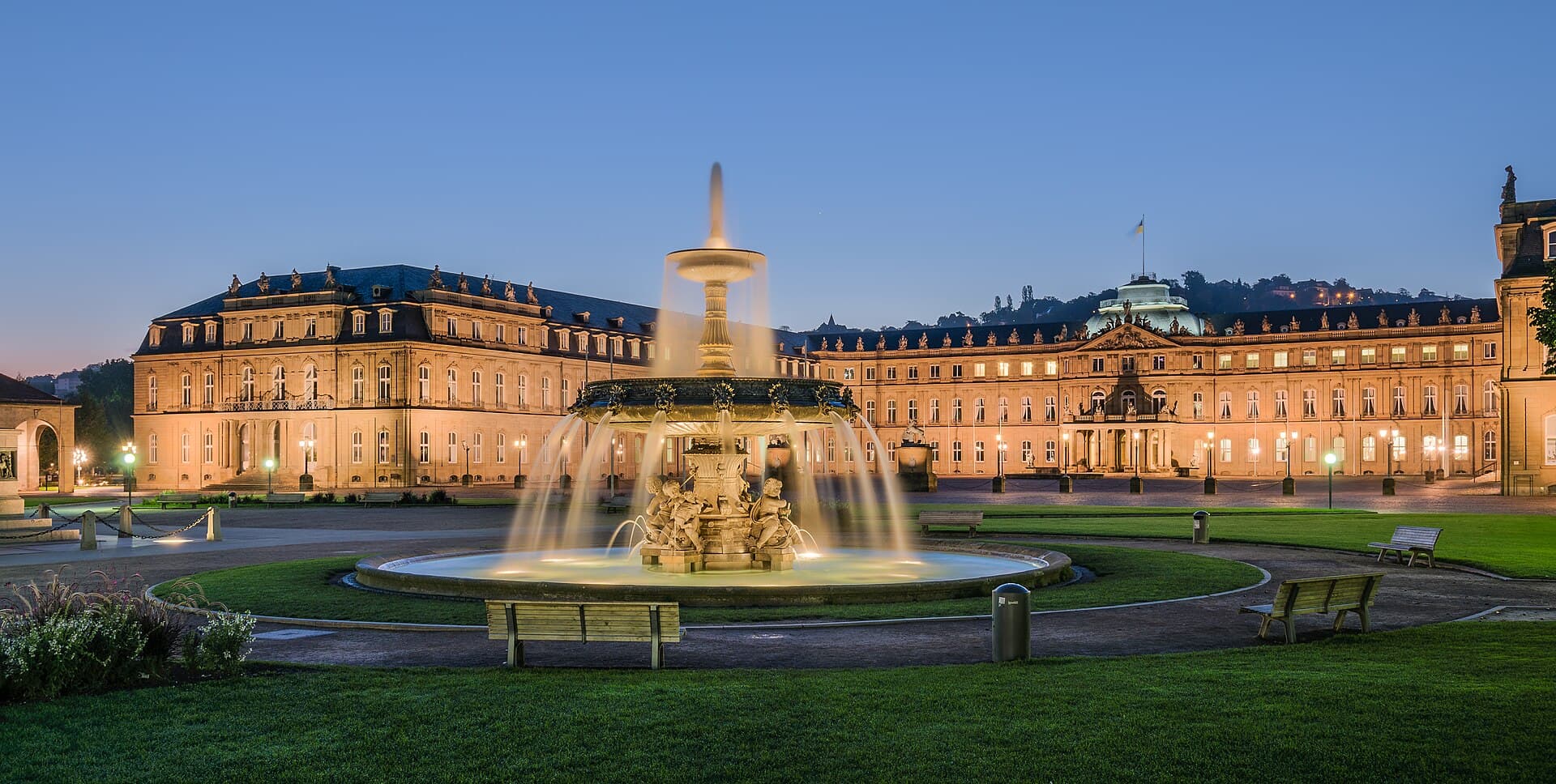
Begin your exploration at Schlossplatz, the city's central square, framed by the majestic New Palace and the historic Old Castle. Ascend to the top of the Kunstmuseum Stuttgart (Museum of Art), a striking glass cube, for expansive views of the square and surrounding city. Nearby, the Markthalle Stuttgart (Market Hall), an Art Nouveau building from 1914, offers a global culinary journey with its array of exotic spices, fresh produce, and international delicacies.
For automotive enthusiasts, the Mercedes-Benz Museum and Porsche Museum are essential visits, showcasing over a century of groundbreaking engineering and iconic vehicles. Allow several hours for each. Immerse yourself in nature at Wilhelma, Germany's only zoological-botanical garden, set within the grounds of a former royal palace in Bad Cannstatt. Alternatively, take a stroll through Rosensteinpark, the largest English-style park in southwestern Germany, also home to the Museum of Natural History.
Consider the Grabkapelle on Württemberg Hill, a 19th-century mausoleum offering romantic views of the city and its vineyards. For a unique architectural experience, visit the Weissenhof Estate, a UNESCO World Heritage site showcasing pioneering modernist housing from the 1927 Werkbund Exhibition, featuring designs by architects like Le Corbusier. Finally, for an unparalleled vista, ascend the Stuttgart Fernsehturm (TV Tower), the world's first of its kind, which provides sweeping views of the city, vineyards, and even the Black Forest on a clear day.
Stuttgart enjoys a mild, slightly continental climate. The most pleasant time to visit for agreeable weather and outdoor activities is from mid-May to mid-September, with July and August being the warmest months, averaging around 19°C (66-67°F). Rainfall is distributed throughout the year, with quick thundery bursts in the summer. For mild temperatures, fewer crowds, and potentially lower prices, consider visiting in April–May or September–October. These shoulder seasons also offer blooming gardens in spring and lively foliage and wine festivals in autumn. The city's celebrated Christmas markets draw many visitors in late November and December.
Stuttgart is well-served by an extensive public transportation network (VVS) comprising buses, U-Bahn (underground/light rail), and S-Bahn (commuter trains). The U-Bahn covers most of the city with 14 main lines, while the S-Bahn connects to outlying areas. Tickets can be purchased at vending machines at stations, on buses from the driver, or via the VVS app. The StuttCard is a convenient option for tourists, offering free public transport and discounts on museums and attractions.
Stuttgart Airport (STR) is located 10 km south of the city center, with S-Bahn trains offering a 25-35 minute transfer to downtown. Taxis are readily available, or you can use ride-sharing apps. Car sharing services are also popular. When dining, punctuality is valued, and a firm handshake is the standard greeting. Traditional Swabian dishes like Maultaschen (stuffed pasta) and Spätzle (egg noodles) are local specialties.