Holy Trinity Church
William Shakespeare's grave carries a very specific warning.
Full story unlocks in the tour
 Lewis Clarke / CC BY-SA 2.0, via Wikimedia Commons
“Beyond the Bard: Uncovering Stratford-upon-Avon's lesser-known narratives.”
Not the postcards. The stories even locals don't know — whispered in your ear, right where they happened.
William Shakespeare's grave carries a very specific warning.
The current Royal Shakespeare Theatre isn't the first, and its design caused quite a stir.
This tranquil waterway almost vanished entirely, saved by an unexpected hero.
Discover every secret of Stratford-upon-Avon
Every address, every reveal in full — in your ear, right where it happened.
You pick your stops. You walk. The voice reveals what the others miss.
No tours available yet. Check back soon — we're preparing them.
Stratford-upon-Avon, a market town in Warwickshire, England, is globally recognized as the birthplace of William Shakespeare. Situated along the River Avon, the town draws millions of visitors annually, eager to explore the sites connected to the life and legacy of the world's most famous playwright.
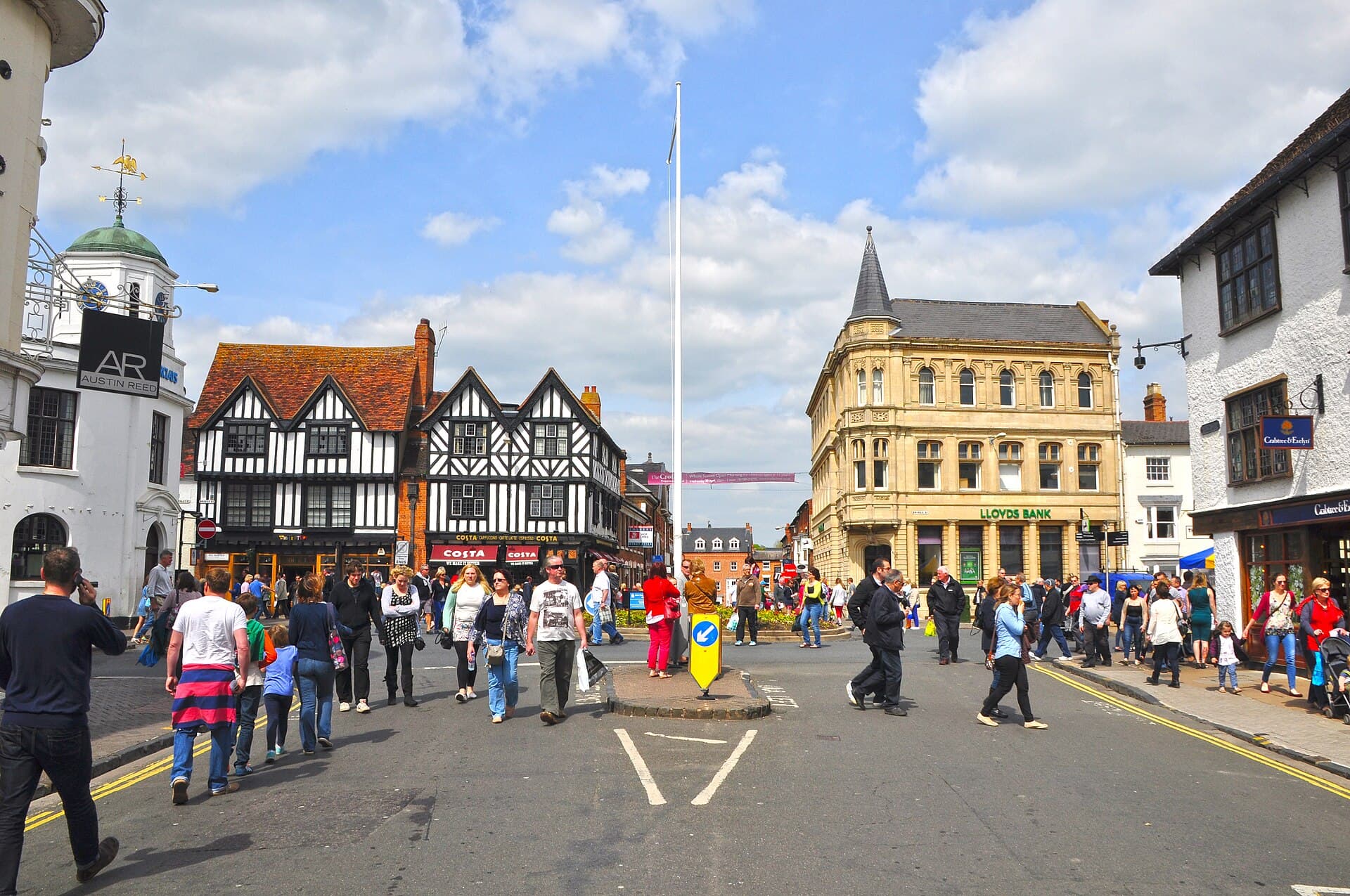
Beyond its Shakespearean connections, Stratford-upon-Avon offers a charming English experience with its historic streets, timber-framed buildings, and scenic riverside. The town provides a blend of cultural immersion and leisurely pursuits, from world-class theatre performances by the Royal Shakespeare Company to tranquil boat trips along the Avon.
The origins of Stratford-upon-Avon can be traced back to an Anglo-Saxon settlement. The earliest written reference to the town, then called 'Aet-Stratford the isles of the ford,' appeared between 693 and 717, likely due to the establishment of Holy Trinity Church. This initial community consisted of the church, a monastery, a watermill, and approximately 20 families. However, Danish raiders destroyed every house in Warwickshire in 1015, leaving little of the first Stratfordians.
In 1196, King Richard I granted Stratford a charter to hold a weekly market, elevating its status to a market town and fostering an increase in trade and urban expansion. The 12th to 14th centuries saw Stratford develop into a 'planned town' with a grid of wide streets and evenly spaced plots, a layout largely maintained even today. The Guild of the Holy Cross assumed municipal responsibility around 1269.
By the time William Shakespeare was born in 1564, Stratford was a thriving town. While the town's physical footprint remained largely unchanged between the 13th and 17th centuries, it experienced the impacts of the English Civil War, including lootings and skirmishes. The 18th century marked the beginning of Stratford's modern tourism industry, sparked by David Garrick's Shakespeare Jubilee in 1769. In the 19th century, infrastructure improvements further solidified Stratford's accessibility and appeal as a destination for 'bardolators.'
The Stratford-upon-Avon Canal was conceptualized in the late 18th century as an alternative route for transporting coal from the Dudley and Stourbridge Canals to Oxford and London, bypassing the monopolistic Birmingham canals. An Act of Parliament in 1793 authorized its construction, with work commencing in November of that year. Despite financial challenges that halted construction at various points, the canal was eventually completed in 1816, connecting to the River Avon at Stratford. The 25.5-mile canal features 56 locks, a tunnel, and several aqueducts.
Following its acquisition by a railway company in 1856, the canal's importance declined, becoming largely unnavigable by the mid-20th century. However, a public outcry and the intervention of a canoeist prevented its official abandonment. The National Trust undertook a restoration project between 1961 and 1964, utilizing volunteers, army personnel, and prisoners, reopening the southern section in 1964. This successful restoration inspired other canal preservation efforts across the country.
Begin your exploration at Shakespeare's Birthplace on Henley Street, a restored 16th-century Tudor home where the playwright was born and spent his childhood. Continue to Anne Hathaway's Cottage, a picturesque thatched farmhouse in Shottery, about a mile and a half from the town center, which was the childhood home of Shakespeare's wife. The cottage, dating back to 1463, retains its original kitchen and parlor.
Next, visit Shakespeare's New Place, the site of Shakespeare's family home from 1597 until his death in 1616. Though the original house was demolished in 1759, the site is now a specially designed garden with exhibitions in the adjacent Nash's House. Explore Hall's Croft, the Jacobean home of Shakespeare's daughter Susanna and her physician husband, Dr. John Hall, which features a walled garden with medicinal herbs. Conclude your Shakespearean journey at Holy Trinity Church, where Shakespeare was baptized and is buried.
Beyond the Shakespeare properties, consider a performance at the Royal Shakespeare Theatre by the Royal Shakespeare Company. Take a stroll along the River Avon or enjoy a boat trip, observing the canal basin with its colorful barges. For a different experience, the Mechanical Art and Design (MAD) Museum offers a collection of kinetic art and automata. The Stratford Butterfly Farm is the largest tropical butterfly attraction in the UK.
The best time to visit Stratford-upon-Avon is during spring (March to May) or early autumn (September to November). During these seasons, the weather is generally pleasant, and the town experiences fewer crowds compared to the peak summer months. Summer (July and August) offers warm and sunny weather, but attractions can be very busy. If you plan to see a Royal Shakespeare Company performance, booking tickets in advance is highly recommended, especially during peak season.
Stratford-upon-Avon is easily accessible, approximately a two-hour train journey from London Marylebone, with some services requiring a change. Alternatively, National Express coaches are available from Victoria Coach Station, though they involve a change in Coventry. If driving, Stratford-upon-Avon is located off Junction 15 of the M40. Once in town, many of the main attractions are within walking distance of each other. Comfortable shoes are recommended for exploring on foot. For attractions further afield, such as Anne Hathaway's Cottage, it's a pleasant 20-30 minute walk or a short drive. Consider purchasing a Shakespeare Story ticket or a Shakespeare Five House Pass for combined entry to multiple Shakespeare Birthplace Trust properties. The town offers a range of dining options, from historic pubs to independent cafes and restaurants.