St. Edward's Church
The north door of St. Edward's Church in Stow-on-the-Wold evokes scenes from a fantasy realm.
Full story unlocks in the tour
 Bs0u10e01 / CC BY-SA 4.0, via Wikimedia Commons
“Where ancient stones recount eras of wool, conflict, and windswept allure.”
Not the postcards. The stories even locals don't know — whispered in your ear, right where they happened.
The north door of St. Edward's Church in Stow-on-the-Wold evokes scenes from a fantasy realm.
A street in Stow-on-the-Wold carries a name that alludes to a particularly sanguinary moment in English history.
One of England's venerable inns in Stow-on-the-Wold conceals a safeguard within its medieval fireplace, intended to repel malevolence.
Discover every secret of Stow-on-the-Wold
Every address, every reveal in full — in your ear, right where it happened.
You pick your stops. You walk. The voice reveals what the others miss.
No tours available yet. Check back soon — we're preparing them.
Stow-on-the-Wold, set atop an 800-foot rise, stands as the highest town in the Cotswolds, a geographical fact that inspired the local saying, 'Stow on the Wold, where the wind blows cold.' This market town, originally called Stow St. Edward or Edwardstow, has served as a pivotal crossroads for centuries, with six significant routes, including the Roman Fosse Way, converging here. Its elevated position and strategic placement meant its establishment by Norman lords sought to capitalize on passing commerce, shaping its identity as an open, practical center rather than a secluded village.
Today, Stow-on-the-Wold draws visitors with its expansive market square, honey-toned stone structures, and a palpable sense of the past. It is a place where enduring customs intertwine with contemporary allure, presenting a varied assortment of antique emporiums, art galleries, and traditional public houses. Whether you are drawn by its historical weight, its distinctive architecture, or simply the desire to experience the quintessential Cotswold character, Stow offers a compelling window into a storied past and a lively present.
## From Iron Age Stronghold to Wool Trade Center Stow-on-the-Wold's origins extend into the Iron Age, with indications suggesting an ancient fortification once occupied its defensible hilltop. The area also contains Stone Age and Bronze Age burial mounds, evidence of continuous human habitation. The town's name, 'Stow,' originates from the Old English word for 'place,' and it was initially known as Stow St. Edward or Edwardstow, likely after Edward the Martyr. It is believed that Maugersbury was the primary settlement before Stow was established as a marketplace on the hilltop, strategically positioned to benefit from the converging roads.
Markets have defined Stow's character since 1107, when King Henry I granted a charter for a weekly market, with proceeds initially directed to Evesham Abbey. This marked the beginning of Stow's ascent as a prominent trading center. By 1330, royal charters permitted annual fairs, which expanded to two per year by 1476. The town became particularly recognized for its sheep fairs, a vital component of the Cotswold wool trade. Daniel Defoe, in the 18th century, reported that up to 20,000 sheep could be exchanged in a single day within the market square. The distinctive narrow passages, known as 'tures,' leading from the market square were intentionally designed to guide and manage these large flocks.
Stow-on-the-Wold also held a significant role in the English Civil War. In 1646, it was the location of the war's final engagement, where Royalist forces were overcome by Parliamentarians. Hundreds of captives were confined in St. Edward's Church, which sustained damage during skirmishes. The town continued to evolve, and by the mid-19th century, the Talbot Hotel became a focal point for corn merchants. The expansive market square, the old penal stocks, and the Market Cross, erected in the 15th century as a reminder for honest dealing, all stand as enduring testaments to Stow's varied and extensive past.
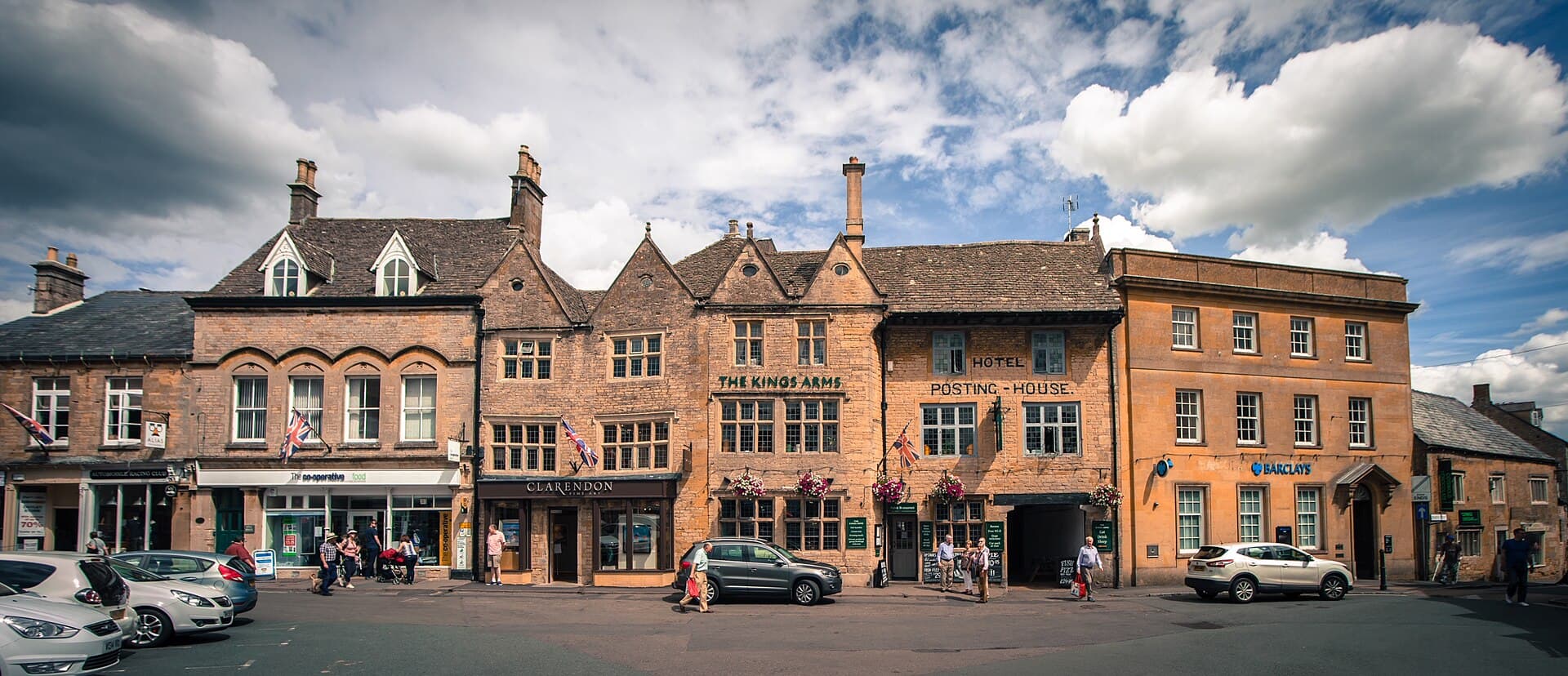
Begin your exploration in the expansive Market Square, the historical core of Stow. Envision the lively sheep fairs of bygone eras as you observe the surrounding 16th-century buildings, now housing antique stores, art galleries, and tea rooms. Seek out the ancient Market Cross and the old village stocks, tangible connections to the town's past.
Just beyond the square, St. Edward's Church merits a visit. Its medieval interior displays stained glass and a painting by Flemish artist Gaspar de Craeyer. The church's north door, framed by two gnarled yew trees, presents a particularly atmospheric scene and a favored photographic subject. Wander along the narrow passageways, or 'tures,' that extend from the square, originally conceived for herding sheep.
Stow-on-the-Wold is recognized for its antique shops and art galleries, many gathered around the Market Square and Sheep Street. The Fosse Gallery, established in 1980, stands as one of the UK's notable galleries outside London, exhibiting contemporary British art. For a glimpse into the town's historical water provision, locate the Stow Wells on Well Lane, a rectangular stone construction that supplied water until the late 1800s.
Beyond the town center, consider a walk through the surrounding countryside. A brief stroll to Maugersbury offers sweeping vistas, or embark on a longer route to nearby villages like Lower Slaughter. Stow also serves as an excellent starting point for exploring other Cotswold attractions such as Batsford Arboretum, Bourton House Gardens, and Chastleton House.
The most agreeable time to visit Stow-on-the-Wold for comfortable weather and outdoor pursuits is between spring (April) and early autumn (October). May and September are especially recommended, offering pleasant temperatures and fewer crowds compared to the peak summer months of July and August. While summer brings the warmest conditions and longer daylight hours, it also sees the highest visitor numbers and prices. For those seeking a more tranquil experience, November to February (excluding the Christmas and New Year period) offers a quieter visit with lower prices, though temperatures will be colder. December is charming for festive markets and a comforting pub atmosphere.
Stow-on-the-Wold is readily accessible by car, positioned at the intersection of several main roads, including the Roman Fosse Way. Parking can be challenging, particularly on weekends and market days. The Market Square provides limited free spaces with a two-hour restriction. For extended stays, the free car park adjacent to Tesco on the Fosseway offers a good option, a brief walk from the town center. There is also a pay-and-display car park on Maugersbury Road. Arriving early on busy days or utilizing the Tesco car park are advisable strategies. Public transport options are available, connecting Stow to other Cotswold towns.
While exploring, wear comfortable footwear as you will likely traverse uneven surfaces. Many shops and galleries are closed on Sundays, so plan accordingly if art and antique browsing are a priority. The town offers a variety of public houses, cafes, and restaurants, many situated in historic buildings, providing ample opportunities for refreshment.