Schmollgruber Passage
A quiet passage just off Steyr's main thoroughfare evokes a corner of the city preserved in time.
Full story unlocks in the tour
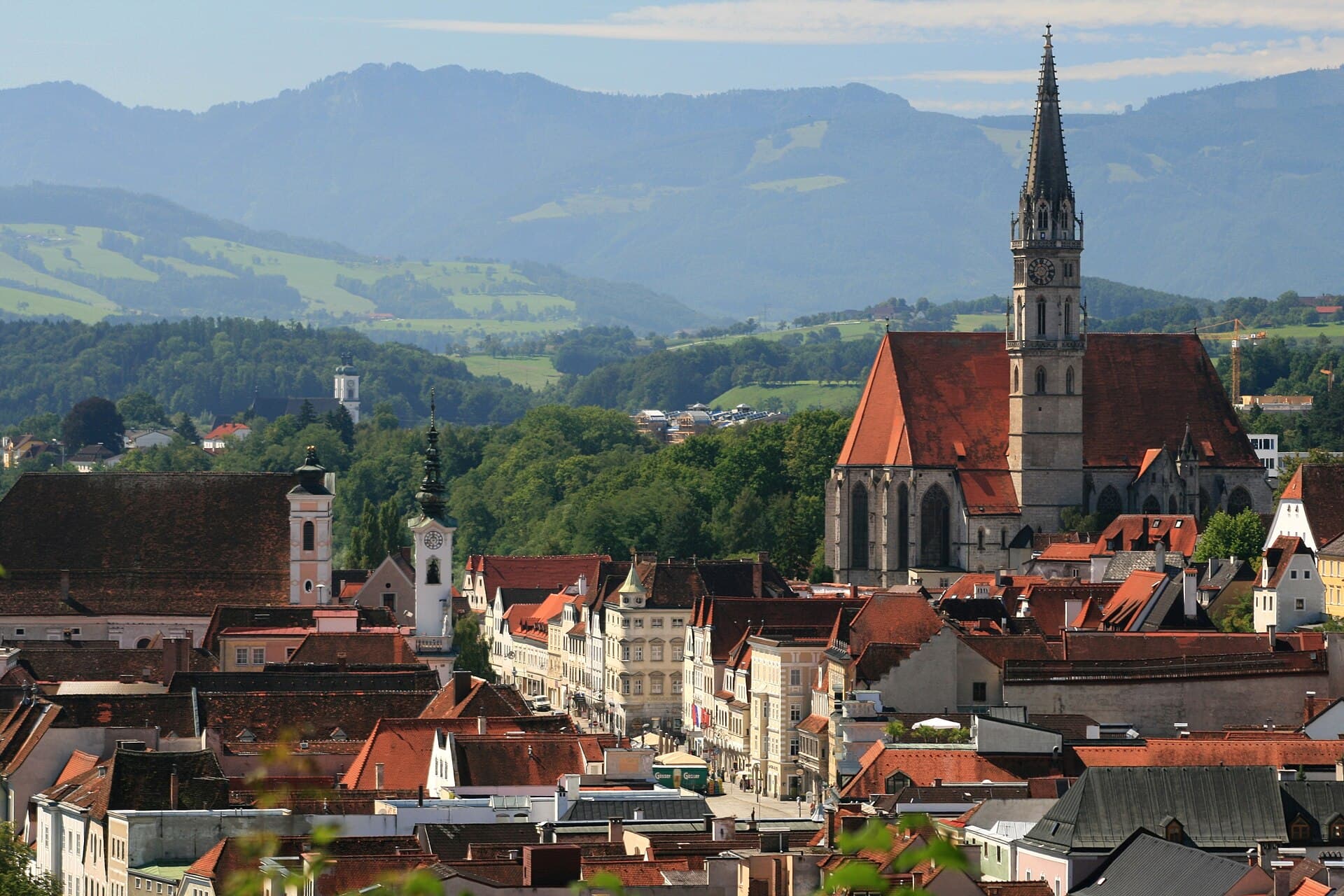 Christoph Waghubinger (Lewenstein) / CC BY-SA 3.0, via Wikimedia Commons
“Where two rivers converge, centuries of stories unfurl.”
Not the postcards. The stories even locals don't know — whispered in your ear, right where they happened.
A quiet passage just off Steyr's main thoroughfare evokes a corner of the city preserved in time.
A report of a curious object beneath a bridge brought out the Steyr fire department for an unexpected retrieval.
This late-Gothic mansion carries a peculiar name, which local lore attributes to a small, golden lion.
Discover every secret of Steyr
Every address, every reveal in full — in your ear, right where it happened.
You pick your stops. You walk. The voice reveals what the others miss.
No tours available yet. Check back soon — we're preparing them.
Steyr, a statutory city in Upper Austria, is where the Steyr and Enns rivers converge, creating a distinctive landscape that has shaped its identity for over a thousand years. This city, the 12th largest in Austria, offers a blend of historical architecture and industrial heritage, presenting an architectural delight. Its well-preserved old town, centered around the Stadtplatz, invites exploration along its lanes and past buildings that recount the passage of centuries.
While not as widely recognized as Vienna or Salzburg, Steyr provides a more tranquil experience, allowing visitors to immerse themselves in its appeal without the crowds. The city's scenic riverfront, with numerous bridges offering various vantage points, is a defining characteristic. Steyr's unique character and picturesque setting make it an appealing destination for those seeking a deeper connection with Austrian history and culture.
The city's elevation at 310 meters above sea level contributes to its unique topographic advantages, influencing local climate and providing expansive views of the surrounding landscape, including the distant Alps on clear days.
The origins of Steyr can be traced back to the 10th century, growing around the castle of the Traungau family. Its strategic location at the confluence of the Enns and Steyr rivers proved crucial to its development. The region's access to iron from the nearby Erzberg Mountain led to Steyr becoming a significant center for Austria's iron industry during medieval times. This trade, particularly in blacksmithing, knives, and weapons, brought prosperity to the city and fostered its economic growth under the Babenberg rulers.
Steyr was first mentioned in documents in the 10th century, and its town rights were documented by the 13th century. The powerful Otakar family, who controlled the Erzberg iron mining, made Steyr Castle a center of medieval courtly culture and Middle High German poetry. After the extinction of the Babenbergs, Steyr came under the rule of King Ottokar II of Bohemia, and later the Habsburg King Rudolf I of Germany.
The city's industrial prowess continued to evolve. By the end of the 16th century, Steyr was manufacturing muskets for the Habsburg Imperial Army. The 19th century saw the establishment of an armory by Leopold Werndl, which later became the Österreichische Waffenfabriksgesellschaft (ÖWG) and eventually Steyr-Werke AG. This company diversified into automobile and bicycle production after World War I, and later formed a large industrial conglomerate through mergers.
Steyr experienced several periods of hardship, including occupations by French troops during the Napoleonic Wars and economic struggles during the Great Depression. It also played a role in the Austrian Civil War in 1934 and became a target for Allied bombing raids during World War II due to its arms production. Despite these challenges, the city's historic center, including the Stadtplatz, was largely restored after the war, preserving its architectural inheritance. Today, Steyr continues to blend its thousand-year history with contemporary culture, maintaining its status as an important center for trade and services.
Steyr's historic center presents a collection of architectural styles and scenic views. Begin at the Stadtplatz, the main town square, recognized for its well-preserved Gothic, Renaissance, and Baroque buildings. The Bummerlhaus, a late-Gothic mansion from the 13th century, stands as a symbol of the city and one of Austria's finest examples of Gothic architecture.
Ascend the covered stairway known as the Pfarrstiege to reach the Stadtpfarrkirche, a large Gothic church that offers impressive architecture and interiors. Overlooking the city and the convergence of the rivers, Schloss Lamberg is a pale pink Baroque castle, built on the foundations of the original Styraburg fortress. While interior access might be limited, its courtyard and gardens are open for exploration.
The defining characteristic of Steyr is the meeting of the Steyr and Enns rivers. Wander the riverfront and cross the numerous bridges, such as those in the Zwischenbrücken area or the Bahnhofstraße bridge, for picturesque views of the city and the striking Church of St. Michael in the Tabor neighborhood. For an expansive view of the old town and surrounding rivers, take the free Tabor Lift up to the hillside.
Explore the appealing lanes of the old town, such as Enge Gasse, which features the Blumauerhaus with its large mural. For a distinct experience, seek out the Schmollgruber Passage, a small passage through an antique clockmaker and jeweller with a clock museum. During the Advent season, the Christkindl Pilgrimage Church and its celebrated post office for letters to the Christkind become a festive highlight.
Steyr is appealing year-round, with each season offering a distinct experience. For general outdoor activities and pleasant weather, the best time to visit is from mid-June to early September, with a peak in the second week of August. During these summer months, expect comfortable temperatures, extended daylight hours, and opportunities for riverside walks and outdoor dining.
If you prefer cooler temperatures and fewer crowds, consider visiting in late spring (May to June) or early autumn (September to October). December transforms Steyr into a festive destination, with its renowned Christmas markets and the Christkindl Pilgrimage Church. Winter sports enthusiasts will find ideal snow conditions in the nearby Alps from December to March.
Steyr is easily accessible, making it a convenient stop on an Austrian itinerary. It's a short journey from Linz, and approximately two hours by train from Vienna or Salzburg, often requiring a transfer in Linz or St. Valentin. The train station is a 10-minute walk from the historic main square. While a day trip allows you to see most of the city's sights, Steyr also offers accommodations if you wish to extend your stay and experience its tranquil atmosphere.
The city center is compact and best explored on foot, with pedestrian areas and lanes. Many cafes and restaurants are available, particularly along the riverfront and in the Stadtplatz. Public transportation within Steyr is available, and the city is a good base for exploring the surrounding Kalkalpen National Park.